.svg)

.webp)
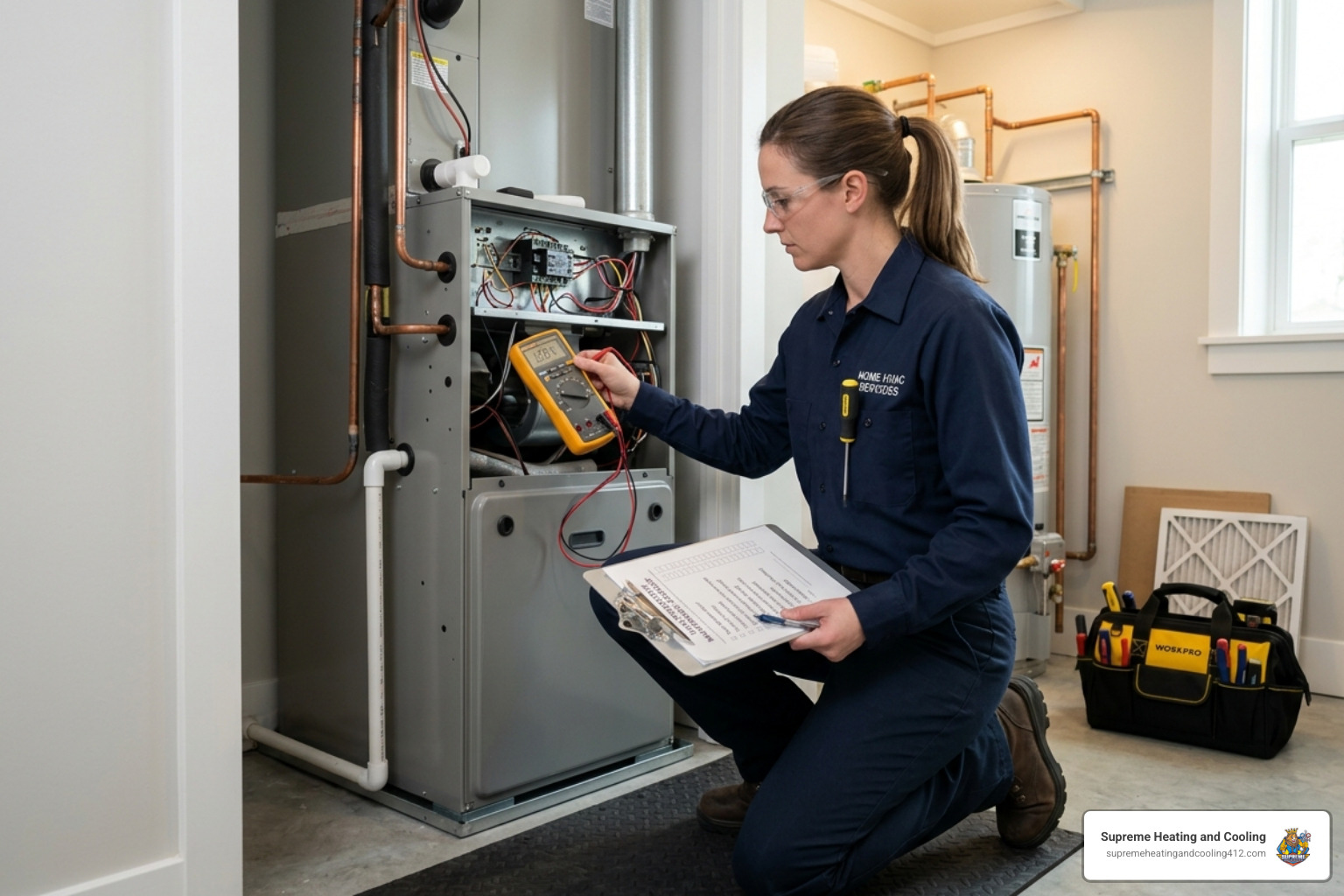
What Your Technician Should Actually Be Doing During an AC Tune-Up
The ac tune up checklist what your technician should check covers far more than a quick filter swap and a glance at your outdoor unit. A thorough professional tune-up typically includes 12 to 20 specific inspection and service steps across both your indoor and outdoor systems.
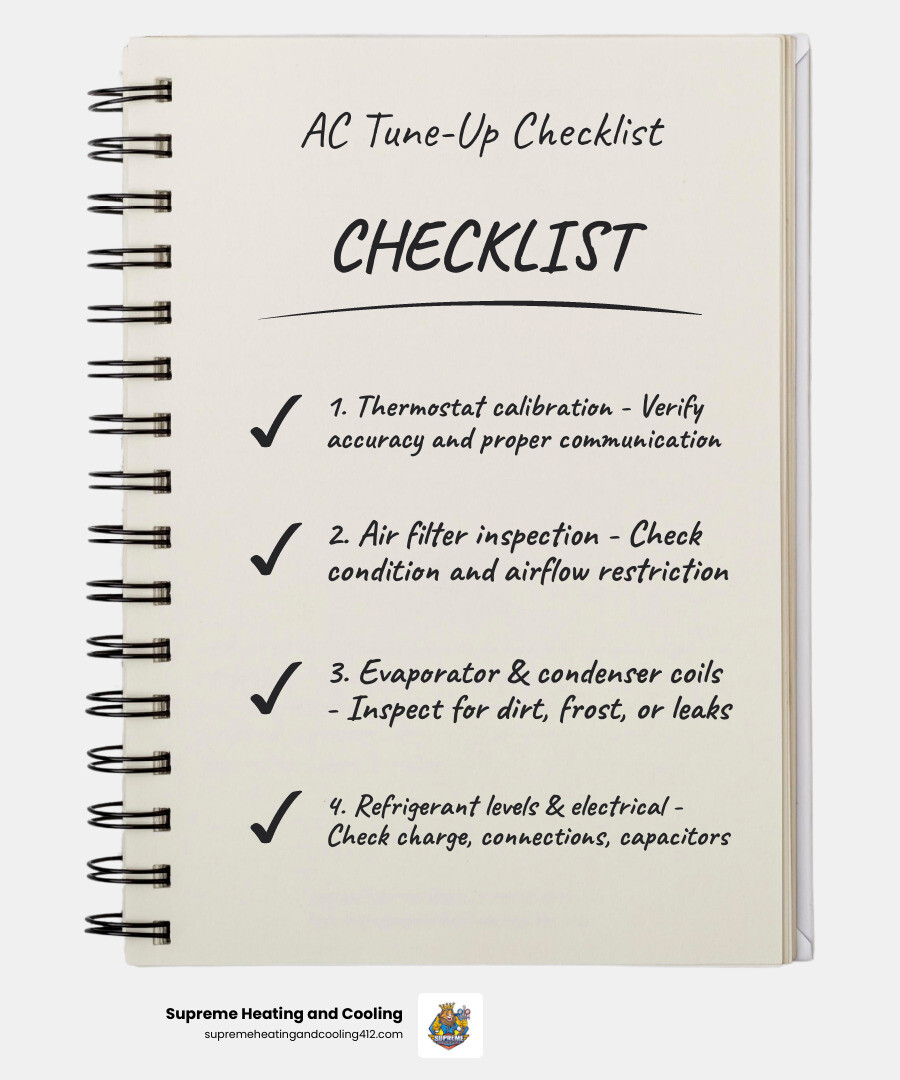
Here is what a qualified technician should check during every AC tune-up:
- Thermostat calibration - verify accuracy and proper communication with the system
- Air filter inspection and replacement - check condition and airflow restriction
- Evaporator coil inspection - look for dirt buildup, frost, or leaks
- Blower motor and fan - check for wear, dust buildup, and proper operation
- Condensate drain line - clear blockages that can cause water damage or mold
- Electrical connections - tighten loose wires, test voltage and amperage
- Capacitors and contactors - test and inspect for wear or failure
- Refrigerant levels - check charge and inspect for leaks
- Condenser coil cleaning - remove dirt and debris from the outdoor unit
- Fan blade balance - inspect for damage or vibration
- Ductwork visual inspection - look for leaks or obstructions
- System performance test - measure airflow, temperature split, and overall output
Most professional tune-ups take between 60 and 90 minutes. If a technician wraps up in 20 minutes, that is a red flag.
Here in Pittsburgh and the surrounding Pennsylvania communities, spring is the ideal window to get this done. Before the humidity sets in and your AC is running full tilt, a professional tune-up from Supreme Heating and Cooling ensures your system is ready to handle the season without surprises. According to the U.S. Department of Energy, a dirty or neglected AC system can use up to 15% more energy — and that cost adds up fast on your monthly utility bill.
Many homeowners do not realize how much is actually involved in a real AC tune-up until they watch a thorough technician work through the process step by step. The difference between a system that runs reliably all summer and one that fails on the hottest day of the year often comes down to whether that annual maintenance actually happened — and whether it was done right.
Why Pittsburgh Homeowners Prioritize Annual Maintenance in April 2026
As we move through April 2026, homeowners in Glenshaw, Plum, and Oakmont are starting to think about the humid summer days ahead. In our region, your air conditioner sits idle for several months during the winter. During that time, dust settles, components can stiffen, and small critters might even decide your outdoor unit looks like a cozy home. Skipping a spring checkup is often cited as the root cause for up to 80% of all HVAC repair calls.
One of the most immediate perks of a tune-up is improved energy efficiency. When your system is clean and calibrated, it doesn't have to work nearly as hard to cool your home. The importance of air conditioner maintenance what you need to know cannot be overstated when you consider that more than half of your home's energy use goes toward heating and cooling. By optimizing airflow and cleaning coils, we can often reduce a system's energy consumption by up to 15%.
Beyond the monthly savings, there is the matter of system longevity. A well-maintained AC unit in Pittsburgh can last 15 to 20 years, whereas a neglected one often starts failing around the 10-year mark. There are significant benefits of home ac maintenance that go beyond the mechanical; it’s about indoor air quality, too. The EPA notes that indoor pollutants can be 2 to 5 times higher than outdoor levels. A clean system with a fresh filter acts as your home’s primary defense against dust and allergens.
Finally, preventative ac maintenance is usually a requirement for keeping your manufacturer’s warranty valid. If a major component like a compressor fails, the manufacturer may ask for maintenance records before covering the part. Regular service keeps you compliant and gives you peace of mind.
The Essential AC Tune Up Checklist What Your Technician Should Check
When we arrive at your home in New Kensington or Forest Hills, we don't just "look" at the unit. A professional ac tune up checklist what your technician should check involves active testing and technical measurements. We use specialized tools to ensure every part of the system is communicating correctly.

A high-quality spring home ac tune-up checklist begins with the "brain" of the system: the thermostat. If your thermostat is miscalibrated by even a few degrees, it can cause the system to run longer than necessary, driving up bills and wearing out parts. We verify that the temperature you see on the screen matches the actual temperature in the room.
We also dive deep into the electrical system. Our technicians tighten loose connections and measure voltage and amperage on the motors. Loose wires can cause "arcing," which creates heat and poses a fire risk. We also test the capacitors and contactors—these are the components most likely to fail during a heatwave. By catching a weak capacitor in April, we prevent a total system shutdown in July. Understanding the benefits of professional air-conditioning maintenance services means knowing that these technical checks are what keep your home safe and cool.
Indoor System: An AC Tune Up Checklist What Your Technician Should Check
The indoor portion of your AC system is responsible for removing heat and humidity from your home's air. The star of this show is the evaporator coil. If this coil is covered in even a thin layer of dust, it acts like a "thermal blanket," preventing the refrigerant from absorbing heat efficiently. This can lead to the coil freezing over, which stops all cooling and can potentially damage the compressor.
Next, we look at the filter. The role of air filters in ac maintenance cleaning and replacement guide is simple but vital: it protects the internal machinery from debris. A dirty filter is the number one cause of blower motor burnout because the motor has to work twice as hard to pull air through the clog.
We also focus heavily on ac condensate drain maintenance. Your AC pulls gallons of water out of the air on a humid Pittsburgh day. If the drain line is clogged with algae or dust, that water has nowhere to go but into your home, potentially causing thousands of dollars in water damage to ceilings or floors. We clear these lines and test the safety overflow switches.
Finally, we perform a visual inspection of the ductwork and a performance test. We measure the "temperature split"—the difference between the air going into the system and the air coming out of the vents. Ideally, we want to see a drop of 15-20°F. If it's lower, it’s a sign that something in the cooling cycle isn't quite right.
Outdoor System: An AC Tune Up Checklist What Your Technician Should Check
The outdoor unit (the condenser) is the workhorse that releases the heat captured from inside your home. Because it lives outside, it is exposed to the elements. The importance of condenser coil cleaning in air-conditioning maintenance is massive. We wash away pollen, dirt, and grass clippings that can choke the unit’s "breathing."
We also check the refrigerant levels. It’s important to remember that an AC doesn't "use up" refrigerant like a car uses gas. If the level is low, it almost always means there is a leak. Operating a system with the wrong refrigerant charge can decrease efficiency by 20% and eventually kill the compressor.
| Feature | Central AC Maintenance | Ductless (Mini-Split) Maintenance |
|---|---|---|
| Filter Care | Replace standard pleated filters | Wash permanent mesh filters |
| Ductwork | Requires visual leak inspection | No ducts to check |
| Condensate | Primary drain line flushing | Individual head drain cleaning |
| Coils | Large outdoor cabinet cleaning | Indoor head and outdoor unit cleaning |
| Refrigerant | Check charge at outdoor valves | Check charge and flare connections |
Professional vs. DIY: Knowing When to Call the Experts
We love it when homeowners take an active interest in their HVAC health. There are several things you can and should do yourself to keep things running smoothly between professional visits.
The DIY Checklist:
- Filters: Check your filter every 30 days and replace it every 1 to 3 months.
- Debris: Keep a 2-foot "clear zone" around your outdoor unit. Trim back weeds and remove fallen leaves.
- Vents: Ensure that furniture, rugs, or curtains aren't blocking your supply or return vents.
- Thermostat: Change the batteries once a year to prevent the screen from going blank at the worst time.
While these steps are great, they don't replace a professional visit. How air-conditioning maintenance keeps older units in top condition involves tools that most homeowners don't have in their garage, such as digital manifolds for refrigerant pressure, megohmmeters for testing motor insulation, and nitrogen for clearing stubborn drain clogs. Handling refrigerant, in particular, requires federal certification and specialized training to ensure it is managed safely and legally.
Signs Your System is Overdue for a Professional Checkup
If you haven't had a technician out to your home in Penn Hills or Bethel Park recently, your system might be sending you "S.O.S." signals. Don't wait for a total breakdown to call us. Watch for these common red flags:
- Rising Energy Bills: If your utility bill has crept up by 15-25% without a change in the weather, your AC is likely struggling with a dirty coil or low refrigerant.
- Weak Airflow: If you can barely feel air coming out of the vents, you could have a failing blower motor or a major duct leak. ENERGY STAR reports that leaky ducts can waste up to 30% of your cooled air.
- Frequent Cycling: If your unit turns on and off every few minutes (short-cycling), it’s putting massive strain on the compressor.
- Strange Noises: Squealing often points to a belt or motor issue, while banging or rattling can mean a loose component or a failing compressor.
- Musty Odors: This is often a sign of "dirty sock syndrome," caused by mold or bacteria growth on the evaporator coil or in the drain pan.
Understanding air-conditioner maintenance how to reduce the environmental impact is also part of the equation. An efficient system runs for shorter periods, uses less electricity, and is less likely to leak refrigerant into the atmosphere.
Frequently Asked Questions about AC Maintenance
How long does a professional AC tune-up typically take?
For a standard residential system that has been maintained regularly, a thorough tune-up takes between 60 and 90 minutes. If you have multiple systems or if the unit hasn't been serviced in years, it may take a bit longer to perform a deep cleaning and full diagnostic.
How often should I schedule an AC tune-up in Pennsylvania?
The industry standard is once per year for the cooling system (ideally in the spring) and once per year for the heating system (in the fall). In our climate, the extreme swing from freezing winters to humid summers puts a lot of stress on the metal and electrical components, making annual checks essential.
What happens if I skip my annual AC maintenance?
Skipping maintenance leads to a "neglect tax." You’ll pay more in monthly energy bills, you’ll face more frequent (and more expensive) emergency repairs, and your system will likely die several years earlier than it should. A minor $150 fix caught during a tune-up can prevent a $4,000 compressor replacement later.
Conclusion
At Supreme Heating and Cooling, we believe that a professional tune-up is the best investment you can make in your home's comfort. We take pride in serving our neighbors across the Pittsburgh area—from the hills of Murrysville to the streets of Fox Chapel—with trustworthy, non-pushy service. Our technicians follow a rigorous ac tune up checklist what your technician should check to ensure nothing is overlooked.
Don't wait for the first 90-degree day to find out your AC isn't up to the task. Give your system the "spa day" it deserves so you can enjoy a worry-free summer. Schedule your professional air conditioning service today and experience the peace of mind that comes with a system that's been tuned to perfection by the local experts.


.svg)
.webp)
.svg)
