.svg)

.webp)
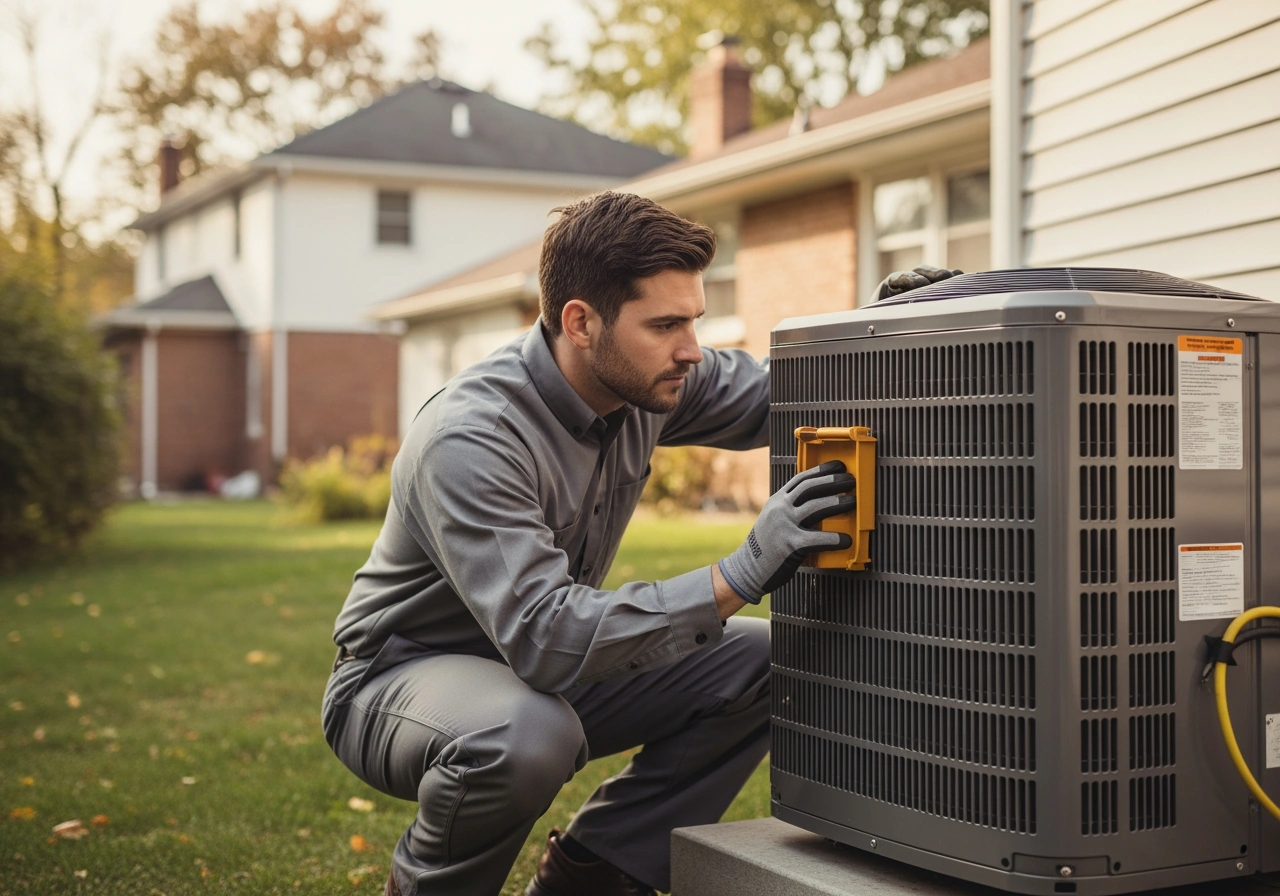
Capacitor Failure: Why It Is the Most Common AC Repair Call HVAC Technicians Respond To
Capacitor failure why it is the most common AC repair comes down to one simple fact: capacitors are small, heat-sensitive electrical components that work incredibly hard every single time your system turns on — and they wear out faster than almost anything else in your unit.
Quick answer: Why is capacitor failure the most common AC repair?
- Capacitors store and release electrical energy to start and run your AC motors
- They are among the most heat-sensitive parts in the entire system
- Every start cycle puts stress on the component
- Heat, age, power surges, and long run times all degrade them steadily
- Roughly 30% of all AC service calls are traced back to a failed or failing capacitor
- Some technicians report capacitors behind 7 out of 10 repairs during peak summer
When your air conditioner hums but won't start, blows warm air, or shuts off after just a few minutes, a failing capacitor is often the first thing a trained technician checks. It's not a coincidence — it's physics and wear working against a part that was always going to be the weak link.
For homeowners in Pittsburgh and the surrounding Pennsylvania area, the combination of humid summers, seasonal use patterns, and the occasional power surge creates exactly the conditions that push capacitors toward early failure. Understanding why this happens — and what to watch for — can save you from a sweltering afternoon waiting on an emergency repair call.
What is an AC Capacitor and What Does It Do?
To understand why this tiny component is responsible for so many service visits from Glenshaw to Bethel Park, it helps to know what a capacitor actually does.
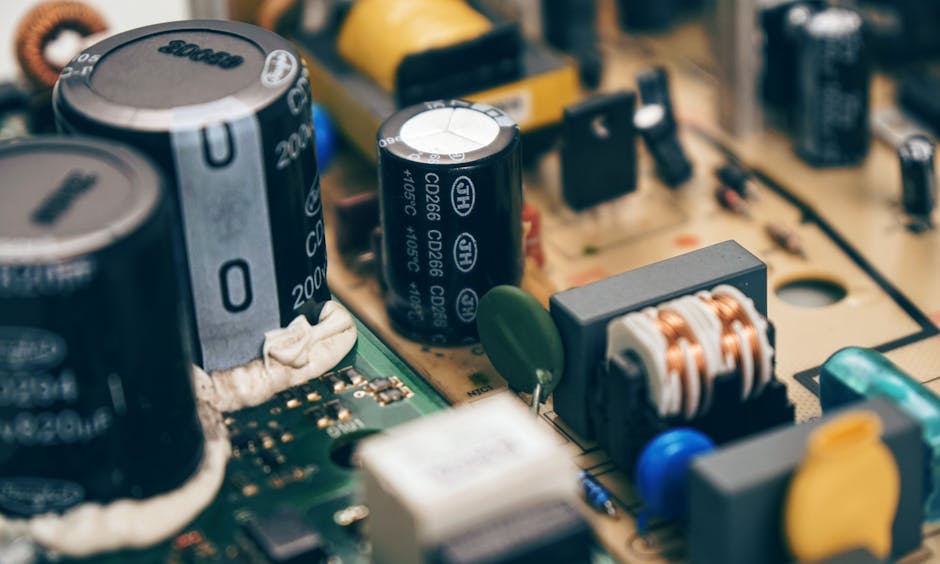
Think of an AC capacitor as a temporary, high-powered battery. It is a small, cylindrical metal canister located inside your outdoor condenser unit’s electrical panel. Inside this canister are conducting metal plates separated by an insulating layer known as a dielectric.
Your home's standard electrical grid provides a steady flow of electrical current, but it doesn't quite have the raw, instantaneous "oomph" required to start the heavy-duty motors inside your air conditioner. The compressor (which pumps the refrigerant) and the outdoor fan motor require a massive surge of electricity to break their inertia and start spinning.
This is where the capacitor comes in. It stores up electrical energy continuously and then releases a massive, high-torque burst of voltage—similar to a car's spark plug—to kick-start the motors. Once the motors are up and running, the capacitor continues to deliver a steadier, phase-shifted flow of electricity to keep them operating efficiently.
The performance of a capacitor is measured in two key specifications:
- Microfarads (µF or MFD): This indicates the electrical storage capacity of the component.
- Voltage (VAC): This represents the electrical pressure the capacitor can safely handle.
If either of these metrics drops below the manufacturer’s specified tolerance, your system's motors will struggle. To learn more about how electrical components support your entire heating and cooling ecosystem, check out our guide on AC Capacitor Replacement.
Start Capacitors vs. Run Capacitors
Not all capacitors in your air conditioner do the same job. Depending on your system's design, you may have separate components handling different stages of the cooling cycle:
- Start Capacitors: These are designed to provide an intense torque boost exclusively during the first few seconds of startup. Once the motor reaches about 75% of its operating speed, a relay disconnects the start capacitor from the circuit. They typically feature high microfarad ratings (often between 80 to 400 µF) but are not built for continuous operation.
- Run Capacitors: These stay active throughout the entire cooling cycle. They provide a continuous, phase-shifted electrical current (usually between 5 and 80 µF) that keeps the compressor and fan motors running smoothly and efficiently.
- Dual-Run Capacitors: Most modern residential air conditioners use a single dual-run capacitor. This space-saving component combines both functions into one canister. It features three terminals on top—labeled HERM (for the hermetic compressor), FAN (for the outdoor fan), and COM (common)—allowing it to support both vital motors simultaneously.
| Capacitor Type | Primary Function | Operational Duration | Typical Capacitance Range |
|---|---|---|---|
| Start Capacitor | Provides high-torque startup boost | Active for 1–3 seconds at cycle start | 80–400 µF |
| Run Capacitor | Maintains smooth, efficient motor operation | Active continuously during the cycle | 5–80 µF |
| Dual-Run Capacitor | Supports both compressor and fan motors | Active continuously during the cycle | Combined ratings (e.g., 45/5 µF) |
Capacitor Failure: Why It Is the Most Common AC Repair
If you ask any experienced HVAC technician in Monroeville or Penn Hills what part they replace most often during July and August, the answer is always the capacitor. It's the undisputed king of cooling system breakdowns.
Statistically, capacitor failure accounts for roughly 30% of all residential AC service calls. During severe summer humidity spikes, some HVAC teams find that up to 70% of their daily repair tickets involve swapping out a dead or weak capacitor.
Why is this part so incredibly vulnerable? It comes down to its internal design and operational environment. Unlike solid copper wiring or heavy cast-iron compressor housings, a capacitor is a delicate electronic instrument. It relies on a thin chemical dielectric fluid and micro-thin layers of metal film.
Every time your air conditioner cycles on, this chemical barrier experiences rapid electrical charging and discharging. Over time, this constant electrical expansion and contraction causes physical wear. Because it is the "gatekeeper" of power for the two hardest-working motors in your AC, it takes the brunt of any electrical or thermal stress. If you suspect your system is starting to struggle under this pressure, read about the early Signs You Need AC Repair to catch issues before they escalate.
Environmental Stressors and Capacitor Failure Why It Is the Most Common AC Repair
While capacitors are designed to handle normal operating conditions, the climate in Western Pennsylvania presents unique challenges.
Extreme summer heat is the ultimate enemy of dielectric fluid. When temperatures climb, the metal cabinet of your outdoor condenser unit acts like an oven, trapping radiant heat. Internal cabinet temperatures can easily climb past 140°F. This intense heat causes the liquid dielectric inside the capacitor to expand, degrade, and eventually leak out through the top seals. Once the fluid is compromised, the capacitor can no longer store an electrical charge.
Furthermore, our local summer humidity forces air conditioners to run for extended, uninterrupted cycles to keep indoor spaces comfortable. These long runtimes mean the capacitor is subjected to continuous electrical current and high temperatures without any time to cool down. If you live in areas with dense summer foliage and high humidity, such as Fox Chapel, keeping your system checked is crucial. For specialized local support, explore our dedicated services for AC Repair in Fox Chapel PA.
Electrical and Mechanical Causes of Capacitor Failure Why It Is the Most Common AC Repair
Beyond local weather patterns, capacitors are highly sensitive to the electrical health of your home:
- Power Surges and Voltage Fluctuations: Summer thunderstorms in the Pittsburgh region frequently cause grid instability, brownouts, and lightning strikes. A sudden spike in voltage can instantly puncture the delicate internal insulation of a capacitor, rendering it useless in a fraction of a second.
- System Short Cycling: If your AC turns on and off too frequently—often due to an oversized system, a clogged air filter, or a faulty thermostat—the capacitor is forced to deliver startup bursts repeatedly. This rapid cycling dramatically accelerates mechanical wear.
- An Aging Compressor: As your AC compressor ages, its internal bearings wear down, creating mechanical resistance. To overcome this friction and start spinning, the aging compressor draws significantly more electrical current (amperage) than it did when new. This extra load puts tremendous strain on the capacitor, often causing it to fail repeatedly. To keep your system's heart in good shape, review our AC Compressor Maintenance Tips.
How to Recognize the Signs of a Failing AC Capacitor
Fortunately, capacitors rarely fail without dropping a few hints first. By recognizing the early warning signs of a declining capacitor, you can schedule a professional visit before you are left with a completely non-functional cooling system on a humid afternoon.
- A Loud Humming Noise from the Outdoor Unit: This is the classic "signature" sound of a bad capacitor. If you hear a loud, steady electrical hum coming from your outdoor condenser, but the fan blades aren't spinning and you don't hear the compressor kick on, the motor is trying to start but lacks the necessary electrical boost.
- A Slow-Starting Fan: If you watch your outdoor unit turn on and notice that the fan blades struggle to build speed, or if they require a physical nudge to start spinning, the run capacitor has likely lost its capacitance.
- Warm Air Blowing from Indoor Vents: If your indoor blower fan is running but your outdoor compressor cannot start due to a failed capacitor, your system will simply circulate warm indoor air without removing any heat.
- Flickering or Dimming Lights on AC Startup: Because a weak capacitor forces the compressor to draw maximum amperage directly from your home's electrical panel to start, you may notice your dining room or living room lights momentarily dim when the cooling cycle begins.
- Unexplained Increases in Energy Bills: When a capacitor's microfarad rating drops by even 10%, the connected motors must draw 8% to 15% more electrical current to do the same amount of work. This inefficiency shows up directly on your monthly utility bills.
- Physical Bulging or Leaking: If you look at a failed capacitor, the visual evidence is usually obvious. A healthy capacitor has a perfectly flat metal top. A failed or failing capacitor will often bulge, dome, or look like a soda can ready to burst. In severe cases, you may see oily dielectric fluid leaking around the terminals or scorch marks from an electrical short.
If you suspect these electrical issues are affecting other parts of your indoor system, such as your furnace blower, take a moment to read about AC Blower Motor Failure Signs.
Why DIY Capacitor Replacement is Genuinely Dangerous
With the rise of online video tutorials, some homeowners are tempted to purchase a cheap capacitor online and attempt a do-it-yourself replacement. However, professional HVAC technicians strongly advise against this. Replacing a capacitor is one of the most dangerous DIY home maintenance tasks you can attempt.
The primary hazard is lethal electrical shock. As we discussed, a capacitor's entire job is to store up a massive electrical charge. Even if you turn off the main breaker to your outdoor unit, pull the electrical disconnect, and unplug the system, the capacitor remains fully charged.
A standard residential run capacitor rated for 370 or 440 volts holds enough stored energy to deliver a severe, potentially fatal electrical shock if touched improperly. Safely discharging this energy requires specialized, insulated tools and precise techniques. A simple slip of a screwdriver can cause an blinding electrical arc, severe burns, or permanent damage to your system's expensive control boards.
Additionally, using a capacitor with the incorrect voltage or microfarad rating can quickly destroy your compressor or fan motor windings. What could have been a straightforward, professional component swap can easily turn into a major system replacement. Trusting a qualified professional keeps your family safe and ensures your manufacturer warranty remains fully intact. For more safe troubleshooting advice, read our AC Repair Tips From Our Experts.
Preventing Premature Failure and Extending Your Capacitor's Lifespan
While capacitors are ultimately wear-and-tear items that will eventually need replacement, you can take several proactive steps to maximize their lifespan and protect your entire air conditioning system:
- Schedule Professional Annual Maintenance: During a routine spring tune-up, a technician will use a highly accurate multimeter to measure the exact microfarad output of your capacitor. If a capacitor rated for 45 µF is reading at 38 µF (outside the acceptable ±6% tolerance), we can replace it proactively before it fails and leaves you without cooling.
- Keep Your Outdoor Condenser Coils Clean: When your outdoor coils are clogged with grass clippings, cottonwood seeds, and dirt, the system cannot shed heat efficiently. This raises the operating pressure (head pressure) and forces the compressor to run hotter and longer, cooking the nearby capacitor.
- Install HVAC-Specific Surge Protection: A dedicated surge protector installed at your outdoor electrical disconnect box can shield your sensitive capacitor, fan motor, and compressor from sudden grid voltage spikes and lightning strikes.
- Change Your Indoor Air Filters Regularly: Clean filters ensure steady airflow across your indoor evaporator coil. Restricted airflow leads to system short-cycling, which multiplies the number of high-stress startups your capacitor must facilitate.
By keeping up with these simple maintenance tasks, you ensure your system runs at peak efficiency all summer long. Dive deeper into maximizing your system's life with our guide on AC Repair Optimal Performance.
Frequently Asked Questions About AC Capacitors
How long do AC capacitors typically last in Pennsylvania?
In moderate, seasonal climates like Western Pennsylvania, a high-quality residential AC capacitor typically lasts between 5 to 10 years.
Because our local systems sit idle during the cold winter months and run heavily during the humid summer, they experience different wear patterns than systems in southern states. However, factors like direct afternoon sun exposure on your outdoor unit, poor maintenance, and frequent local power fluctuations can easily shorten this lifespan to 3 to 5 years. Most homeowners can expect to replace their AC capacitor at least once or twice over the lifespan of their cooling system.
Can running my AC with a bad capacitor damage other components?
Yes, absolutely. Running an air conditioner with a weak or failing capacitor is highly damaging.
When a run capacitor is weak, the compressor and fan motors must draw excessive electrical current to keep spinning. This extra amperage generates intense heat within the motor windings. Over time, this heat degrades the protective insulation inside the motor, leading to a direct electrical short, motor burnout, or a completely seized compressor. Replacing a failed capacitor is a quick, routine service; replacing a burned-out compressor is a major, high-cost undertaking. For help navigating these scenarios, consult our guide on AC Repair vs Replacement Factors to Make the Right Decision.
How do professional technicians diagnose a failing capacitor?
Professional technicians use a systematic diagnostic process to evaluate a capacitor safely:
- Safety Discharge: Before touching any terminals, the technician disconnects all electrical power and uses a properly rated discharging tool to safely bleed off any stored high-voltage charge.
- Visual Inspection: They check for physical telltale signs of failure, such as a domed top, rusted terminals, or oily chemical leaks.
- Multimeter Capacitance Test: Using a professional-grade multimeter set to the microfarads (µF) setting, the technician measures the actual capacitance between the HERM-to-COM and FAN-to-COM terminals. If the reading has drifted more than 5% to 6% below the printed rating on the canister, the capacitor is flagged for replacement.
- Dissipation Factor Check: In some cases, advanced testing is performed to check the internal resistance of the capacitor, ensuring it can release its stored energy cleanly and efficiently.
Conclusion
At Supreme Heating and Cooling, we believe in providing our neighbors throughout the greater Pittsburgh area with honest, dependable, and friendly service. Whether you are located in Fox Chapel, Monroeville, Bethel Park, or Swissvale, our personable team of local experts is always ready to help you maintain a comfortable, safe, and energy-efficient home.
If you hear a strange humming sound from your outdoor unit, notice your AC blowing warm air, or simply want to catch a weak capacitor before it leaves you stranded in the summer heat, we are here to help. We pride ourselves on our non-pushy, highly professional approach, ensuring you get the exact repairs you need at competitive, straightforward rates.
If you live in the Penn Hills area and suspect your air conditioner needs a professional checkup, check out our AC Repair Penn Hills PA page, or simply Schedule professional air conditioning service today to keep your home perfectly cool and comfortable all season long!


.svg)
.webp)
.svg)
