.svg)

.webp)
Identifying Common Heat Pump Problems and How to Prevent Them
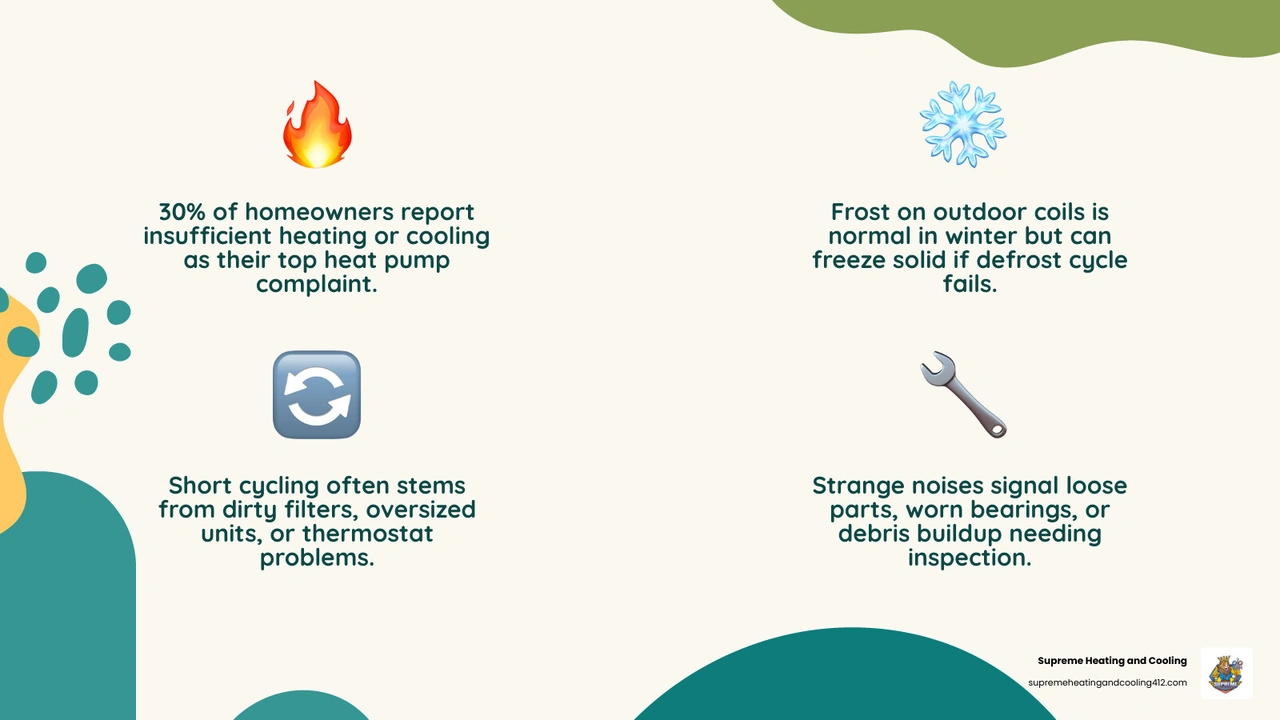
Common heat pump problems and how to prevent them affect nearly every homeowner who relies on a heat pump for year-round comfort — and in Pittsburgh, PA, where winters bite hard and summers get sticky, a struggling heat pump is more than just an inconvenience. According to Angi data, nearly 30% of homeowners report insufficient heating or cooling as their top heat pump complaint. Left unchecked, small issues can snowball into costly repairs or full system failures.
Here is a quick overview of the most common heat pump problems and how to prevent them:
| Problem | Common Cause | Prevention Tip |
|---|---|---|
| Insufficient heating or cooling | Dirty filters, low refrigerant, thermostat fault | Replace filters every 30-90 days; schedule bi-annual maintenance |
| Frozen outdoor coils | Restricted airflow, low refrigerant | Keep unit clear of debris; check filters monthly |
| Short cycling | Oversized unit, thermostat issues, clogged filter | Proper sizing at install; regular filter changes |
| Strange noises | Loose parts, worn motor bearings, debris | Prompt professional inspection |
| Unit won't turn on | Tripped breaker, thermostat settings, failed capacitor | Check breaker and thermostat first; call a pro if unresolved |
| Weak airflow | Clogged filter, blocked vents, dirty coils | Replace filters regularly; keep vents unobstructed |
| Rising energy bills | Dirty coils, refrigerant issues, poor airflow | Annual professional tune-up; filter maintenance |
For a deeper look at warning signs your system may already be struggling, see Indicators For Heat Pump Repair.
The good news is that most of these problems are preventable with consistent, simple maintenance and knowing when to call a professional. This guide walks Pittsburgh-area homeowners through exactly what to watch for — and what to do about it.
Troubleshooting Common Heat Pump Problems and How to Prevent Them in Winter
In April 2026, we are seeing more homeowners in areas like Fox Chapel and Penn Hills transition to high-efficiency heat pumps. However, winter in Western Pennsylvania puts these systems to the ultimate test. One of the most frequent calls we receive involves Heat Pump Defrost Cycle Issues.
During winter, it is normal for frost to form on the outdoor coils because the coil is typically 10 to 20 degrees colder than the outside air. Your system is designed to enter a "defrost mode" to melt this frost. However, if the defrost sensor or control board fails, that frost turns into a thick block of ice. To prevent this, ensure your outdoor unit isn't being dripped on by a leaky gutter, which can cause localized icing that the defrost cycle can't handle.
Another winter concern is the heat pump relying too heavily on "auxiliary heat" (the electric heat strips). If your thermostat isn't calibrated correctly or the outdoor sensor is faulty, your energy bills will skyrocket. If you notice a Heat Pump Failure In Fox Chapel during a cold snap, check your thermostat settings first to ensure it isn't accidentally set to "Emergency Heat" mode, which bypasses the efficient heat pump entirely.
Proactive Steps for Common Heat Pump Problems and How to Prevent Them in Summer
When the humidity hits Monroeville and Sewickley, your heat pump reverses its job to act as an air conditioner. Efficiency here depends heavily on two things: refrigerant levels and airflow. If you find your Heat Pump Not Cooling In Monroeville Pa, the culprit is often a dirty evaporator coil or a slow refrigerant leak.
Refrigerant is the lifeblood of your system. Unlike a car's oil, it isn't "used up"; if it's low, there is a leak. Hissing sounds or ice on the indoor copper lines are major red flags. Furthermore, summer brings the risk of water damage. As the unit dehumidifies your home, moisture collects in a condensate pan. If the drain line is clogged with algae or dust, you might find your Heat Pump Leaking Water In Sewickley Pa. To prevent this, we recommend a professional cleaning of the condensate lines at the start of every cooling season.
Addressing Frozen Coils and Airflow Restrictions

Nothing stops a heat pump faster than restricted airflow. When air can't move freely across the coils, the heat transfer process breaks down, leading to the dreaded frozen coil. Whether it's the indoor evaporator coil or the outdoor condenser coil, ice is a symptom of a deeper problem.
The most common cause of frozen coils is a simple, dirty air filter. A clogged filter forces the blower motor to work harder, which can eventually lead to motor failure. To keep your system breathing easy, follow our Heat Pump Maintenance Tips and replace your filters every 30 to 90 days.
If your filters are clean but the coils are still icing up, you likely have a Heat Pump Refrigerant Leak. Low refrigerant levels drop the pressure inside the coils, causing them to dip below freezing temperatures and turn any moisture in the air into ice. This is a job for the pros—handling refrigerant requires specialized tools and EPA certification.
Understanding Short Cycling and Unusual Noises
"Short cycling" is when your heat pump turns on and off every few minutes without ever reaching the temperature set on your thermostat. This is incredibly hard on the compressor—the most expensive part of your system—and can lead to a premature death for your unit.
Causes of short cycling include:
- Oversized Units: If a system is too powerful for the square footage of your home, it cools or heats the air too quickly and shuts off before it can properly dehumidify or balance the temperature.
- Thermostat Placement: If your thermostat is near a drafty window or a heat source (like a lamp), it will get "confused" and trigger the system unnecessarily.
- Electrical Issues: Failing capacitors or control boards can cause intermittent power loss.
While the system is running, listen closely. Your heat pump should be relatively quiet. If you start hearing Heat Pump Making Unusual Sounds, it's trying to tell you something. A grinding sound often points to dirty motor bearings, while a loud rattling usually means a panel is loose or debris (like a twig) has fallen into the outdoor fan. For more help identifying these sounds, check out our Heat Pump Error Code Guide.
Preventive Maintenance Strategies for Pennsylvania Homeowners
The best way to handle common heat pump problems and how to prevent them is to stop them before they start. In the Pittsburgh area, our hardware faces unique challenges, from heavy pollen in the spring to road salt and snow in the winter.
| Maintenance Task | Frequency | Who Does It? |
|---|---|---|
| Replace Air Filters | Every 30-90 Days | Homeowner |
| Clear Debris from Outdoor Unit | Monthly | Homeowner |
| Inspect/Clean Condensate Drain | Annually | Homeowner/Pro |
| Check Refrigerant Levels | Bi-Annually | Professional |
| Tighten Electrical Connections | Annually | Professional |
| Clean Evaporator & Condenser Coils | Annually | Professional |
For residents in Westmoreland County, staying on top of Heat Pump Maintenance Greensburg Pa ensures that the summer heat doesn't catch you off guard. Similarly, if you are in the eastern suburbs, regular Heat Pump Maintenance Penn Hills Pa can extend the life of your unit by years.
We highly recommend bi-annual inspections—once in the spring before the cooling season and once in the fall before the heating season. This "preventative medicine" for your HVAC system is the most effective way to manage Heat Pump Repair And Maintenance.
Frequently Asked Questions about Heat Pump Care
What is the average lifespan of a heat pump in Pittsburgh?
On average, a well-maintained heat pump lasts about 15 years. However, the lifespan can be significantly shorter if the system is forced to work through issues like dirty coils or low refrigerant. In our local climate, the strain of switching between extreme cold and high humidity makes professional Heat Pump Repair Pittsburgh Pa a vital part of reaching that 15-year milestone. If your system is over 12 years old and requires a major repair like a compressor replacement, it is often more cost-effective to consider an upgrade.
How often should I change my heat pump air filters?
You should check your filters once a month and replace them at least every 90 days. If you have pets or allergies, you should aim for every 30 to 60 days. Clean filters are the easiest way to ensure optimal airflow and protect your indoor air quality. For those utilizing Heat Pump Services Wilkinsburg Pa, we often find that simple filter neglect is the root cause of most "no-heat" calls.
Why is my heat pump making a loud rattling noise?
Rattling is usually caused by something loose. It could be a screw on the exterior cabinet, or it could be the coolant pipes vibrating against the house. In some cases, it’s a sign that the fan motor is starting to fail. If you are noticing this in the Allegheny Valley, our experts in Heat Pump Repair Cheswick Pa can quickly tighten components or replace worn parts. Don't ignore it—vibrations can eventually lead to refrigerant leaks. We have a full list of Heat Pump Repair Issues We Fix if the noise turns out to be more serious.
Conclusion
Your home should be a sanctuary of comfort, regardless of what the Pennsylvania weather is doing outside. By understanding common heat pump problems and how to prevent them, you take control of your home’s efficiency and your family’s comfort. From changing filters to keeping the outdoor unit clear of snow and leaves, your proactive steps make a massive difference.
When DIY troubleshooting isn't enough, Supreme Heating and Cooling is here to help. We pride ourselves on providing trustworthy, non-pushy service to our neighbors throughout the greater Pittsburgh area. Whether you need a routine tune-up or an emergency repair, our personable team is committed to keeping your Heat Pump running at peak performance all year long. Reach out to us today to schedule your seasonal maintenance and stop the shivers before they start!


.svg)
.webp)
.svg)
