.svg)

.webp)
Why How a Tune Up Improves Efficiency and Lowers Bills Matters Before Summer Hits
How a tune up improves efficiency and lowers bills comes down to one core idea: a well-maintained system doesn't have to work as hard to keep your home comfortable — and less work means less energy used and lower monthly costs.
Here's a quick look at how it works:
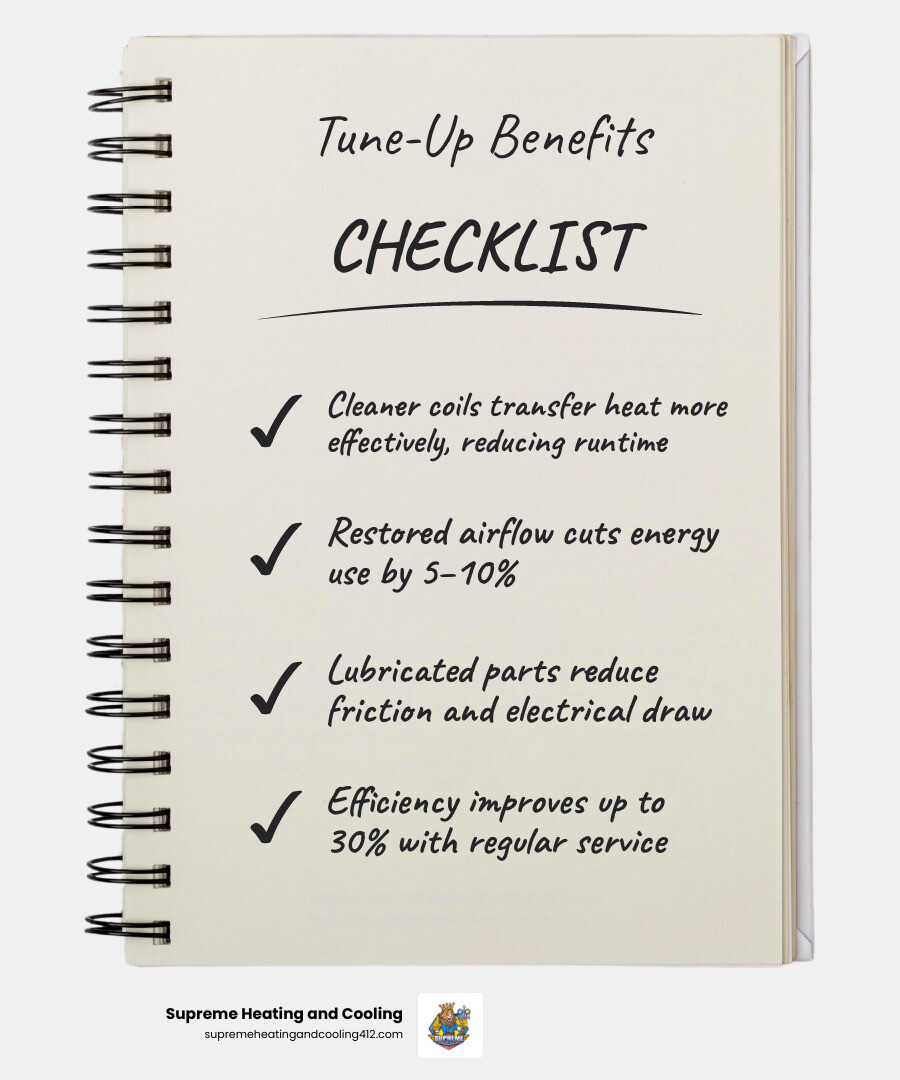
- Cleaner coils transfer heat more effectively, reducing how long your system runs
- Restored airflow from filter and blower service can cut energy use by 5–10%
- Calibrated thermostats prevent temperature overshoot and unnecessary cycling
- Lubricated moving parts reduce friction and electrical draw
- Sealed or flagged duct issues stop the roughly 20% of cooled air that leaks before reaching your rooms
- Refrigerant checks ensure your AC isn't working overtime due to a low charge
- Early detection of worn parts prevents small problems from becoming expensive summer emergencies
The result? Homeowners who schedule regular tune-ups can see heating and cooling efficiency improve by as much as 30%, with real-world savings of hundreds of dollars per season.
For Pittsburgh-area families, this matters even more. Summer cooling loads in neighborhoods like Bethel Park, Monroeville, and Fox Chapel put serious stress on HVAC systems — especially ones that haven't been touched since last year. A system running at less than peak efficiency doesn't just cost more to operate. It's also far more likely to break down on the hottest day of the year, when repair wait times are longest and the heat is at its worst.
Think of it the way you think about your car. You wouldn't skip oil changes and expect the engine to perform flawlessly for years. Your HVAC system is no different. Routine preventative maintenance keeps every component running the way it was designed to — quietly, efficiently, and reliably.
The good news is that one professional tune-up visit, typically lasting one to two hours, is enough to address all of it.
Tune-Up vs. Repair: Why Proactive Maintenance is Essential
It is a common misconception that you only need to call an HVAC professional when something stops working. However, there is a massive difference between a tune-up and a repair. A repair is "reactive"—it happens after a component has already failed, often leaving you in a hot house in Plum or Oakmont while you wait for a fix. A tune-up, on the other hand, is "proactive." It is a multi-point inspection and cleaning designed to ensure those failures never happen in the first place.
Think of a tune-up as a wellness check for your home. During a professional visit, we aren't just looking for what’s broken; we are looking for what might break. We look at the "big picture" of your system’s health.
Preventative Care vs. Reactive Repairs
When you wait for a system to break, you are often dealing with "collateral damage." For example, a dirty air filter (which is a simple maintenance item) can eventually cause your evaporator coil to freeze. A frozen coil puts immense strain on the compressor. By the time you call for a "repair," you might be looking at a much more complicated and expensive situation than if you had simply had a technician check the system in the spring.

System Longevity and Warranty Protection
Beyond day-to-day comfort, regular maintenance is a shield for your investment. Most HVAC manufacturers actually require documented annual maintenance to keep your warranty valid. If a major component fails five years into a ten-year warranty, the manufacturer may ask for proof that the system was serviced professionally. Without it, you could be left footing the bill for a part that should have been covered.
By choosing air conditioning services for a seasonal tune-up, you are essentially buying years of extra life for your system. A well-maintained AC unit can last 15 to 20 years, whereas a neglected one might start failing at the 10-year mark.
How a tune up improves efficiency and lowers bills for Pittsburgh homeowners
In our corner of Pennsylvania, from the hills of Penn Hills to the riverfront in Aspinwall, our HVAC systems deal with everything from humid 90-degree July afternoons to sudden April cold snaps. This volatility means your system is constantly adjusting.
When we talk about how a tune up improves efficiency and lowers bills, we are talking about restoring the system to its "factory-fresh" state. Over a single season, dust, pet dander, and outdoor debris like cottonwood seeds or grass clippings clog up the delicate fins of your outdoor condenser. Inside, dust blankets the evaporator coil. This layer of grime acts like an insulator, making it harder for the system to remove heat from your home.
The 30% Efficiency Gain
Research shows that the average energy efficiency increase after a proper tune-up can be as high as 30%. When your system is clean and calibrated, it reaches your desired temperature faster. This reduces the "run time" of the compressor and the blower motor.
| System Condition | Energy Consumption | Performance Level | Monthly Bill Impact |
|---|---|---|---|
| Maintained (Annual Tune-Up) | Optimized/Low | Peak Efficiency | Lowest Possible |
| Minor Neglect (2+ years) | Increased by 10-15% | Struggling Airflow | Noticeable Spike |
| Severely Neglected | Increased by 25-40% | High Failure Risk | Major Financial Drain |
In places like Monroeville, where humidity can make 80 degrees feel like 90, a system that isn't pulling moisture out of the air effectively will cause you to lower the thermostat even further, compounding the energy waste. A tune-up ensures the dehumidification process is working perfectly, so you feel cooler at higher temperatures.
Critical Components Optimized During a Professional Service
A professional tune-up is much more than a quick "once-over." It is a methodical process that touches every critical part of your cooling system. When we visit your home in Fox Chapel or Turtle Creek, we follow a rigorous checklist to ensure nothing is missed.
- Thermostat Calibration: We verify that your thermostat is actually reading the room temperature correctly. If it’s off by just two degrees, your system could be running for hours longer than necessary every week.
- Refrigerant Level Check: An AC system doesn't "use up" refrigerant like a car uses gas. If the levels are low, there is a leak. Running a system with low refrigerant is one of the fastest ways to burn out a compressor.
- Electrical Connection Inspection: Heat causes wires to expand and contract, which can loosen connections over time. We tighten these to prevent "pitting" or electrical shorts that could lead to a system shutdown.
- Blower Motor Lubrication: Reducing friction in the motor means it uses less electricity to move the same amount of air.
- Condensate Drain Cleaning: We clear out the algae and sludge that builds up in your drain line. This prevents water backups that can damage your floors or trigger a safety switch that kills your AC in the middle of a heatwave.
For more details on what we cover, you can view our full range of air conditioning services.
How a tune up improves efficiency and lowers bills by restoring airflow
Airflow is the lifeblood of your HVAC system. If the air can't move, the heat can't move. One of the most significant ways how a tune up improves efficiency and lowers bills is by identifying "bottlenecks" in your airflow.
We often find that homes in Greensburg or New Kensington have significant dust levels that have bypassed the filter and coated the internal blower wheel. A dirty blower wheel can't "bite" the air as effectively, reducing airflow by up to 20%. Furthermore, we inspect the visible portions of your ductwork. It is estimated that the average house loses 20% of its costly cooled air through leaks in the ductwork. If that cold air is leaking into your attic or crawlspace instead of your bedroom, you are literally throwing money away.
How a tune up improves efficiency and lowers bills through mechanical precision
Precision is what separates a DIY attempt from a professional service. In Penn Hills and surrounding areas, reliability is key. We look at the "start components" of your system—the capacitors and relays. These parts take the brunt of the electrical load every time your AC kicks on.
If a capacitor is "leaking" or out of spec, it forces the motor to draw more current to start. This not only raises your electric bill but also creates heat that wears out the motor windings. By replacing a struggling capacitor during a tune-up, we prevent a "no-cool" call later in the summer and keep your electrical draw as low as possible. This precision also prevents "short-cycling," where the system turns on and off too frequently, which is incredibly inefficient and hard on the equipment.
Frequently Asked Questions about HVAC Efficiency
Can I perform HVAC maintenance myself or is professional service essential?
While we love a proactive homeowner, there is a limit to what you can safely do. We encourage you to:
- Change your filters every 1–3 months.
- Clear debris (leaves, tall grass, or mulch) from around your outdoor unit—keep at least two feet of clear space.
- Keep vents open and unobstructed by furniture.
However, a professional tune-up requires specialized tools. Homeowners generally don't have the gauges to check refrigerant pressures, the meters to test electrical draw, or the training to handle high-voltage components and chemical refrigerants. For the safety of your family and the integrity of your warranty, professional service is essential once a year.
What are the signs that indicate an HVAC system needs a tune-up?
If you notice any of the following in your Pittsburgh home, don't wait for the scheduled season—call us right away:
- Rising Utility Bills: If your usage is the same but your bill is climbing, your efficiency is dropping.
- Unusual Noises: Banging, screeching, or rattling often points to a mechanical part nearing failure.
- Frequent Cycling: If the AC turns on and off every few minutes, it’s struggling to maintain equilibrium.
- Uneven Temperatures: If the kitchen is freezing but the upstairs bedroom is a sauna, you likely have airflow or calibration issues.
- Persistent Odors: Musty smells can indicate mold in the drain pan or coils.
How do HVAC tune-ups improve indoor air quality and safety?
A tune-up isn't just about the machine; it’s about the people inside the home. During a furnace tune-up in the fall, we perform critical safety checks on the heat exchanger to look for cracks that could leak carbon monoxide. In the summer, our focus shifts to preventing mold and bacterial growth in the damp environment of your AC's evaporator coil.
By removing deep-seated dust and ensuring proper filtration, we help reduce allergens in your home. This provides peace of mind for families in Swissvale and Forest Hills, knowing that the air they breathe is clean and the system is operating safely.
Conclusion
At Supreme Heating and Cooling, we take pride in being a trustworthy, personable partner for our neighbors throughout the Pittsburgh region. Whether you are in Wilkinsburg, Pitcairn, or Upper Saint Clair, our goal is to ensure you never have to worry about your home’s comfort.
Understanding how a tune up improves efficiency and lowers bills is the first step toward a stress-free summer. By investing in a simple, professional service now, you can enjoy lower monthly costs, a longer-lasting HVAC system, and the peace of mind that comes with knowing your family is safe and cool.
Don't wait for the first 90-degree day to find out your system is struggling. Schedule your professional AC tune-up today and experience the Supreme difference—honest, non-pushy service from a team that truly cares about your comfort.


.svg)
.webp)
.svg)
