.svg)

.webp)
What the New AC Refrigerant Rules Mean for Homeowners
How ac refrigerant changes affect homeowners is one of the most searched HVAC questions of 2025 and 2026 — and for good reason. Here is a quick summary before we dive deeper:
- New systems built after January 1, 2025 must use refrigerants with a Global Warming Potential (GWP) of 700 or less
- Your existing R-410A system is not banned — you can still use and repair it
- R-410A will become harder to find and more expensive over time as new production winds down
- New replacement systems will cost more — estimates suggest 20% to 30% higher than pre-2025 prices
- New refrigerants (R-454B and R-32) are safe for home use when installed by a qualified technician
- Federal tax credits and local rebates are available to help offset the cost of upgrading
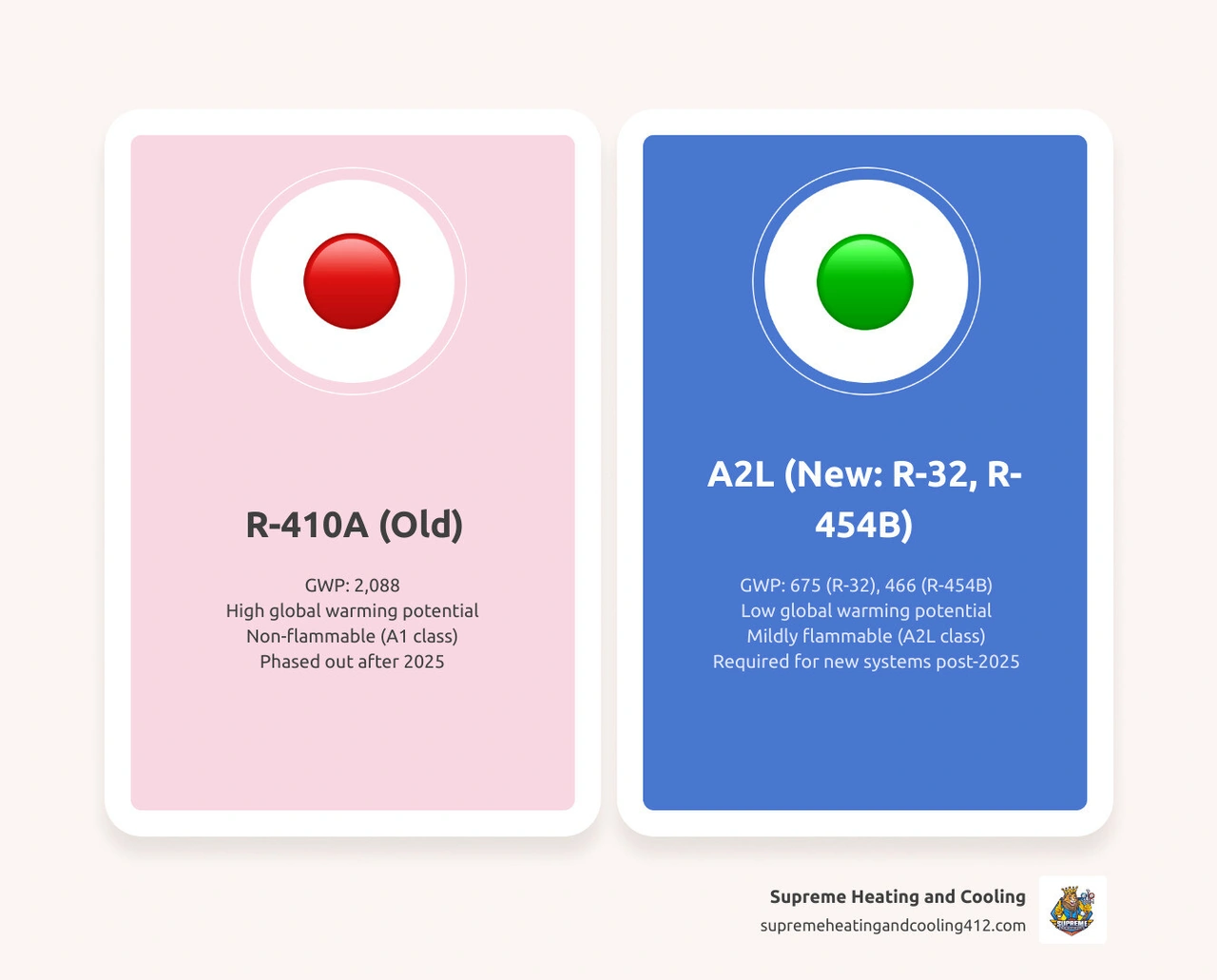
If you own a home with central air conditioning, the rules governing what goes inside your AC system just changed in a big way. The EPA, under the American Innovation and Manufacturing (AIM) Act of 2020, now requires all newly manufactured residential HVAC systems to use refrigerants that are far less harmful to the climate than the current standard, R-410A. R-410A has a GWP of 2,088 — meaning it traps over 2,000 times more heat in the atmosphere than carbon dioxide when released. The new replacements, R-454B and R-32, bring that number down to 466 and 675 respectively.
For most Pittsburgh-area homeowners, this transition will not mean an emergency trip to replace your AC unit this summer. But it does mean that decisions you make over the next few years — whether to repair, maintain, or replace your system — will be shaped by these new rules in ways that matter to your comfort, your budget, and your home's long-term value.
Why Pittsburgh Residents Need to Know How AC Refrigerant Changes Affect Homeowners
As we move through May 2026, the transition that began last year is now in full swing. The EPA mandate was designed to protect the environment by phasing out high-GWP substances. For decades, we used R-22 (Freon), which depleted the ozone layer. We then moved to R-410A, which was better for the ozone but high in global warming potential. Now, the industry is pivoting to a new class of refrigerants to meet the 700 GWP limit set by the AIM Act.
Understanding how ac refrigerant changes affect homeowners in places like Plum, Oakmont, and New Kensington is vital because the equipment being manufactured today is fundamentally different from what was available just a few years ago. The new standards prioritize environmental protection without sacrificing the cooling power we need during those humid Pennsylvania summers.
| Refrigerant | Global Warming Potential (GWP) | Flammability Class | Status in 2026 |
|---|---|---|---|
| R-410A | 2,088 | A1 (Non-flammable) | Phasing out; available for repairs only |
| R-32 | 675 | A2L (Mildly flammable) | New standard for many brands |
| R-454B | 466 | A2L (Mildly flammable) | New standard for many brands |
How AC refrigerant changes affect homeowners with existing R-410A systems
If your current air conditioner was installed between 2010 and 2024, it likely uses R-410A. The most important thing to know is that you are not required to replace this system. We can still service and repair it. However, because new production of R-410A is being restricted to drive the transition, the supply will gradually tighten.
Over time, the industry will rely more heavily on reclaimed refrigerant—gas that has been recovered from old systems and purified to new standards. While this helps the environment, it may eventually impact the availability of the fluid if your system develops a leak. This makes annual maintenance more critical than ever; catching a small leak now prevents the need for an expensive refill later.
How AC refrigerant changes affect homeowners looking for energy-efficient upgrades
For those in Forest Hills or Wilkinsburg considering a new installation, the news is quite positive regarding efficiency. Systems designed for the new A2L refrigerants are often more energy-efficient than their predecessors. Replacing an aging, inefficient unit with an ENERGY STAR certified model can cut annual energy bills by significantly.
Furthermore, the Inflation Reduction Act provides a federal tax credit of up to 30% for qualifying high-efficiency upgrades. This is capped at $600 for central air conditioners and up to $2,000 for heat pumps. When you combine these with local utility rebates available in the Pittsburgh area, the transition to a modern, low-GWP system becomes a much more manageable investment.
The Science of A2L: Safety and Performance
You may hear the term "A2L" frequently when discussing new HVAC equipment. This is a safety classification. "A" stands for low toxicity, and "2L" stands for mild flammability. While the idea of a flammable refrigerant might sound concerning, it is important to put it in perspective. These refrigerants are much harder to ignite than the natural gas or propane many of us use to heat our homes or cook our food.
These new fluids, like R-454B (a blend of R-32 and R-1234yf) and pure R-32, are already used safely in millions of cars and portable AC units worldwide. They offer excellent heat transfer properties, which means the system doesn't have to work as hard to move heat out of your home. However, because they operate at different pressures than older gases, you cannot simply "drop" them into an old unit. Doing so would lead to significant AC Refrigerant Pressure Problems and potential equipment failure.
Managing Maintenance and Repairs in the Post-2025 Era
In this new era of HVAC, the "top-off" is a thing of the past. Refrigerant is not a fuel; it’s a medium that travels in a sealed loop. If your system is low, it has a leak. In the past, some might have opted to just add more gas every year, but with R-410A prices expected to rise and the environmental impact of leaks being a major concern, fixing the root cause is the only responsible path.
Our team uses modern electronic leak detectors that are sensitive enough to find a Heat Pump Refrigerant Leak as small as 4 grams per year. Whether you are dealing with a AC Refrigerant Leak in Homes or trying to navigate our AC Freon Leak Ultimate Guide, the goal is the same: seal the system and protect the compressor.
Signs your system might have an AC Freon Leak:
- Warm Air: The vents are blowing, but the air isn't cold.
- Ice Buildup: You see frost or ice on the copper lines or the indoor evaporator coil.
- Hissing Sounds: A noticeable bubbling or hissing noise near the unit.
- High Bills: Your electricity usage spikes because the system is running 24/7 to keep up.
- Humidity Issues: The house feels "stuffy" or damp even when the AC is on.
Maximizing Comfort and Efficiency with New HVAC Standards
New systems designed for the 2025 mandate aren't just about the gas inside; they are smarter. Most new A2L-compliant units come equipped with a Refrigerant Detection System (RDS). If the system detects a leak, it automatically shuts down the compressor and turns on the indoor blower motor to dissipate the refrigerant safely.
This automation also contributes to better indoor air quality. Many of these modern systems feature variable-speed blower motors that provide more consistent temperatures and better dehumidification than older "on-off" models.
Benefits of upgrading to a new A2L system:
- Future-Proofing: You won't have to worry about the phase-out of older refrigerants.
- Advanced Safety: Integrated sensors monitor the system 24/7.
- Lower Footprint: You are using a refrigerant with a GWP that is 70% to 80% lower than R-410A.
- Enhanced Comfort: Modern systems provide more precise temperature control.
Frequently Asked Questions about Refrigerant Rules
Do I have to replace my current AC system immediately?
No. There is no law requiring you to pull out a working R-410A system. EPA compliance focuses on the manufacturing and installation of new equipment. As long as your system is healthy and efficient, you can continue to use it. We recommend regular maintenance to ensure it lasts its full 15-to-20-year lifespan.
Will R-410A be available for future repairs?
Yes, R-410A will remain available for the foreseeable future, though it will primarily come from reclaimed and recycled sources. While we don't anticipate it disappearing overnight, the cost of the refrigerant itself will likely increase as the supply of virgin (newly manufactured) gas decreases.
Are the new A2L refrigerants safe for my family?
Absolutely. The transition to A2L refrigerants involved years of rigorous safety testing. Because these systems include Refrigerant Detection Systems and are installed with specific safety protocols, they pose no greater risk to your family than traditional systems. In fact, the added sensors provide an extra layer of monitoring that older systems lacked.
Conclusion
At Supreme Heating and Cooling, we understand that these industry shifts can feel overwhelming. Whether you live in Bethel Park, Fox Chapel, Greensburg, or Monroeville, our mission is to provide the trustworthy, non-pushy guidance you need to make the right choice for your home. We aren't here to force an upgrade; we are here to help you maintain your current system for as long as it makes financial sense and to be the expert team you call when it's finally time for a more efficient, eco-friendly replacement.
If you’re concerned about a potential leak or want to discuss how the 2025 transition affects your specific cooling needs, we are just a phone call away. Let us help you keep your home comfortable while navigating these new environmental standards with ease.


.svg)
.webp)
.svg)
