
.svg)

.webp)

Why Condenser Coil Damage Is One of the Costliest AC Problems Homeowners Face
Understanding how condenser coil damage leads to costly AC repair could save you hundreds — or even thousands — of dollars before summer hits Pittsburgh. When the condenser coil in your outdoor unit starts failing, the effects ripple through your entire system fast: energy bills climb, cooling weakens, and in the worst cases, the compressor burns out entirely.
Here's a quick look at how condenser coil damage escalates into major repair costs:
| Stage of Damage | What Happens | Potential Consequence |
|---|---|---|
| Dirty or clogged coil | Heat can't escape properly | 30-40% increase in energy use |
| Bent or damaged fins | Airflow is restricted | Longer run times, higher bills |
| Corrosion or pinhole leak | Refrigerant escapes slowly | Weak cooling, iced-over lines |
| Ignored damage over time | Compressor works under extreme strain | Compressor failure or full system breakdown |
| Complete system neglect | Cascading component failures | Full AC replacement needed |
Many Pittsburgh homeowners don't think twice about their outdoor AC unit until it stops keeping up on a 90-degree day. But the condenser coil — that grid of metal fins wrapping around your outdoor unit — is quietly doing one of the hardest jobs in your entire home. When it gets dirty, bent, corroded, or starts leaking, your air conditioner doesn't just cool a little less. It works dramatically harder, wears out faster, and can fail completely at the worst possible time.
The good news? Most of the damage is preventable. And catching it early makes a real difference in what you'll spend.
What the Condenser Coil Does and Why It Matters
To understand why a little bit of damage outside can lead to a massive headache inside, we have to look at the role of the condenser coil. Think of your air conditioner not as a machine that "creates" cold, but as a machine that "moves" heat. Your AC is essentially a heat sponge, and the condenser coil is where that sponge gets wrung out.
What the condenser coil does in an air conditioning system
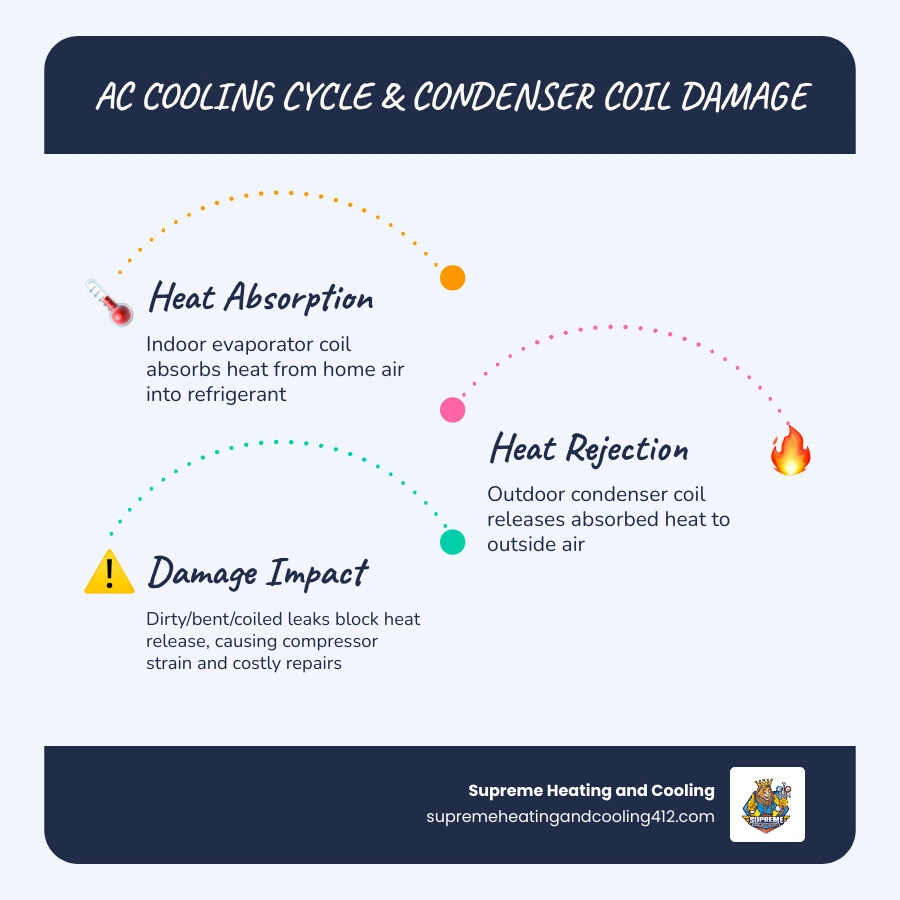
The condenser coil is located in your outdoor unit. Its primary job is to release the heat that was collected from inside your home. Inside the system, a chemical called refrigerant travels in a loop. It starts indoors, where it absorbs heat, then travels outdoors as a hot, high-pressure gas.
As this hot refrigerant flows through the condenser coil, a large fan pulls outdoor air across the metal fins. This air "soaks up" the heat from the refrigerant, allowing it to cool down and turn back into a liquid. This liquid then heads back inside to start the process all over again. If the coil is damaged, this heat exchange fails. This is precisely how condenser coil damage leads to costly AC repair: when heat can't escape, the system can't cool.
Why condenser coil problems affect the whole AC system
When the condenser coil is dirty or damaged, the refrigerant stays hotter than it should. This creates "high head pressure," which means the compressor has to push much harder to move that refrigerant through the lines.
This extra work leads to:
- Compressor Strain: The compressor is the "heart" of your AC. Forcing it to work against high pressure is like asking a person to run a marathon while breathing through a straw.
- Longer Run Times: Because the heat isn't leaving the system efficiently, your AC has to run for much longer cycles to reach the temperature set on your thermostat.
- Short Cycling: In some cases, the system gets so hot that it shuts itself off to prevent a fire or total meltdown, only to turn back on a few minutes later.
For more technical details on how pressure affects your system, check out our guide on AC Refrigerant Pressure Problems.
Condenser coil vs evaporator coil
It’s easy to get these two confused. The evaporator coil is located inside your home (usually near your furnace or in the attic). It is responsible for absorbing heat. The condenser coil is the outdoor one that releases heat.
Both coils must be clean and intact for the system to stay in balance. If the outdoor coil is damaged, the indoor coil might actually freeze over because the refrigerant isn't flowing at the correct temperature or pressure. You can learn more about maintaining your indoor components in our article on AC Evaporator Coil Care.

The Most Common Types of Condenser Coil Damage
In our years serving neighbors in areas like Monroeville and Fox Chapel, we’ve seen that condenser coils are tough, but they aren't invincible. They are sits outside 365 days a year, exposed to everything Pennsylvania weather can throw at them.
Physical damage to fins and tubing
The most visible type of damage involves the "fins"—those thin, aluminum slats that look like a radiator. They are incredibly delicate.
- Hail Damage: A heavy storm can flatten these fins in seconds.
- Lawn Equipment: We often see "weed whacker" damage where the bottom of the coil has been shredded by a trimmer.
- Pressure Washers: This is a common homeowner mistake. Using a high-pressure stream to "clean" the unit can actually crush the fins flat, permanently blocking airflow.
- Falling Branches: In wooded areas like Oakmont or Penn Hills, falling debris can puncture the copper tubing inside the coil.
Corrosion, leaks, and age-related wear
Even if nothing ever hits your AC, time and chemistry can still take a toll. Formicary corrosion occurs when microscopic tunnels form in the copper tubing due to a reaction with pollutants in the air. This leads to pinhole leaks.
If you see an oily residue on the coil or around the base of the unit, that’s a major red flag. That oil is mixed with your refrigerant, and a leak means your system is losing its ability to cool. Most condenser coils have a lifespan of about 10–15 years before metal fatigue makes leaks almost inevitable. If you suspect a leak, read more about AC Refrigerant Leak in Homes.
Dirt buildup and neglected maintenance
While it might not look like "damage" in the traditional sense, a dirty coil is just as destructive. Dust, pollen, grass clippings, and pet hair can form a thick, felt-like blanket over the coils.
This "thermal blanket" insulates the coils, keeping the heat trapped inside the refrigerant. The Department of Energy has noted that dirty coils can increase energy consumption by 30% to 40%. In a Pittsburgh summer, that can add hundreds of dollars to your utility bills. Learn why professional cleaning is so vital in The Importance of Condenser Coil Cleaning in Air Conditioning Maintenance.
How Condenser Coil Damage Leads to Costly AC Repair
The reason we emphasize this topic is that coil damage never stays "just" coil damage. It starts a chain reaction that eventually hits the most expensive parts of your air conditioner.
How condenser coil damage leads to costly ac repair through lost efficiency
When the coil can't release heat, the refrigerant doesn't fully turn back into a liquid. This is called "reduced subcooling." Instead of a cool liquid returning to your indoor unit, you get "flash gas"—a mixture of liquid and bubbles. This mixture is terrible at absorbing heat, which means your vents will blow lukewarm air. You’ll notice your energy bills spiking by 15% to 25% as the system struggles to keep up with the thermostat.
How condenser coil damage leads to costly ac repair by straining the compressor
This is the "big one." The compressor is designed to handle gas, not liquid or high-pressure heat. When the condenser coil is damaged, the discharge temperature of the compressor can skyrocket.
If that temperature exceeds 225°F, the oil that lubricates the compressor begins to break down. Without lubrication, the compressor will eventually seize or "burn out." Replacing a compressor is one of the most expensive repairs in the HVAC world, often costing thousands. Proper AC Compressor Maintenance Tips are your best defense against this outcome.
What happens if coil damage is ignored
If you ignore the warning signs, the damage progresses through these stages:
- Stage 1: Rising energy bills and slightly longer run times.
- Stage 2: The system struggles to reach the set temperature on hot afternoons.
- Stage 3: Refrigerant lines start to vibrate or hiss; ice may form on the copper pipes.
- Stage 4: The compressor begins to make loud banging or clicking noises.
- Stage 5: Total system shutdown. In many cases, an older system with a failed compressor is no longer worth repairing.
Signs Homeowners Should Watch For
You don't need to be an HVAC expert to spot trouble. Keep your eyes and ears open for these symptoms.
Performance and comfort symptoms
The first signs usually happen inside your home:
- Warm Air: The air coming from your registers feels "room temperature" rather than crisp and cold.
- High Humidity: Because the system isn't cooling efficiently, it isn't removing moisture from the air, leaving your home feeling "sticky."
- The Never-Ending Cycle: If your AC turns on at 10:00 AM and doesn't shut off until midnight, something is wrong with the heat exchange.
Visible and audible clues outside
Walk out to your unit in Bethel Park or Upper Saint Clair and look for:
- Hissing or Bubbling: This almost always indicates a refrigerant leak.
- Oily Spots: Refrigerant leaks leave behind a dark, greasy residue that collects dust.
- Bent Fins: If the exterior looks like it was hit by a stray baseball or hail, airflow is being blocked.
- Ice Buildup: Seeing ice on the outdoor unit during a 90-degree day is a sure sign of a serious pressure or refrigerant issue.
What to do if you suspect condenser coil damage
If you notice these signs, turn the system off immediately. Continuing to run a damaged AC will only accelerate the damage to the compressor.
- Check for obvious obstructions (like a plastic bag stuck against the unit).
- Do not try to add refrigerant yourself; this requires specialized tools and EPA certification.
- Document the symptoms and call a professional.
We can help diagnose the exact issue—check our AC Refrigerant Pressure Problems page for more on what we look for during an inspection.
Preventing Condenser Coil Damage With Routine Maintenance
The best way to avoid the question of how condenser coil damage leads to costly AC repair is to make sure the damage never happens in the first place.
Maintenance habits that help prevent damage
- The Two-Foot Rule: Keep plants, shrubs, and weeds trimmed back at least two feet from all sides of the unit. Air needs to breathe!
- Annual Cleaning: Have a professional clean your coils every spring. This removes the "blanket" of dirt that builds up over the winter.
- Gentle Rinsing: You can gently rinse the outside of the unit with a garden hose (no high-pressure nozzles!) to remove loose grass and dust.
- Filter Changes: Believe it or not, a clean indoor filter reduces the overall strain on the entire system, including the outdoor coil.
Mistakes that can make condenser coil damage worse
We’ve seen well-meaning homeowners accidentally cause more damage by:
- Using Pressure Washers: We can't say it enough—never use a pressure washer on your AC.
- Harsh Chemicals: Many household cleaners can actually eat away at the aluminum fins.
- Coil Comb Misuse: While "fin combs" exist to straighten bent fins, using the wrong size or too much force can puncture the delicate refrigerant tubes underneath.
When repair makes sense and when replacement becomes the smarter move
Sometimes, a coil is so badly damaged or corroded that it must be replaced. But is it worth it?
| Factor | Favor Repair | Favor Replacement |
|---|---|---|
| Age | Under 10 years old | Over 12-15 years old |
| Refrigerant | Uses R-410A | Uses phased-out R-22 (Freon) |
| Warranty | Parts are still covered | Warranty has expired |
| Condition | Rest of system is healthy | Frequent previous repairs |
If your system is older and uses R-22, a major coil repair is often a "sinkhole" for money. In those cases, moving to a modern, high-efficiency unit is the better long-term investment. For more help with this decision, see our articles on AC Repair vs New Unit Long Term Savings and AC Age and Efficiency Issues. If you live in an older home in an area like Wilkinsburg or Aspinwall, you might also find our guide on AC Replacement in Older Homes helpful.
Frequently Asked Questions About Condenser Coil Damage
How often should a condenser coil be cleaned?
For most homes in the Pittsburgh area, once a year is perfect. However, if you have a lot of cottonwood trees nearby, or if you have outdoor pets that shed near the unit, you might need a quick cleaning every few months during the peak of summer.
Can bent condenser fins be fixed?
Yes, if the damage is minor. We use a tool called a fin comb to carefully "brush" the metal back into place. However, if the fins are crushed over a large area, the metal may be too brittle to move, or the tubing underneath may already be compromised.
Is a leaking condenser coil always replaceable or repairable?
Small "pinhole" leaks can sometimes be repaired by a process called brazing. However, if the coil is old and has multiple leaks, it’s a sign that the metal is failing everywhere. In that case, replacing the coil (or the unit) is the only reliable fix.
Conclusion
Your air conditioner is a significant investment in your family's comfort. By understanding how condenser coil damage leads to costly AC repair, you can take the small, proactive steps needed to keep your system running efficiently for its full 15-to-20-year lifespan.
Whether you're in Plum, Glenshaw, or downtown Pittsburgh, don't wait for your AC to start blowing warm air. A simple spring tune-up can catch bent fins, early corrosion, or dirt buildup before they turn into a mid-July emergency. At Supreme Heating and Cooling, we pride ourselves on being the trustworthy, non-pushy experts you can rely on to keep your home cool and your energy bills low.
Ready to ensure your system is in top shape? Learn more about our professional AC services and schedule your maintenance visit today.


.svg)
.webp)
.svg)
