.svg)

.webp)

Your Year-Round Comfort Starts Here: How Does a Heat Pump Work in a Four Season Climate?
How does a heat pump work in a four season climate is one of the most common questions Pennsylvania homeowners ask before making the switch from a traditional furnace and air conditioner setup. The short answer: a heat pump moves heat rather than generating it, and a reversing valve lets it switch direction depending on the season.
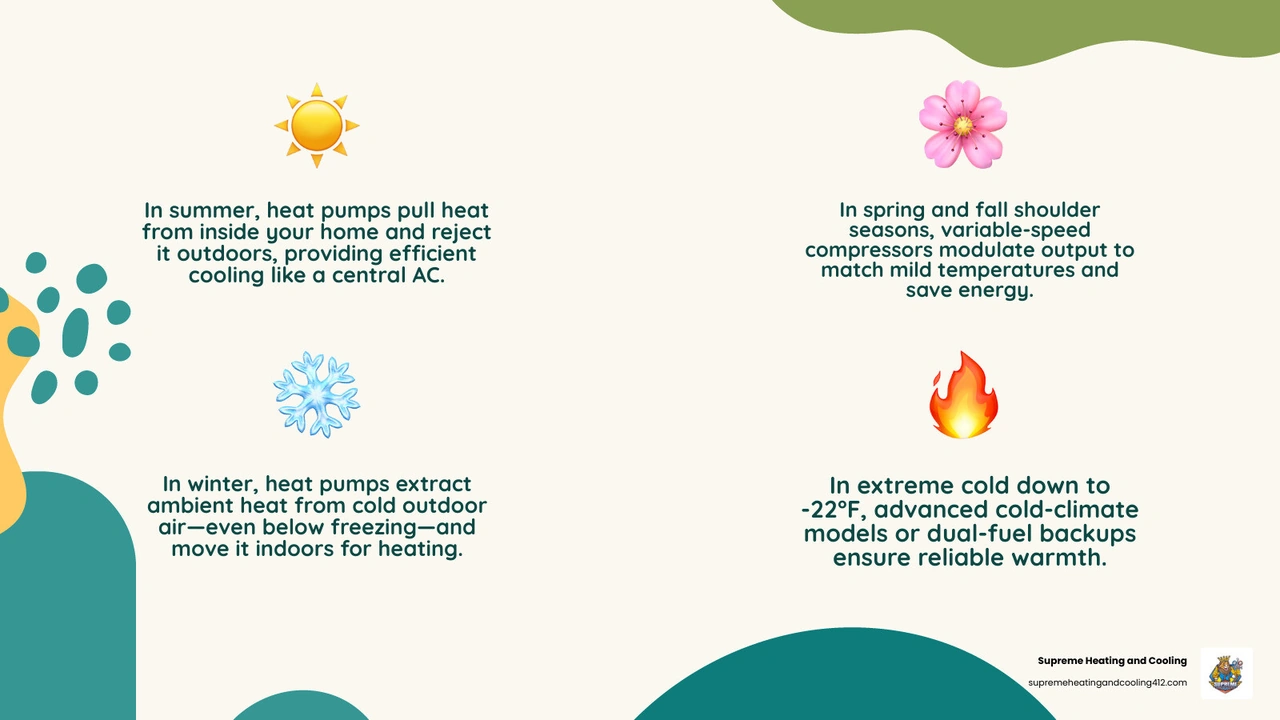
Here is how it works across all four seasons at a glance:
- Summer: The heat pump pulls heat from inside your home and releases it outdoors, cooling your living space just like a central air conditioner would.
- Spring and Fall: Variable-speed technology lets the system run at partial capacity to match mild, unpredictable temperatures without wasting energy.
- Winter: The system extracts heat energy from cold outdoor air — yes, even below freezing — and moves it inside to warm your home.
- Extreme Cold: Modern cold climate heat pumps can operate down to -22°F, and dual-fuel systems can automatically switch to a gas furnace backup when temperatures drop hard.
The reason this matters for Pittsburgh-area families is that Pennsylvania gets all four seasons in full force. Summers here are hot and humid. Winters can be genuinely brutal. Spring and fall swing back and forth like they cannot make up their mind. A heat pump that handles all of that with one system, using electricity instead of burning fuel, is a meaningful upgrade for comfort and efficiency.
Heat pumps can deliver up to four units of heat energy for every one unit of electricity they consume. That makes them dramatically more efficient than even the best gas furnaces, which top out at around 98% efficiency. A heat pump, by contrast, can reach up to 300% efficiency under the right conditions.
For homeowners who are tired of running a separate furnace in winter and a separate air conditioner in summer, a heat pump simplifies everything into a single system that adapts to whatever the weather throws at you.
The Science of Heat Transfer: How Does a Heat Pump Work in a Four Season Climate?

To understand how does a heat pump work in a four season climate, we have to look at the basic physics of heat. Heat naturally moves from a warm place to a cold place. A heat pump uses a small amount of electricity to reverse that natural flow. It doesn't create heat by burning gas or heating up a metal coil; instead, it acts as a "heat transporter."
The magic happens through the refrigeration cycle. A specialized fluid called refrigerant circulates between an indoor unit and an outdoor unit. In the winter, this refrigerant becomes incredibly cold—much colder than the air outside. Because it is so cold, it can actually absorb heat from the "warm" outdoor air (even when it feels freezing to us).
Key components that make this possible include:
- The Compressor: This is the heart of the system. It squeezes the refrigerant, raising its temperature and pressure so it can release heat inside.
- The Reversing Valve: This is the "brain" that allows the system to switch between heating and cooling. It literally reverses the direction of the refrigerant flow.
- Heat Exchangers (Coils): These allow the refrigerant to swap heat with the air.
Because a Heat Pump moves heat rather than creating it, it is incredibly efficient. While a high-end furnace might reach 98% efficiency, a heat pump can achieve a Coefficient of Performance (COP) of 3 or 4. In simple terms, that means it produces 300% to 400% more energy than it consumes in electricity.
Seasonal Adaptability: From Humid Summers to Transitional Springs
One of the biggest advantages of a heat pump in the Greater Pittsburgh area is its ability to adapt. We don't just have "hot" and "cold" days; we have "sticky" days, "brisk" days, and days where the morning starts at 30°F and ends at 65°F.
Modern systems use variable-speed compressors. Unlike older systems that are either "all the way on" or "all the way off," a variable-speed unit can adjust its output in tiny increments. This "load matching" ensures that your home stays at a perfectly consistent temperature without the constant starting and stopping that wears out equipment and spikes energy bills. For homeowners in areas like Bethel Park, this means superior comfort during those unpredictable months. If you need help choosing a system that fits this profile, our Heat Pump Services Bethel Park Pa can guide you through the latest modulating technology.
How Does a Heat Pump Work in a Four Season Climate During Humid Summers?
In the summer, a heat pump is effectively a high-efficiency central air conditioner. It uses the reversing valve to pull heat out of your indoor air and dump it outside.
However, in Pennsylvania, the heat isn't the only problem—it’s the humidity. High-efficiency heat pumps are actually better at dehumidification than standard AC units. Because they can run for longer, lower-speed cycles, they pull more moisture out of the air. This prevents that "clammy" feeling and improves indoor air quality. When looking for a summer-ready unit, pay attention to the SEER2 rating (Seasonal Energy Efficiency Ratio). A higher SEER2 means more cooling for less money. If you are in the New Kensington area and your current system is struggling with the July humidity, our Heat Pump Services New Kensington Pa can help you upgrade to a system that breathes easier.
Managing the "Shoulder Seasons" of Spring and Fall
Spring and fall are the "true test" of any HVAC system. These transitional months often require heating in the morning and cooling by 3 PM. Because a heat pump can switch modes instantly, it handles these shifts effortlessly.
Precise modulation is key here. During a 55°F spring afternoon, you don't need 100% of your system's power. A variable-speed heat pump might run at only 25% capacity, maintaining a steady breeze that keeps the air from becoming stagnant. This constant, gentle airflow also helps with moisture control during rainy Pennsylvania Aprils. To ensure your system is ready for these rapid switches, we always emphasize The Importance Of Seasonal Heat Pump System Maintenance. A quick tune-up in the spring and fall ensures the reversing valve and sensors are primed for the "shoulder season" swings.
Conquering the Cold: Advanced Technology for Pennsylvania Winters
There is a persistent myth that heat pumps don't work in the cold. While that may have been true in the 1980s, 2026 technology has changed the game. "Cold Climate Heat Pumps" (CCHP) are specifically engineered for regions like ours.
These systems use advanced compressors and vapor injection technology to maintain their heating capacity even when the thermometer drops. Some models can now provide 100% of their rated heat down to 5°F and continue operating effectively down to -22°F. If you ever run into trouble during a cold snap, having a reliable Heat Pump Repair New Kensington Pa Guide or a local expert on speed dial is essential for peace of mind.
How Does a Heat Pump Work in a Four Season Climate During Frigid Winters?
In heating mode, the outdoor unit acts as the evaporator and the indoor unit acts as the condenser. The refrigerant absorbs ambient heat from the outside air—which, scientifically speaking, contains heat energy all the way down to absolute zero (-459°F).
As the refrigerant absorbs this heat, it is compressed into a hot gas and pumped indoors. The indoor fan blows air across the hot coils, distributing warmth throughout your home. In Pennsylvania, you want to look for a high HSPF2 (Heating Seasonal Performance Factor) rating.
One common sight in winter is the "defrost cycle." Because the outdoor coils get very cold, frost can build up on them. The heat pump will occasionally switch into a temporary cooling mode to warm up the outdoor coils and melt the ice. This is perfectly normal! However, if your system stays iced over, you might need professional help. Check out our 247 Heat Pump Repair Pittsburgh Guide for tips on what to look for when the snow starts to pile up.
Hybrid and Dual-Fuel Solutions for Extreme Temperatures
For homeowners who want the ultimate safety net, we often recommend a "Dual-Fuel" or hybrid system. This setup pairs an electric heat pump with a high-efficiency gas furnace.
How does it work?
- Milder Cold (Above 35°F): The heat pump handles the heating with incredible efficiency.
- Extreme Cold (Below 30°F): The system automatically switches to the gas furnace.
Gas furnaces produce a "hotter" air temperature, which many people find more comfortable when it is 10°F outside. This hybrid approach gives you the best of both worlds: the low operating costs of a heat pump for 85% of the year and the raw power of gas for those few "Polar Vortex" weeks. For residents looking for a custom setup, our Heat Pump Installation Monroeville Pa team can design a dual-fuel system that fits your home’s specific needs.
Choosing the Right System for Your Home’s Layout
Not every home in the Pittsburgh area is built the same. From historic homes in Fox Chapel to newer constructions in Penn Hills, the "right" heat pump depends on your ductwork and layout.
- Air-Source Heat Pumps: The most common type, using outdoor air to heat and cool. These are great for homes with existing ductwork.
- Ground-Source (Geothermal): These use the stable temperature of the earth. While they have a higher upfront effort to install, they are the most efficient systems on the planet.
- Ductless Mini-Splits: Perfect for older homes in places like Oakmont or Aspinwall that don't have ducts. These allow for "zoned comfort," meaning you can heat the living room without wasting energy on an empty guest room.
Whether you need a full Heat Pump Installation Penn Hills Pa or you are considering a Heat Pump Replacement Glenshaw Pa, the key is proper sizing. An oversized unit will cycle too often, while an undersized unit will struggle to keep up in January.
Maximizing Efficiency and Longevity in the Greater Pittsburgh Area
To get the most out of your heat pump, you have to look at the "whole home" picture. A 300% efficient heat pump won't save you money if all that warm air is escaping through a drafty attic.
| Feature | Heat Pump | Traditional Furnace + AC |
|---|---|---|
| Energy Source | Electricity | Gas/Oil + Electricity |
| Efficiency | Up to 300-400% | Max 98% (Heating) |
| Carbon Footprint | Low (No on-site combustion) | Higher (Burns fossil fuels) |
| Maintenance | Bi-annual (Spring/Fall) | Annual (One for each) |
| Comfort | Consistent, modulated air | Hot/Cold blasts |
To protect your investment, Expert Heat Pump Maintenance is non-negotiable. In a four-season climate, your heat pump works almost every day of the year. Regular service, especially Heat Pump Maintenance Upper Saint Clair Pa, ensures that the coils are clean and the refrigerant levels are perfect.
Don't forget that as of April 2026, there are still significant federal tax credits and local utility rebates available for high-efficiency heat pump installations. These can often offset a large portion of the initial investment.
Frequently Asked Questions About Four-Season Heat Pumps
Do heat pumps really work when it is below freezing in Pennsylvania?
Yes! Modern "Cold Climate" models are designed specifically for northern winters. By using variable-speed inverters and specialized refrigerants, they can extract heat from the air even when it is well below zero. In fact, some models maintain high efficiency down to -22°F. If your system is struggling in the cold, it may just need a professional Heat Pump Repair Turtle Creek Pa to check the defrost sensors or refrigerant charge.
Can a heat pump replace both my central AC and my furnace?
Absolutely. That is the primary beauty of the system. It is an all-in-one solution. By replacing two separate pieces of equipment with one high-efficiency unit, you save space and simplify your maintenance schedule. If your old furnace is on its last legs, a Heat Pump Replacement Murrysville Pa is often the smartest long-term move.
How often does a heat pump need maintenance in a four-season climate?
Because heat pumps run year-round (unlike a furnace that sleeps in summer), we recommend bi-annual checks. A spring visit prepares the system for the cooling load and humidity, while a fall visit ensures the heating components and defrost cycles are ready for the snow. Simple tasks like filter changes should be done every 1-3 months, but for the technical stuff, a professional Heat Pump/Heat Pump Maintenance Verona Pa ensures your warranty stays valid and your bills stay low.
Conclusion
At Supreme Heating and Cooling, we believe that every Pennsylvania family deserves a home that feels like a sanctuary, regardless of what the weather is doing outside. Whether it is a sweltering July afternoon in Swissvale or a snowy midnight in Greensburg, a properly installed heat pump is the most efficient way to stay comfortable.
We pride ourselves on being more than just technicians; we are your neighbors. Our team is known across the Greater Pittsburgh area for being trustworthy, knowledgeable, and—most importantly—non-pushy. We won't try to sell you a system you don't need. Instead, we focus on finding the right solution for your home’s unique layout and your family’s comfort goals.
If you are ready to master the seasons and lower your energy footprint, we are here to help. From installation to long-term care, let us show you why so many of your neighbors trust us with their Heat Pump needs. Reach out to our friendly team today and let's get your home ready for whatever Pennsylvania throws at it next!


.svg)
.webp)
.svg)
