.svg)

.webp)
Why Size Matters: How Oversized AC Units Make Humidity Problems Worse
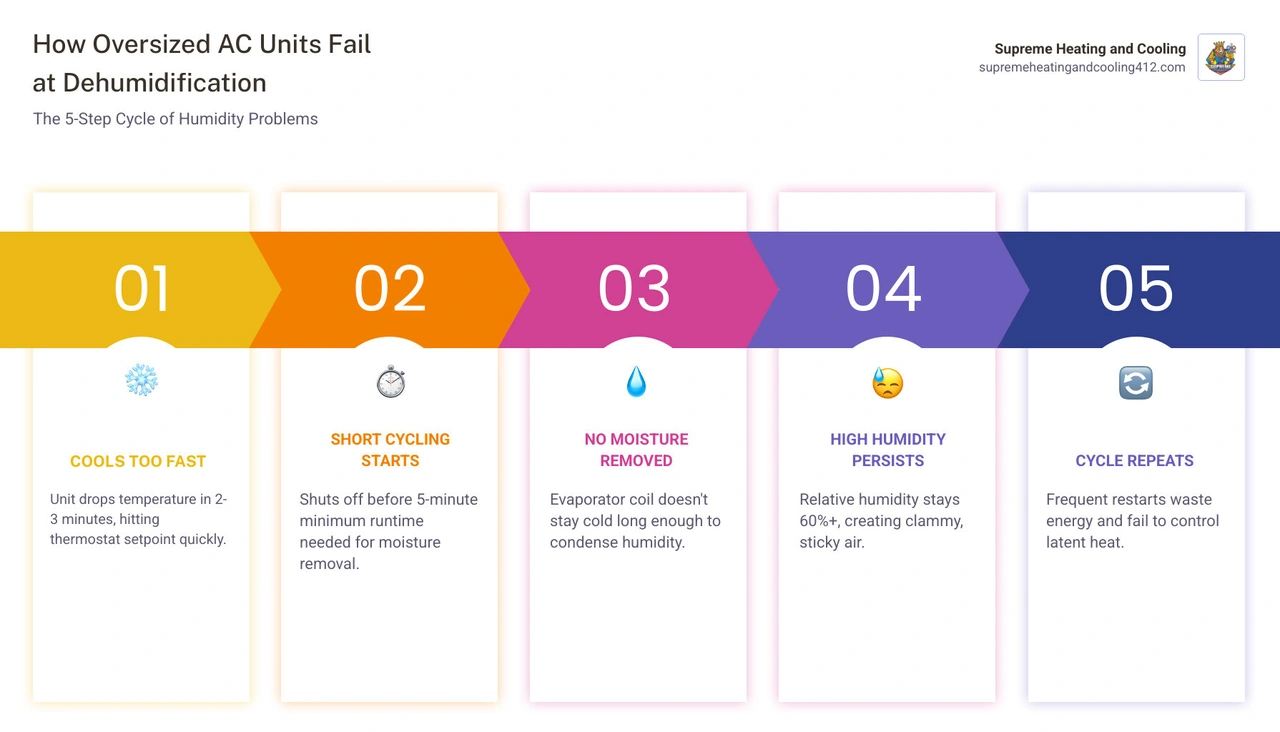
How oversized AC units make humidity problems worse comes down to one simple fact: your AC needs time to pull moisture out of the air, and an oversized unit shuts off before it ever gets the chance.
Here is what happens:
- Oversized AC cools too fast - The unit blasts cold air, hits the thermostat's target temperature in just 2-3 minutes, and shuts off
- Short cycling = no dehumidification - Effective moisture removal requires at least 5 minutes of continuous runtime; most oversized units never reach that threshold
- Humidity stays high - Even though the air feels cool, relative humidity can stay at 60% or above, well past the comfortable 40-50% target
- The cycle repeats - The unit kicks back on soon after, drawing heavy startup power, then shuts off again without finishing the job
- Result - A home that feels cold and clammy at the same time, with rising risks of mold, musty odors, and poor air quality
If your Pittsburgh-area home feels sticky even when the AC is running, an oversized system is one of the most common culprits. Residential HVAC systems are frequently installed at two to three times the capacity a home actually needs, and homeowners often have no idea until the humidity problems and high energy bills show up.
This guide walks you through exactly why this happens, how to spot the signs, and what you can do about it.
Understanding How Oversized AC Units Make Humidity Problems Worse

In the HVAC world, we talk about two types of "heat." There is sensible heat, which is the temperature you see on your thermostat, and latent heat, which is the moisture (humidity) in the air. A properly functioning air conditioner is designed to tackle both. However, when a unit is too large for the space it serves, it "wins the race" to lower the sensible heat but completely fails to address the latent heat.
This failure happens because of a phenomenon called short cycling. When your AC kicks on, it doesn't just instantly start dehumidifying. The evaporator coil inside your home has to get cold enough to reach the dew point. Once that coil is cold, the moisture in your home's air condenses onto the metal—much like water droplets forming on a cold glass of iced tea on a July day in Plum or Oakmont. That water then drips into a pan and is carried away through a drain line.
If the unit is oversized, it satisfies the thermostat so quickly that the coil never stays cold long enough to "wring out" the air. This is why home air feels sticky even when the temperature is 70 degrees.
| System Status | Cycle Runtime | Moisture Removal Efficiency | Indoor Feel |
|---|---|---|---|
| Oversized | 2–3 Minutes | Extremely Low (5–10%) | Cold and Clammy |
| Slightly Oversized | 5–8 Minutes | Moderate (40–50%) | Inconsistent |
| Properly Sized | 15–20 Minutes | High (90–100%) | Crisp and Dry |
Why an oversized AC unit fails to dehumidify effectively
The physics of dehumidification is a time-dependent process. To remove moisture, the air must pass over the cold evaporator coil multiple times. When we look at airflow rates and CFM (cubic feet per minute), an oversized unit moves a massive volume of air very quickly. This high velocity sounds powerful, but it actually works against you. The air moves so fast that it doesn't have enough "dwell time" on the coil to drop its moisture.
Furthermore, the 5-minute rule is a critical industry benchmark. It typically takes at least five minutes of continuous operation for the evaporator coil to reach thermal equilibrium and start the condensation process. If your unit shuts off at the three-minute mark, the moisture stays in the air—or worse, it stays on the coil and evaporates back into your ductwork once the fan stops.
The impact of short cycling on your indoor environment
Short cycling creates a "yo-yo" effect in your home. The thermostat is satisfied, but the air is stagnant and heavy. This leads to temperature swings where one room feels like a freezer while another feels like a sauna. Because the unit is constantly stopping and starting, you also deal with energy spikes. It takes much more electricity to start a motor than to keep one running.
Over time, this constant on-off behavior slashes the system lifespan. You are putting years of wear and tear on the compressor and fan motor in just a few seasons. Most importantly, it compromises humidity control for homes, leaving you with that dreaded "cold jungle" feeling where you're shivering but your skin feels tacky.
Signs Your System is Too Big for Your Pennsylvania Home
How do you know if your AC is the wrong size? In our experience serving areas like Bethel Park and Monroeville, the signs are usually right in front of you.
- Uneven Temperatures: You notice the living room is freezing, but the back bedrooms remain humid and warm. This happens because the unit doesn't run long enough to push conditioned air to the furthest reaches of your ductwork.
- Musty Odors: High humidity leads to enhancing indoor air quality issues, often manifesting as a "dirty sock" smell.
- High Energy Bills: If your bills are skyrocketing but your comfort is plummeting, your unit is likely wasting power on frequent startups.
- Frequent Startups: If you hear your AC kick on and off every 10 minutes, that is a classic red flag.
How oversized AC units make humidity problems worse for your health
High humidity isn't just a comfort issue; it's a health hazard. When relative humidity stays above the 60% threshold, your home becomes a breeding ground for mold growth and dust mites. These allergens thrive in damp environments, and once they take hold in your ductwork, they are circulated throughout your house every time the fan kicks on.
For families in Fox Chapel or Penn Hills, this can lead to increased respiratory issues, allergies, and asthma flare-ups. This is a primary reason why maintain IAQ in Fox Chapel is so vital for long-term wellness. A properly sized AC keeps humidity between 40% and 50%, which is the "sweet spot" for both comfort and health.
Mechanical symptoms of a capacity mismatch
Beyond your health, the machine itself suffers. Compressor wear is the most expensive consequence. The compressor is the heart of your AC, and it is designed for long, steady runs, not rapid-fire bursts. Short cycling also puts immense blower motor stress on your furnace or air handler.
In some cases, you might even see frozen coils. It sounds counterintuitive, but the high-pressure environment of an oversized unit can cause the temperature to drop too low, turning that un-drained moisture into ice. You might also notice ductwork noise, such as rattling or "banging" when the high-powered blower kicks on, which can eventually lead to disconnected joints and air leaks.
How to Properly Size an AC Unit for Long-Term Comfort
The only way to avoid these problems is to move away from "rules of thumb." Many contractors will tell you that you need "one ton of cooling for every 500 square feet." In May 2026, we know that this outdated method is exactly why so many homes have oversized units.
A professional Manual J load calculation is the gold standard. This calculation factors in:
- The total square footage and ceiling height.
- The quality and amount of insulation in your walls and attic.
- Window orientation (how much sun hits your glass and at what time of day).
- The local climate in the Pittsburgh region.
- The number of occupants and heat-generating appliances.
By using data instead of guesses, we can ensure the role of AC services in improving indoor air quality is maximized through a perfectly matched system.
Why runtime matters for dehumidification
We generally look for 20-minute cycles during the peak of a Pennsylvania summer. This allows the system to reach steady-state efficiency, where it is running at its most cost-effective level. Longer runtimes ensure that the air is filtered more often and that latent heat removal is consistent. When a system runs for a full cycle, it effectively mixes the air in the home, eliminating those annoying hot and cold spots.
How oversized AC units make humidity problems worse in multi-story homes
In split-level or multi-story homes in places like Greensburg or Upper Saint Clair, an oversized AC is a disaster for air distribution. Because the unit shuts off so quickly, the conditioned air never makes it through the trunk lines to the upper floors or remote rooms. This leads to temperature stratification, where the downstairs is a walk-in cooler and the upstairs feels like a humid attic.
For these homes, a properly sized unit—or better yet, a zoning system or multi-stage cooling unit—is the best way to ensure every floor stays dry and comfortable.
Practical Solutions for Managing Humidity with Existing Systems
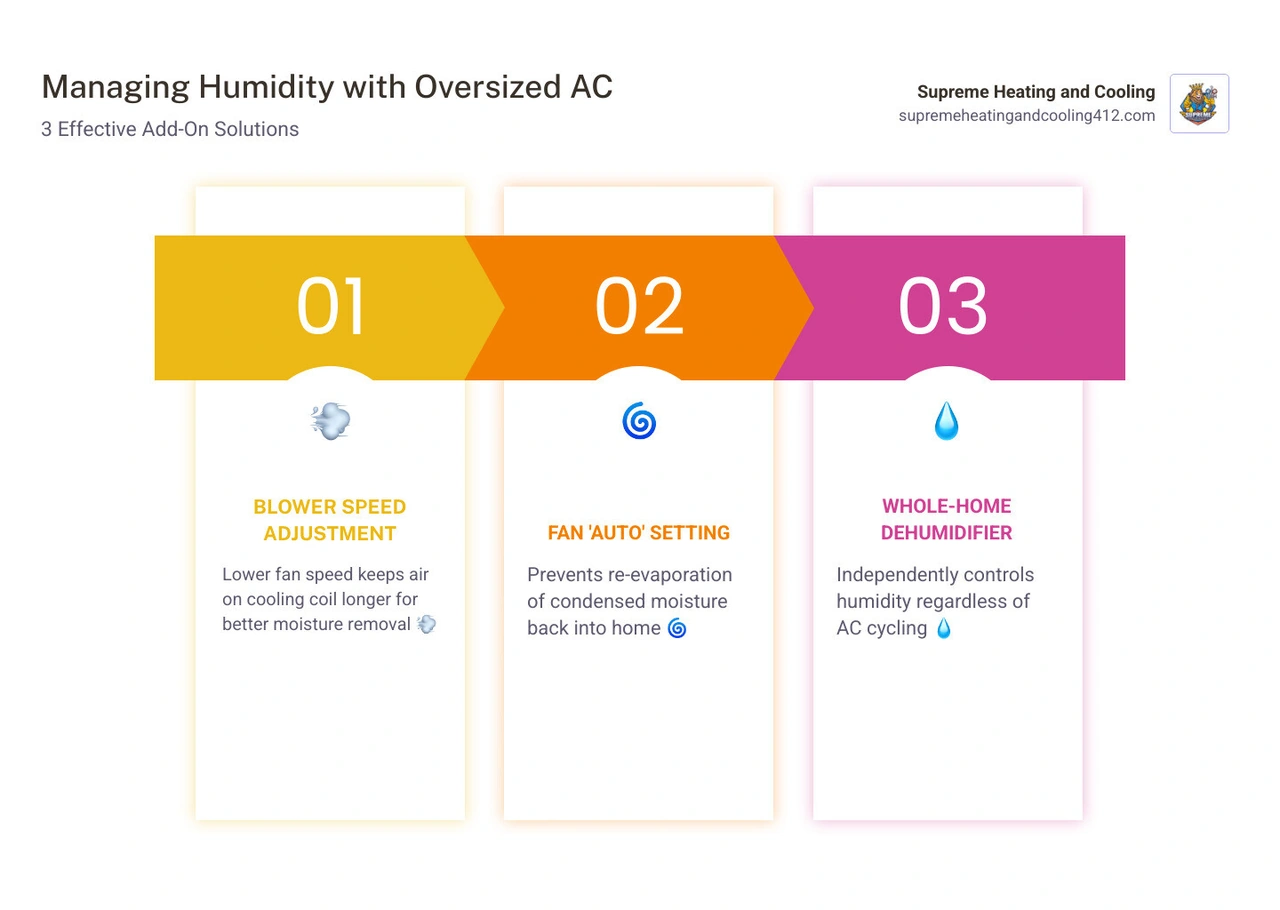
If you already have an oversized unit and aren't ready for a full replacement, there are a few "hacks" we can use to help.
- Blower Speed Adjustment: A technician can often lower the fan speed (within manufacturer specs). Slower airflow allows the air to stay on the cooling coil longer, increasing moisture removal.
- Fan "Auto" Setting: Never run your fan on "On" during the summer. If the fan runs constantly, it will blow the moisture that just condensed on the coil right back into your house before it can drain. Always use the "Auto" setting.
- Whole-Home Dehumidifiers: This is often the best solution. By adding a dedicated dehumidifier to your HVAC system, you can control moisture independently of the temperature.
Thermostat settings and add-ons
Modern smart thermostats often have settings to help mitigate short cycling. You can sometimes set minimum run times or "overcool" settings that allow the AC to run a bit longer to pull out humidity, even if the temperature is slightly below the setpoint. Additionally, installing UV lights near the coil can prevent the mold growth that thrives in the damp environments created by oversized units.
When to consider professional intervention
If your home feels like a "cold jungle," it’s time to call in the experts. A professional load evaluation can tell you exactly how oversized your system is. We can also perform a ductwork inspection to see if your vents are actually sized to handle the air your unit is pushing. Sometimes, a simple refrigerant charge adjustment or cleaning a clogged coil can help, but if the mismatch is severe, a system replacement might be the only way to achieve true comfort and stop the cycle of high energy bills.
Frequently Asked Questions
How long should a normal AC cycle last?
Ideally, an AC cycle should last between 15 to 20 minutes. While a minimum of 7–10 minutes is required to prevent mechanical damage, the longer 20-minute cycles are what actually provide effective dehumidification. On very hot days, it is perfectly normal (and even efficient) for a properly sized unit to run almost continuously.
Can I just lower the thermostat to remove more humidity?
This is known as "thermostat ratcheting," and it usually backfires. While it forces the unit to run longer, it also makes the home uncomfortably cold and wastes a significant amount of energy. Furthermore, it increases the risk of the evaporator coil freezing, which can lead to a total system breakdown.
Is a 3-ton AC unit too big for a 1,500 square foot home?
In the Pittsburgh climate, a 3-ton unit is often way too large for a 1,500 sq. ft. home, especially if the home has modern insulation and windows. A 3-ton unit is typically better suited for homes between 1,600 and 2,400 square feet. However, every home is different, which is why a Manual J calculation is necessary to find the exact BTU requirements.
Conclusion
At Supreme Heating and Cooling, we believe that bigger is rarely better when it comes to your home's HVAC system. Our goal is to provide our neighbors in Pittsburgh, Monroeville, and throughout the surrounding areas with honest, trustworthy advice. We don't push the biggest, most expensive units; we push for the right unit.
Proper sizing is the foundation of a comfortable, healthy, and energy-efficient home. If you are tired of dealing with sticky air and high utility bills, our personable team is ready to help with professional load calculations and expert air conditioning services. Let us help you turn your "cold jungle" back into a comfortable sanctuary.


.svg)
.webp)
.svg)
