.svg)

.webp)

Why Understanding How the Compressor, Evaporator, and Condenser Function Matters for Your Home Comfort
Understanding how the compressor, evaporator, and condenser function is the key to knowing what your AC system actually does every time it kicks on. Here's a quick breakdown:
| Component | Location | Primary Job |
|---|---|---|
| Compressor | Outdoor unit | Pressurizes refrigerant, raising its temperature |
| Condenser | Outdoor unit | Releases heat from refrigerant, converting it from gas to liquid |
| Evaporator | Indoor unit | Absorbs heat from indoor air, converting refrigerant from liquid to gas |
On a hot summer day, stepping into a cool home feels effortless. But behind that comfort is a continuous loop of physics happening inside your HVAC system. Your AC doesn't actually create cold air — it moves heat out of your home. The compressor, condenser, and evaporator each play a specific role in that process, working together in what's known as the vapor-compression refrigeration cycle.
Whether you're troubleshooting a warm room, preparing for a tune-up, or simply curious about what's humming outside your window, knowing how these three components work gives you a real advantage as a homeowner.
It is fascinating to think that the core technology we use today was pioneered by Willis Carrier way back in 1902. While the electronics have become much smarter, the fundamental physics of the refrigeration cycle remain the same. By manipulating the pressure and state of a chemical called refrigerant, your system can absorb heat from your living room in Pittsburgh and dump it into the outdoor air in your backyard.
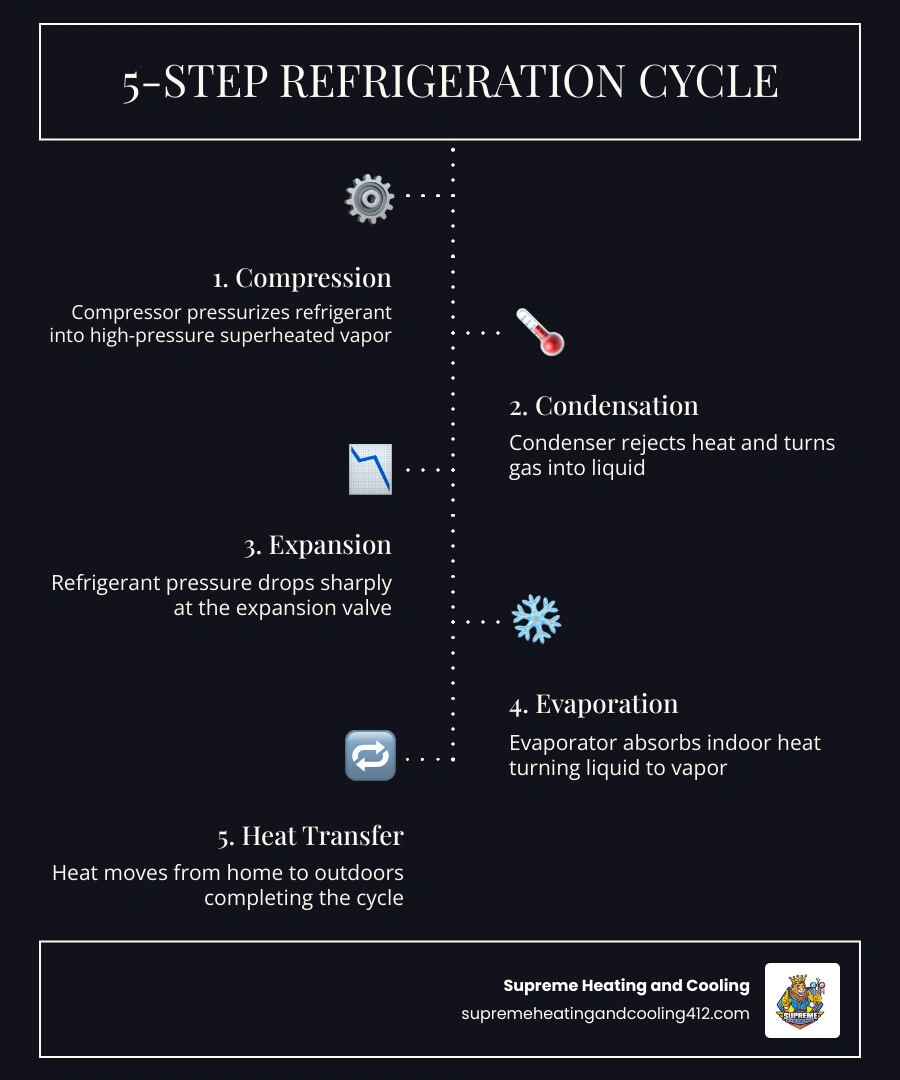
The Refrigeration Cycle: How the Compressor Evaporator and Condenser Function Together
The magic of modern air conditioning relies on the vapor-compression cycle. This is a continuous loop where refrigerant travels between your indoor and outdoor units, changing from a liquid to a gas and back again. This "phase change" is vital because, as we know from physics, liquids absorb a massive amount of heat when they evaporate into gas, and gases release that heat when they condense back into liquid.
The cycle is designed for two main missions: heat absorption (inside) and heat rejection (outside). If any one of the three main components fails to do its job, the entire cycle breaks down. This is why The Importance of Air Conditioner Maintenance cannot be overstated. When we perform a tune-up in places like Monroeville or Bethel Park, we are essentially ensuring that the thermodynamics of this cycle are perfectly balanced.
How the compressor evaporator and condenser function in residential split systems
In a typical residential "split system"—the kind most of us have in Pennsylvania—the components are split between an indoor unit (usually in the basement or a closet) and an outdoor unit. These two halves are connected by copper tubing called "line sets."
The refrigerant flows through these tubes, carrying heat like a conveyor belt. The evaporator sits inside, the condenser and compressor sit outside, and the refrigerant acts as the vehicle. If there is a blockage or a mechanical failure, you'll need AC Repair Optimal Performance to get the heat moving again.
How the compressor evaporator and condenser function to maintain efficiency
Efficiency in an HVAC system is often measured by the Coefficient of Performance (COP). Most residential systems achieve COP values between 2 and 5. This means for every unit of electricity the system uses, it moves 2 to 5 units of heat.
To maintain this efficiency, the system relies on "latent heat"—the energy required to change a substance's state without changing its temperature. By perfectly timing these phase changes, your AC can move huge amounts of energy with relatively little electricity. However, if the refrigerant level is off, efficiency plummets. If you suspect your system is struggling, check out our AC Freon Leak Ultimate Guide to see if a leak is sabotaging your comfort.
The Compressor: Pressurizing the System for Heat Transfer

If the refrigeration cycle is the "circulatory system" of your AC, the compressor is the heart. Located in the outdoor unit, its job is to take low-pressure, cool refrigerant gas from the indoor unit and squeeze it.
When you compress a gas, its temperature rises significantly. The compressor turns the refrigerant into a high-pressure, high-temperature "superheated vapor." This step is crucial because, for heat to leave the refrigerant and enter the outside air, the refrigerant must be hotter than the air outside—even on a 90°F day in Fox Chapel! To keep this "heart" beating strongly, we recommend following these AC Compressor Maintenance Tips.
Common Types of Compressors
Not all compressors are built the same. Depending on the age and type of your system, you might have one of the following:
- Reciprocating: These use pistons and valves, much like a car engine. They are common in older or smaller units.
- Scroll: Most modern residential units use scroll compressors. They use two spiral-shaped pieces to compress the gas more quietly and efficiently.
- Rotary Screw: Usually found in large commercial buildings, these use two interlocking rotors.
- Centrifugal: These are for very large industrial applications, using high-speed impellers.
- Inverter/Variable Speed: This is the gold standard in 2026. Instead of just being "on" or "off," these compressors can slow down or speed up to match your cooling needs exactly, saving a ton of energy.
The Condenser: Converting Gas to Liquid and Rejecting Heat
Once the compressor has turned the refrigerant into a hot, high-pressure gas, it heads into the condenser coil. This is the large outdoor coil wrapped around your unit. As a large fan pulls outdoor air across these finned coils, the heat from the refrigerant is rejected into the atmosphere.
As the refrigerant loses heat, it undergoes a phase change, condensing from a gas back into a "saturated liquid." To ensure the system runs smoothly, we often look for "subcooling." This means the liquid is cooled several degrees below its boiling point, ensuring that only pure liquid—no gas bubbles—heads back toward the indoor unit. Keeping the area around your outdoor unit clear is vital; otherwise, the heat has nowhere to go. Also, don't forget that AC Condensate Drain Maintenance is part of keeping the whole system clean and functional.
The Role of Subcooling in System Reliability
Subcooling is like an insurance policy for your AC. By cooling the liquid refrigerant further, we protect the expansion device from "flash gas," which can cause erratic cooling and noise. When we service homes in Greensburg or Penn Hills, we check these subcooling levels to make sure your system is rejecting heat as efficiently as possible.
The Evaporator: Absorbing Indoor Heat and Humidity
Now we reach the "business end" of the cycle: the evaporator. Usually tucked away inside your furnace or air handler, the evaporator coil is where the actual cooling happens.
Cold, low-pressure liquid refrigerant enters the evaporator. Your indoor blower fan pushes warm house air over these cold coils. The refrigerant is so cold that it absorbs the heat from your air almost instantly. This causes the refrigerant to boil and turn back into a gas. This is why AC Evaporator Coil Care is so important—if the coils are dirty, they can't absorb heat effectively, and your house stays warm.
Moisture Removal and Dehumidification
A wonderful side effect of the evaporator's job is dehumidification. As warm, humid air from your home hits the cold evaporator coils, the moisture in the air condenses into water droplets—just like a cold soda can "sweats" on a humid day. This water collects in a drain pan and is piped away. This is why your AC doesn't just make the air cooler; it makes it feel "crisper" and more comfortable by lowering the humidity.
The Expansion Valve: Regulating Refrigerant Flow
While the compressor, condenser, and evaporator are the "big three," they couldn't work without the expansion valve (often a TXV or EEV). Think of this as the "nozzle" on a spray bottle.
The expansion valve sits just before the evaporator. It takes the high-pressure liquid from the condenser and forces it through a small opening, causing a sudden drop in pressure. This "adiabatic flash evaporation" instantly cools the refrigerant to its coldest point. The valve also acts as a brain, metering exactly how much refrigerant enters the evaporator based on the heat load in your home. It ensures that all the liquid turns into gas before it leaves the evaporator, which is vital because liquid refrigerant can destroy a compressor if it "slugs" back into the outdoor unit.
Comparing Components: Differences in Function and Location
To help visualize how the compressor, evaporator, and condenser function in relation to one another, here is a quick comparison table:
| Feature | Condenser (Outdoor) | Evaporator (Indoor) |
|---|---|---|
| Location | Outside your home | Inside (Furnace/Air Handler) |
| Primary State Change | Gas to Liquid (Condensing) | Liquid to Gas (Evaporating) |
| Heat Action | Rejects heat to the outdoors | Absorbs heat from the indoors |
| Pressure Level | High Pressure | Low Pressure |
| Refrigerant State | Hot vapor entering, warm liquid leaving | Cold liquid entering, cool vapor leaving |
Frequently Asked Questions about AC Components
What happens if the compressor fails?
The compressor is the most expensive and critical part of your system. If it fails, the refrigerant stops moving, and your AC will blow warm air. Often, a failing compressor will make loud grinding noises or cause your circuit breaker to trip. Because it's a sealed unit, a failed compressor usually requires a major repair or a full system replacement.
Why is the condenser located outside?
The condenser's job is to dump the heat collected from inside your house. If the condenser were inside, it would simply be releasing the heat back into your living room, achieving nothing! By placing it outside, we can use the outdoor air as a "heat sink" to absorb the energy your system has removed from your home.
How does the evaporator remove humidity?
Humidity removal is a natural part of the cooling process. When air hits the cold evaporator coils (which are usually around 40-45°F), it reaches its "dew point." The moisture in the air can no longer remain a vapor and turns into liquid water on the coils. This water then drips into a pan and is safely drained out of your home.
Conclusion
At Supreme Heating and Cooling, we believe that a well-informed homeowner is a happy homeowner. Knowing how the compressor, evaporator, and condenser function helps you understand why regular filter changes and professional tune-ups are so important for your comfort and your wallet.
Whether you are in Pittsburgh, Monroeville, Bethel Park, Fox Chapel, Greensburg, or Penn Hills, our team is here to ensure your refrigeration cycle is running at peak efficiency. We pride ourselves on our trustworthy, non-pushy service and our commitment to keeping Pennsylvania families comfortable all year round.
If your system is making strange noises, failing to keep up with the summer heat, or if you just want the peace of mind that comes with a professional inspection, we are here to help. Schedule your professional AC service today and let us take the "heat" out of your HVAC worries!


.svg)
.webp)
.svg)
