.svg)

.webp)

The Low-GWP Refrigerant Shift Is Already Here — Is Your Home Ready?
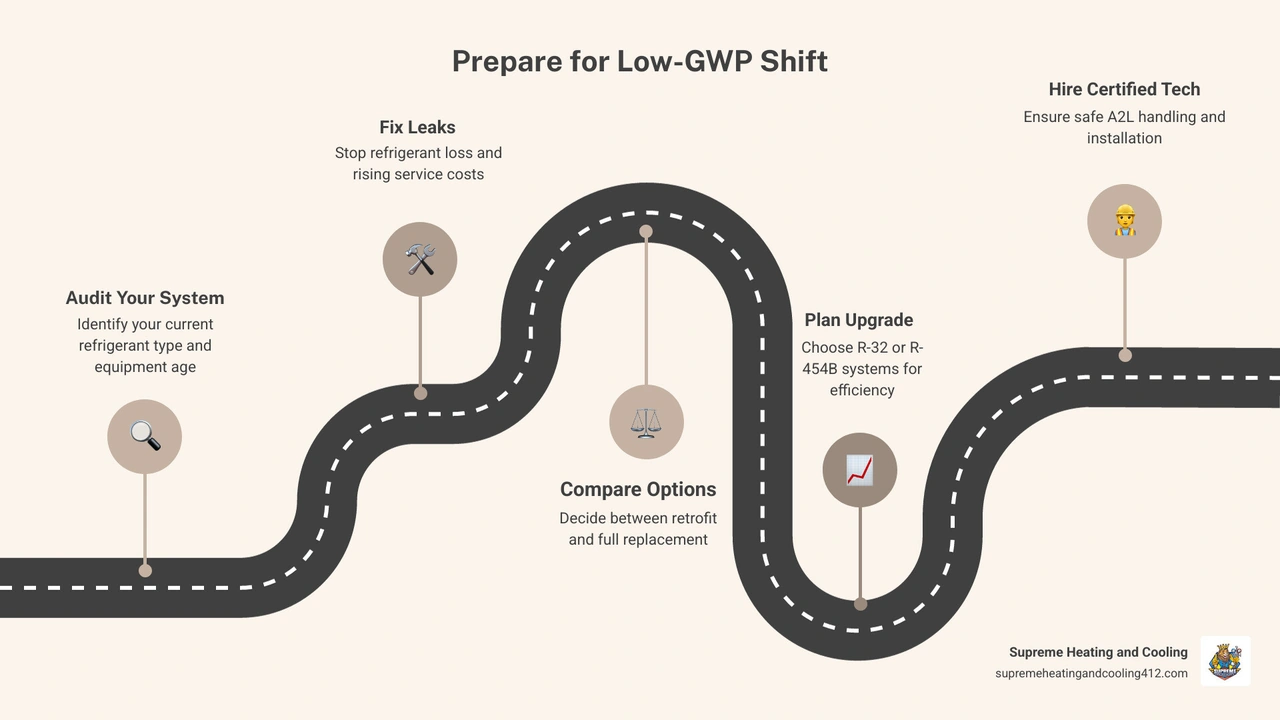
How to prepare for the shift to low GWP refrigerants starts with five clear steps every Pittsburgh-area homeowner should take now:
- Audit your current system — Find out what refrigerant your AC uses and how old the equipment is.
- Fix any existing leaks — Leaking refrigerant wastes money and accelerates your exposure to rising service costs.
- Evaluate retrofit vs. replacement — Not every system can be updated; some are better replaced with a low-GWP unit.
- Plan your equipment upgrade — New systems using R-32 or R-454B are already on the market and ready to install.
- Work with a certified local HVAC professional — A2L refrigerants require specific handling, so choosing the right technician matters.
If your home's air conditioner still runs on R-410A — and most do — you're already feeling the early effects of one of the biggest shifts the HVAC industry has seen in decades. R-410A carries a Global Warming Potential (GWP) of 2,088, which is over 2,000 times more potent than carbon dioxide as a greenhouse gas. Under the EPA's AIM Act, production of high-GWP refrigerants like R-410A has been steadily cut, and new equipment using it has been banned since January 2025.
That's not a distant deadline anymore — it's already in effect.
By late 2025, R-410A prices had risen to roughly 3.3 times their 2014 levels at the consumer end, and even higher at the distributor level. The next major production cut arrives in 2029, and experts expect that step-down to push costs even higher. For homeowners in Pittsburgh and across Pennsylvania, that means the cost of simply maintaining an older R-410A system is going to keep climbing — while newer, more efficient low-GWP alternatives are already available and ready to install.
The good news? You don't have to figure this out under pressure. Acting now — before supply tightens further — puts you in control of the timeline and the costs.
Understanding the Regulatory Timeline and the Low-GWP Transition
To grasp why this shift is happening, we have to look at the global and national policies driving it. Globally, approximately 80% of hydrofluorocarbons (HFCs) are emitted in the refrigeration, air conditioning, and motor vehicle AC sectors. Because these gases are incredibly powerful greenhouse gases, governments around the world agreed to phase them down under the Kigali Amendment to the Montreal Protocol.
In the United States, this phase-down is enforced by the Environmental Protection Agency (EPA) through the American Innovation and Manufacturing (AIM) Act. The AIM Act directs the EPA to phase down HFC production and consumption by 85% by 2036.
At the same time, international policies like the European Union's F-Gas Regulation (Regulation 2024/573) are pushing even stricter limits. For example, the EU F-Gas rules slashed permitted HFC supply for 2025–2026 to about 42.9 million tonnes of CO₂-equivalent—a massive 48% drop below the 2023 reference level. The EU has also set aggressive thresholds, such as a GWP limit of 750 for single-split air conditioners and a strict sub-150 GWP limit for residential splits starting in 2029.
While those European targets are highly aggressive, they show the direction the global market is moving. Here in Pennsylvania, our transition is governed by the EPA's timelines, which are reshaping how we heat and cool our homes. To understand how these changes will impact the equipment in your basement or backyard, check out our guide on The Future of Air Conditioning: Innovations and Sustainability.
Why the EPA is Phasing Out R-410A in Pennsylvania
For over two decades, R-410A was the standard refrigerant for residential heat pumps and central air conditioners. It replaced R-22 (commonly known as Freon) because R-410A does not deplete the ozone layer. However, as environmental science advanced, the focus shifted from ozone depletion to Global Warming Potential.
GWP is a relative measure of how much heat a greenhouse gas traps in the atmosphere over a 100-year period compared to carbon dioxide, which has a GWP baseline of 1.
- R-410A has a GWP of 2,088. This means releasing one pound of R-410A into the air has the same warming impact as releasing more than a ton of CO₂.
- R-22 had a GWP of 1,810 (plus its ozone-depleting properties).
Because of this high warming potential, the EPA mandated that starting January 1, 2025, all newly manufactured residential air conditioning and heat pump systems must use refrigerants with a GWP of 700 or less. Since R-410A sits way above this threshold, its era in new equipment has officially ended. If you are curious about how proper maintenance helps minimize these environmental impacts, take a look at our article on Air Conditioning Maintenance: How to Reduce the Environmental Impact.
How to Prepare for the Shift to Low GWP Refrigerants by Knowing the Deadlines
Navigating the transition requires keeping an eye on a few critical milestones.
- January 1, 2025 (The Manufacturing Ban): New residential AC units and heat pumps can no longer be manufactured or imported if they use refrigerants with a GWP of 700 or higher.
- January 1, 2026 (The Installation Deadline): In most cases, components and systems designed for high-GWP refrigerants like R-410A can no longer be installed in new residential applications.
- 2029 (The Steepest Step-Down): Under the AIM Act, HFC production allowances will drop from 60% of the baseline down to just 30%. This 50% drop in supply is expected to create a significant "quota squeeze," making virgin R-410A much harder to find and far more expensive.
For homeowners in places like Monroeville, Bethel Park, and Fox Chapel, this means that while you do not have to pull a perfectly running R-410A system out of your home, servicing it when a leak occurs will become increasingly costly. Preparing now ensures you aren't left in a hot, humid Pennsylvania July with a broken AC and an astronomical repair bill.
What Are Low-GWP Refrigerants and How Do They Compare?
The HVAC industry didn't just eliminate R-410A; manufacturers spent years developing and testing safer, highly efficient alternatives. The primary replacements for residential cooling are classified as A2L refrigerants.
To understand what "A2L" means, we look at the standard safety classifications:
- Class A indicates low toxicity.
- Class 1 means no flame propagation (like R-410A).
- Class 2L means "mildly flammable" with a slow burning velocity (less than 10 cm/second) and a high lower flammability limit (LFL).
- Class 3 represents highly flammable hydrocarbons (like propane).
| Refrigerant | GWP Value | Safety Class | Temperature Glide | Primary Residential Use |
|---|---|---|---|---|
| R-410A | 2,088 | A1 (Non-flammable) | 0.1°C (Near-azeotropic) | Legacy systems (Pre-2025) |
| R-32 | 675 | A2L (Mildly Flammable) | 0°C (Single-component) | Modern mini-splits & ACs |
| R-454B | 466 | A2L (Mildly Flammable) | ~1.5°C (Zeotropic blend) | Central ACs & Heat Pumps |
| R-290 (Propane) | 3 | A3 (Highly Flammable) | 0°C (Pure hydrocarbon) | Small self-contained units |
These new alternatives offer excellent thermodynamic properties. For instance, R-32 delivers 5% to 8% better operating efficiency than R-410A and requires about a 30% smaller charge volume to achieve the same cooling capacity. To learn more about how sustainable modern cooling repairs and systems have become, read our post on Eco-Friendly AC Repair: Sustainable HVAC Solutions.
Mildly Flammable A2L Alternatives: R-32 and R-454B
R-32 and R-454B are the clear front-runners for residential systems in Western Pennsylvania.
- R-32 (GWP 675): Developed extensively by global manufacturers like Daikin (which has installed over 280 million R-32 units worldwide since 2012), R-32 is a single-component refrigerant. This means it has zero temperature glide, making it incredibly easy to charge and reclaim because the gas doesn't separate into different components.
- R-454B (GWP 466): This is a zeotropic blend of R-32 and R-1234yf. With a GWP of 466, it sits well below the EPA's 700 GWP limit and provides a very close match to the operating pressures of R-410A, making it a favorite for major North American central air conditioning manufacturers.
Because A2L refrigerants are mildly flammable, safety standards like ASHRAE 15 and UL 60335-2-40 dictate how these systems are built. They include built-in safety features, such as leak detection sensors that automatically activate the indoor blower fan to safely disperse any leaking gas long before it can reach a concentration that could ignite.
Natural Refrigerants: R-290, R-744, and R-717
Natural refrigerants are substances that occur naturally in our environment. While they are highly popular in commercial and industrial applications, their residential use remains limited due to safety regulations.
- R-290 (Propane - GWP 3): Propane is an outstanding refrigerant with a GWP of nearly zero. However, because it is highly flammable (A3), safety standards limit its charge size. Under standards like EN IEC 60335-2-89, the charge limit for self-contained commercial systems recently rose from 150g to 500g, but for whole-house residential ducted systems, the charge required is too large to safely use indoors under current codes.
- R-744 (Carbon Dioxide - GWP 1): CO₂ is non-toxic and non-flammable, but it operates at extremely high pressures (often over 1,000 psi in transcritical mode). While there were over 50,000 transcritical CO₂ systems running in European retail stores by the end of 2025, the high system complexity and cost make it impractical for typical home central air conditioners.
- R-717 (Ammonia - GWP 0): Ammonia is highly efficient but carries high toxicity (Class B2L). It is strictly reserved for industrial cold storage facilities and large-scale commercial chillers where dedicated safety systems and trained operators are present.
How to Prepare for the Shift to Low GWP Refrigerants
Now that you know the "why" and the "what," let's talk about the "how." Transitioning your home to a low-GWP system doesn't have to be a headache. With a little proactive planning, you can ensure your family stays cool and comfortable without facing surprise expenses down the road. For more details on choosing sustainable home comfort solutions, check out our article on Eco-Friendly Options with Heating Contractors for a Sustainable Home.
How to Prepare for the Shift to Low GWP Refrigerants: A 5-Step Homeowner Guide
Whether you live in Greensburg, Penn Hills, or Pittsburgh, managing this transition comes down to a structured approach. If you suspect your current system is already losing charge, start by reading our AC Freon Leak Ultimate Guide to understand what you might be facing.
Step 1: Audit Your Existing Home HVAC System
You can't plan for the future until you know what you currently have. Step one is to step outside and look at the technical data plate on your outdoor air conditioner or heat pump condenser.
Write down:
- The Refrigerant Type: It will typically say R-22, R-410A, or possibly R-407C.
- The Manufacture Date: If your system was built before 2010, there is a high chance it runs on R-22. If it was built between 2010 and 2024, it almost certainly uses R-410A.
- The General System Health: Have you noticed weak airflow, long run times, or strange noises?
Knowing these details helps you understand your system's risk profile. If you want to dive deeper into how refrigerant issues present themselves, read our guide on AC Freon Leak.
Step 2: Address Existing Leaks and Maintenance Issues
If your system has a slow, persistent leak, ignoring it is no longer an option. Because R-410A production is capped, the cost of adding "top-off" gas during a service call will continue to climb. Furthermore, running a system low on refrigerant causes the compressor to run hotter and work harder, leading to premature mechanical failure and higher electric bills.
If you suspect a leak, have a professional perform electronic leak detection and repair the physical tubing rather than just refilling the system. To understand why simple "recharges" are often a temporary bandage, read about AC Refrigerant Leak in Homes and what to do if you have a Heat Pump Refrigerant Leak.
Step 3: Evaluate Retrofit vs. Replacement Options
A common question we hear from homeowners in Plum and Oakmont is: "Can you just drain my R-410A and put R-454B or R-32 in its place?"
The short answer is no.
A2L refrigerants are not "drop-in" replacements for older systems. R-32 and R-454B operate at different pressures, require different compressor lubricants, use different expansion valve calibrations, and require specific electrical components designed to prevent sparks. Putting an A2L refrigerant into a system designed for R-410A is a serious safety hazard and will void your manufacturer's warranty.
If your R-410A system is less than 8 to 10 years old and in excellent health, your best option is to maintain it carefully and address leaks promptly. If your system is over 12 years old and experiencing AC Refrigerant Pressure Problems, investing in a full system replacement is almost always the more cost-effective long-term decision.
Step 4: Plan Your Equipment Upgrades with Low-GWP Alternatives
If you are planning to replace your air conditioner or heat pump, look specifically for systems designed for R-454B or R-32.
Upgrading to a modern low-GWP system offers several advantages:
- Lower Energy Bills: These new systems often provide a 10% to 20% improvement in energy efficiency compared to older R-410A units.
- Future-Proof Servicing: Because these refrigerants are the new industry standard, you won't have to worry about supply shortages or soaring service costs for the next 15 to 20 years.
- Environmental Peace of Mind: You are significantly reducing your home's potential carbon footprint.
Step 5: Partner with a Certified Local HVAC Professional
Because A2L refrigerants are mildly flammable, they require specialized tools and training to install and service. Technicians must use spark-proof recovery machines, digital manifolds calibrated for A2L pressure curves, and sensitive leak detectors specifically rated for mildly flammable gases.
When choosing a contractor in communities like Glenshaw, Swissvale, or Upper Saint Clair, ensure their technicians are fully trained and certified in A2L safety standards. Working with a knowledgeable, friendly, and non-pushy team ensures your new system is installed safely, keeping your home compliant with all local building and fire codes.
Safety Standards and Equipment Requirements for A2L Systems
Because A2L refrigerants carry a mild flammability rating, the safety standards governing their installation are much more rigorous than those for older A1 systems. Industry standards like ASHRAE 15 and EN 378 establish strict rules regarding where equipment can be located and how much refrigerant charge can be safely used based on the square footage of your home.
When installing a new A2L system, professional technicians must follow precise procedures:
- Ignition Source Control: All electrical components within the outdoor condenser and indoor air handler must be sealed or spark-proof to prevent any potential ignition in the highly unlikely event of a major leak.
- Integrated Safety Sensors: Many larger A2L systems feature built-in leak detection sensors. If a leak is detected, the sensor immediately shuts down the compressor and turns on the indoor fan to safely circulate and dilute the refrigerant.
- Brazing Safety: Technicians must purge the lines with nitrogen while brazing to prevent copper oxidation and ensure completely leak-tight joints.
These safety measures make modern A2L systems incredibly safe for residential use. To make sure you get honest, reliable service without being misled about how these systems operate, read our article on Don't Get Fooled: Understanding AC Leaks and Refills.
Frequently Asked Questions About the Low-GWP Transition
Can I still service my existing R-410A air conditioner after 2026?
Yes, you can absolutely still service your existing R-410A system. The EPA's regulations ban the manufacture and installation of new R-410A systems, but they do not outlaw the use of existing units. You can continue to repair and recharge your current AC using reclaimed or recovered R-410A. However, keep in mind that as the HFC quota phase-down continues toward the 2029 milestone, the cost of R-410A refrigerant will continue to rise. For more information on dealing with legacy system leaks, see our AC Freon Leak Ultimate Guide.
Is it safe to have an A2L mildly flammable refrigerant in my home?
Yes, A2L refrigerants are exceptionally safe. The "mildly flammable" classification means they are incredibly difficult to ignite. In fact, it takes a highly concentrated leak combined with a direct, open flame to cause ignition. Normal household items like light switches, wall outlets, or standard appliances do not produce enough energy to ignite an A2L gas. When combined with the factory-installed safety sensors and sealed electrical components in modern units, the risk of any fire hazard is virtually non-existent.
How do I know if my current AC has a refrigerant leak?
Refrigerant systems are completely sealed, meaning they should never "lose" gas over time. If your system is low, it has a physical leak. Common signs of a leak include:
- Warm Air Blowing from Vents: The system runs, but the air coming from your registers isn't cold.
- Ice on the Coils: Low refrigerant pressures cause the indoor evaporator coil to drop below freezing, causing condensation to freeze solid on the copper tubing.
- Hissing or Bubbling Noises: A physical puncture in the line often makes an audible sound near the indoor or outdoor unit.
- Longer Run Cycles: Your AC runs constantly without ever reaching the temperature set on your thermostat.
If you notice any of these issues, consult our guide on AC Refrigerant Leak in Homes to learn more about your next steps.
Conclusion
The shift to low-GWP refrigerants is a positive step forward for our environment, bringing highly efficient technology into our homes. By taking the time to audit your current system, address existing leaks, and plan ahead for your next upgrade, you can avoid emergency expenses and enjoy reliable comfort for years to come.
At Supreme Heating & Cooling, we serve homeowners across the greater Pittsburgh region—including Monroeville, Bethel Park, Fox Chapel, Greensburg, Penn Hills, and surrounding communities. Our friendly, knowledgeable, and non-pushy team is always here to help you navigate these regulatory changes with honest advice and competitive pricing.
Ready to make sure your home is prepared for the transition? Contact us today to schedule a professional system audit or learn more about our eco-friendly air-conditioning solutions!


.svg)
.webp)
.svg)
