.svg)

.webp)

What Every Pittsburgh Homeowner Should Know About How Their AC Works
How your air conditioner works explained simply comes down to one core idea: your AC doesn't create cold air — it moves heat out of your home.
Here's a quick breakdown:
- Warm indoor air is pulled across a cold evaporator coil inside your home
- Refrigerant inside that coil absorbs the heat and evaporates into a gas
- The compressor pressurizes that gas, concentrating the heat
- The condenser coil outside releases that heat into the outdoor air
- The refrigerant cools back into a liquid and the cycle starts over
That's it. Your AC is essentially a heat-transfer machine running on repeat.
Most people assume their AC is pumping cold air in, similar to the way a heater pumps warm air in. But the science works the other way around. When Willis Carrier invented the first modern air conditioning system on July 17, 1902, the breakthrough wasn't about making cold — it was about moving heat. That same principle powers every AC unit keeping Pittsburgh homes comfortable today.
Understanding how this process works helps you spot problems early, use your system more efficiently, and have more informed conversations with your HVAC technician when something goes wrong.
The Science of Cooling: How Your Air Conditioner Works Explained Simply
To understand your cooling system, we have to look at a few "remarkable" laws of physics. The most important one is phase conversion. This is a fancy way of saying that when a liquid turns into a gas (evaporation), it absorbs a massive amount of heat. Think about how you feel cold when you step out of a swimming pool on a breezy day in Monroeville; that's the water on your skin evaporating and taking your body heat with it.
Your AC uses this exact principle but does it inside a closed loop of copper pipes. Another key rule is the Second Law of Thermodynamics, which states that heat always travels from a warmer object to a cooler one. By making the coils inside your home colder than the air, we force the heat to jump into the system. By making the coils outside hotter than the Pittsburgh summer air, we force the heat to jump out.

If this closed loop ever breaks, you might experience a drop in cooling power. If you suspect your system is losing its "cooling juice," check out our AC Freon Leak Guide to see what steps to take next.
Understanding the Refrigeration Cycle Explained Simply
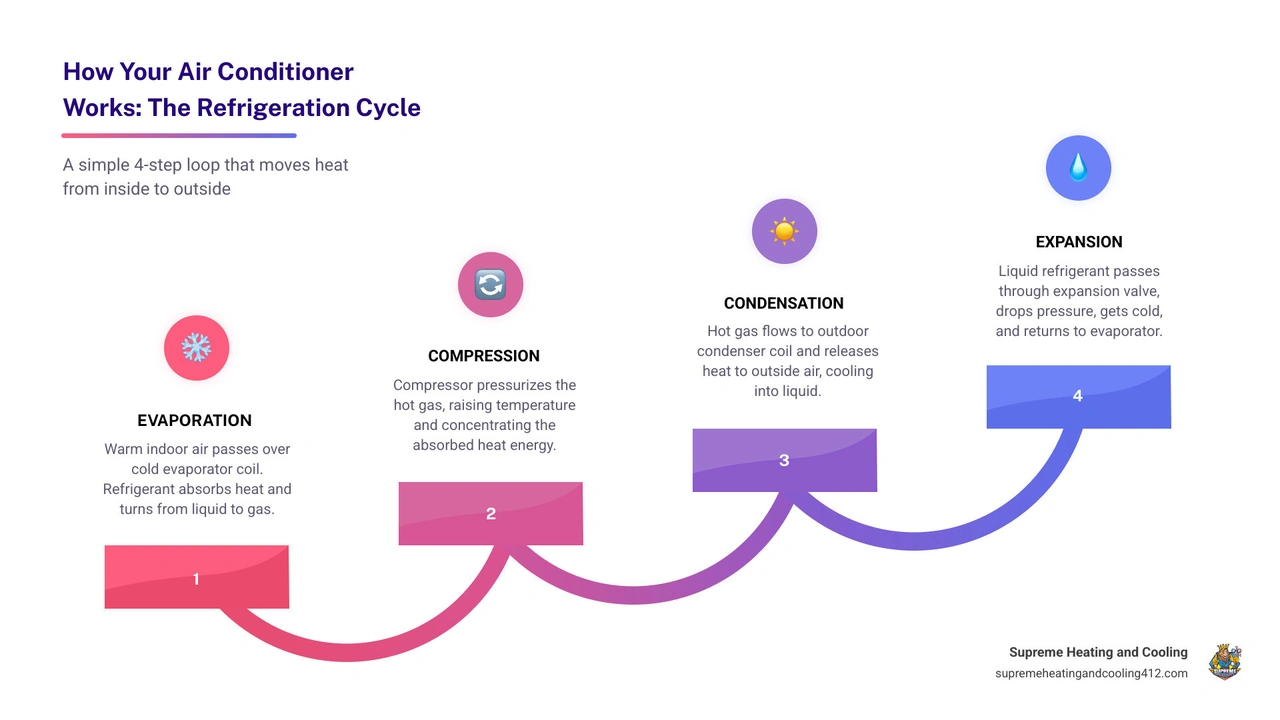
The refrigeration cycle is an endless, elegant loop consisting of four main stages: evaporation, compression, condensation, and expansion.
During evaporation, the indoor unit absorbs thermal energy from your living room. During compression and condensation, that energy is moved and rejected outdoors. Finally, during expansion, the pressure is released, chilling the refrigerant so it can head back inside to grab more heat. It is a continuous relay race where "heat" is the baton being passed from your sofa to the backyard.
The Role of Refrigerant in Your Home
Refrigerant is a specialized chemical compound designed to have an incredibly low boiling point. While water boils at 212°F, some refrigerants boil at temperatures well below zero. This allows them to stay in a "ready" state to absorb heat even when your home feels relatively cool.
In May 2026, we are seeing more environmentally friendly refrigerants than ever before, following international agreements like the Montreal Protocol. These chemicals act as the "workhorse" of your system, flowing through a sealed environment to ensure no heat is left behind.
The Core Components: Meet the Team Inside Your AC
Your air conditioner isn't just one big box; it’s a team of components working in perfect synchronization. In a standard split-system common in places like Bethel Park or Fox Chapel, these parts are split between an indoor unit (often in your basement or attic) and an outdoor unit.
- The Evaporator Coil: Located inside, this is where the "cooling" happens.
- The Compressor: The "heart" located in the outdoor unit.
- The Condenser Coil: The outdoor radiator that releases the heat.
- The Expansion Valve: The "brain" that regulates refrigerant flow.
- The Blower Fan: The muscles that move air through your ductwork.
Keeping these parts clean is vital. For example, the indoor portion needs specific attention to maintain airflow. You can learn more about this in our guide on AC Evaporator Coil Care.
Why the Compressor is the Heart of the System
Without the compressor, the heat would have nowhere to go. Its job is to take the warm, low-pressure gas coming from your home and squeeze it. When you compress a gas, its temperature rises significantly.
The compressor raises the refrigerant temperature to about 120°F or higher. Why? Because if it’s 90°F outside in Greensburg, the refrigerant must be hotter than the outside air for the heat to escape. If your compressor starts making strange sounds, it could be a sign of mechanical distress. If you hear something off, read our article on Why AC Makes Grinding Noises to troubleshoot the sound.
Evaporator vs. Condenser Coils
These two coils look similar—lots of copper tubing and aluminum fins—but they have opposite jobs.
| Feature | Evaporator Coil (Indoor) | Condenser Coil (Outdoor) |
|---|---|---|
| Primary Job | Absorbs heat from indoor air | Rejects heat into outdoor air |
| Refrigerant State | Changes from liquid to gas | Changes from gas to liquid |
| Temperature | Very cold (approx. 40°F) | Very hot (approx. 120°F+) |
| Location | Inside the air handler/furnace | Inside the outdoor metal cabinet |
Step-by-Step: The Refrigeration Cycle in Action
Let’s walk through the journey of heat as it leaves your home. This process happens thousands of times a day during a humid Pennsylvania summer.
- Warm Air Intake: Your blower fan pulls warm air from your rooms through return ducts.
- Absorption: This air passes over the cold evaporator coils. The refrigerant inside "drinks up" the heat.
- Evaporation: As it absorbs heat, the refrigerant turns from a cold liquid into a cool gas.
- Compression: The gas travels to the outdoor unit where the compressor squeezes it into a hot, high-pressure vapor.
- Dissipation: The outdoor fan blows air across the condenser coils, and the heat escapes into the backyard.
- Expansion: The now-liquid refrigerant passes through an expansion valve, which drops the pressure (and temperature) instantly—a process called "flashing"—and sends it back inside to start over.
For a deeper look at how these systems integrate with your home's existing infrastructure, see our post on How Air Conditioners Work.
How Your Air Conditioner Works Explained Simply to Remove Humidity
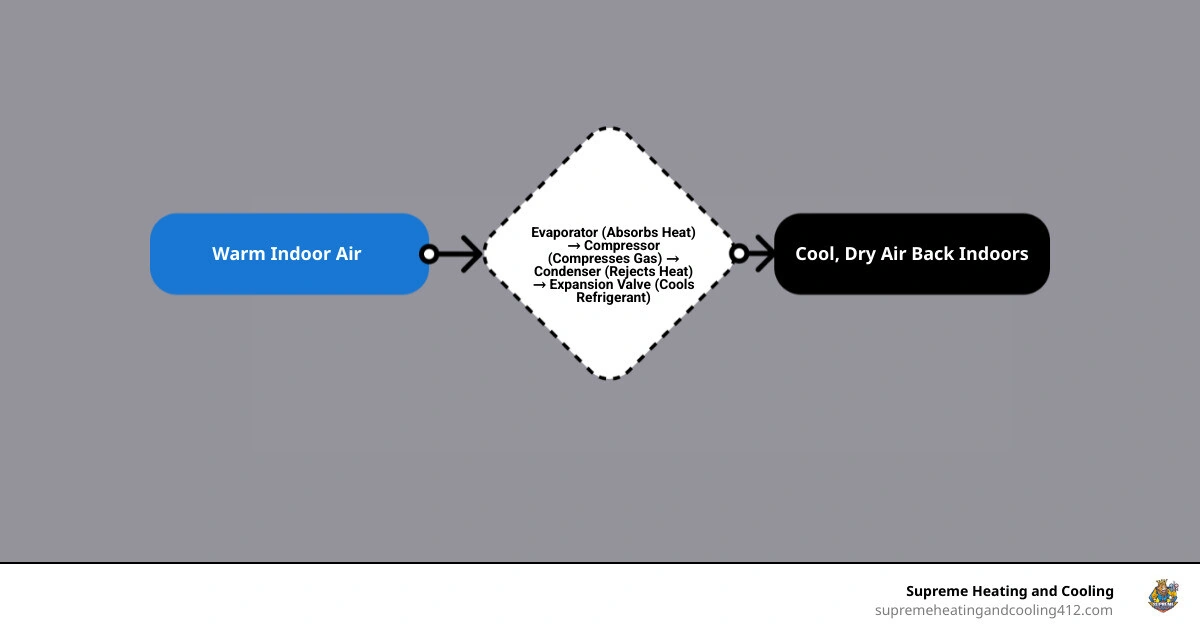
Have you ever noticed your AC unit "sweating" or a PVC pipe dripping water outside? That’s actually a sign the system is working! As warm, moist air from your home hits the freezing-cold evaporator coil, the air reaches its "dew point."
Just like a cold can of soda sweats on a picnic table in Penn Hills, moisture from your indoor air condenses into liquid water on the coils. This water drips into a pan and flows out through a condensate drain line. This dehumidification is just as important as the cooling; drier air feels much more comfortable, even at higher temperatures.
Why Your AC Doesn't Pull in Outside Air
A common myth is that your AC brings in "fresh" air from outside. In reality, your AC is a recirculation system. It takes the air already inside your home, cleans it via a filter, cools it, and sends it back.
This is much more energy-efficient because it’s easier to cool 75-degree indoor air down to 70 than it is to cool 95-degree outdoor air. It also helps maintain better indoor air quality by keeping a sealed environment where pollutants and allergens from outside are filtered out.
Different Systems for Pennsylvania Homeowners
Not every home in the Pittsburgh area is built the same. From historic homes in Swissvale to new builds in Murrysville, different architectures require different cooling solutions.
- Split Systems: The most common residential setup. You have an outdoor "box" and an indoor coil often attached to your furnace.
- Packaged Units: All components are in one outdoor cabinet, usually seen in homes with limited indoor space or on rooftops.
- Ductless Mini-Splits: Perfect for older homes without ductwork. One outdoor unit can connect to up to five indoor "heads," allowing for multi-zone cooling.
- Heat Pumps: These look like AC units but can reverse the cycle to provide heat in the winter—a very popular choice for energy efficiency in May 2026.
Central Air vs. Portable Units
When it comes to power, central air is the heavyweight champion. A standard residential system ranges from 1 to 5 tons of cooling capacity. In HVAC terms, a "ton" is 12,000 BTUs (British Thermal Units) per hour.
Compare the energy usage:
- Window Units: 900–1,440 watts per hour.
- Portable Units: 2,900–4,100 watts per hour.
- Central AC: 3,000–3,500 watts per hour.
While central air uses more total power, it is significantly more efficient at cooling large spaces compared to running multiple portable units.
Choosing the Right Fit for Your Space
The right system depends on your square footage and existing ductwork. Modern systems are rated by SEER2 (Seasonal Energy Efficiency Ratio). As of 2026, the minimum standards have increased to ensure homeowners save more on their monthly bills. A higher SEER2 rating means the unit provides more cooling for every dollar of electricity you spend.
Maintenance for Longevity and Efficiency
An air conditioner is a major investment. On average, a well-maintained system should last 15 to 20 years. However, neglecting it can cut that lifespan in half and send your energy bills through the roof.
The #1 cause of AC failure is restricted airflow. When air can't move, the "heat transfer" stops, and the system works twice as hard to do half the job. Regular AC Maintenance is the best way to prevent these "death by a thousand cuts" issues.
The Importance of Annual Tune-ups
We recommend a professional tune-up once a year, ideally in the spring before the first heatwave hits Pittsburgh. A technician will check refrigerant levels, tighten electrical connections, and flush the condensate drain line. This prevents the common "water in the basement" surprise caused by algae clogs. For more details on what a pro looks for, check our Air Conditioner Maintenance page.
DIY Tips for Better Performance
While internal repairs should be left to the experts at Supreme Heating and Cooling, there are several things you can do to help your system:
- Change Filters Monthly: During peak summer, a dirty filter is your AC's worst enemy.
- The 7-10 Degree Rule: Instead of turning the AC off when you leave for work in Oakmont, just raise the thermostat 7 to 10 degrees. This prevents the house from "heat soaking," making it easier to cool back down later.
- Clear the Perimeter: Keep at least 18 to 24 inches of clearance around your outdoor unit. Remove leaves, grass clippings, and shrubs.
- Check the Fins: If the aluminum fins on your outdoor unit are bent, you can carefully straighten them with a "fin comb" or a butter knife to restore airflow.
Frequently Asked Questions about Air Conditioning
Does an air conditioner actually create cold air?
No. In physics, "cold" is simply the absence of heat. Your AC works by subtracting heat from the air. When you remove the heat energy, the temperature naturally drops. It’s a process of energy transfer, not "cold air" creation.
Is it cheaper to leave my AC on all day?
Generally, yes—if you manage the temperature. It is more cost-effective to let the AC cycle naturally at a slightly higher temperature while you're away than to turn it off entirely. If the walls, furniture, and floors in your home get hot, the AC has to work for hours just to remove the "stored" heat before you even feel a breeze.
Why is my AC freezing up?
If you see ice on your indoor unit, it’s usually because the evaporator coil isn't getting enough heat to "drink." This happens if the air filter is filthy (no air moving over the coil) or if the refrigerant is low. When the coil doesn't have enough heat to absorb, its temperature drops below freezing, and the moisture in the air turns to ice. Turn the system off immediately and call a pro if this happens!
Conclusion
Understanding how your air conditioner works explained simply helps you take better care of your home and your wallet. By moving heat instead of creating cold, your AC performs a daily scientific miracle that keeps your family comfortable through the toughest Pennsylvania summers.
At Supreme Heating and Cooling, we pride ourselves on being the trustworthy, non-pushy experts for our neighbors in Pittsburgh, Monroeville, Bethel Park, and beyond. Whether you need a quick tune-up to keep the refrigeration cycle running smoothly or a brand-new high-efficiency installation, our personable team is here to help.
Don't wait for the next heatwave to find out if your system is up to the task. Schedule your professional air conditioning service today and breathe easy knowing your home comfort is in expert hands.


.svg)
.webp)
.svg)
