
.svg)

.webp)
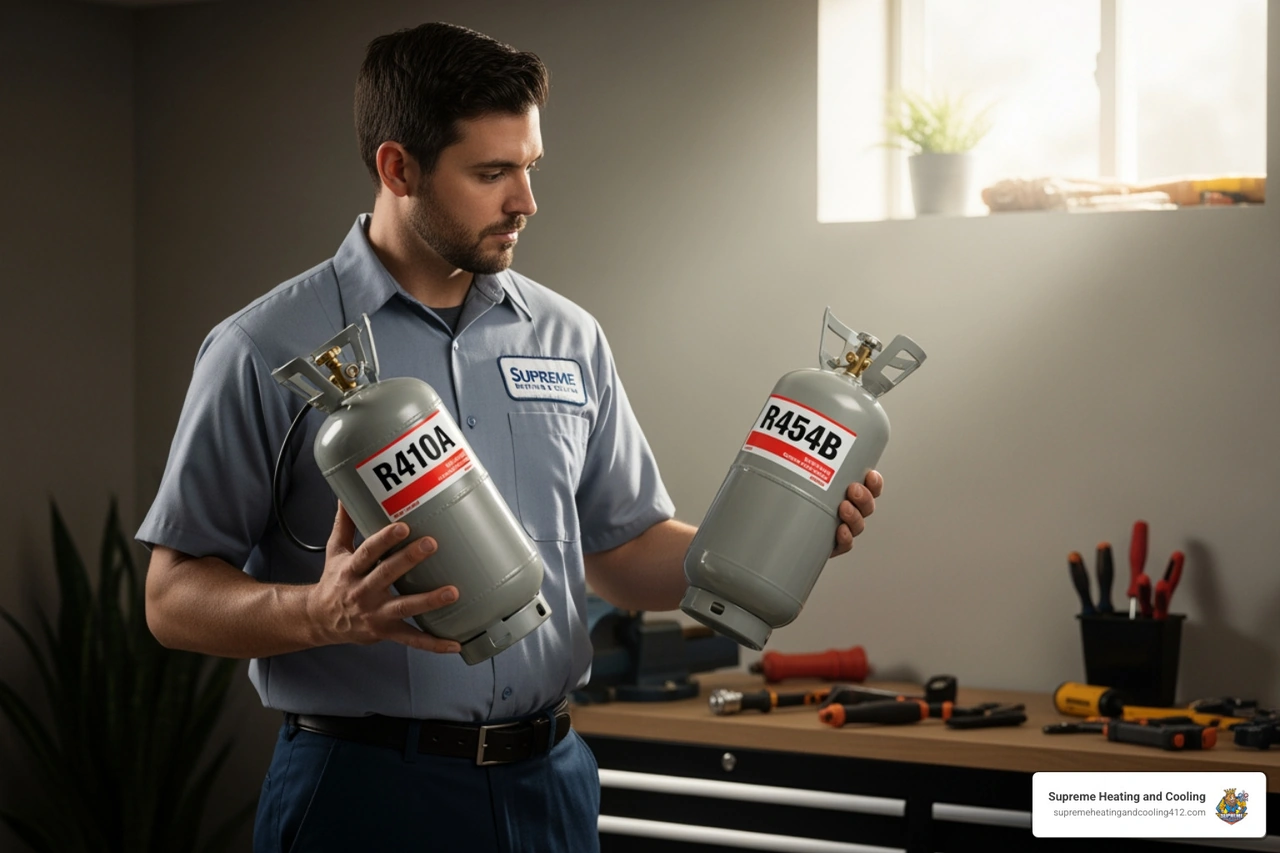
What Homeowners in Pittsburgh Need to Know About R410A vs R454B Refrigerant
If you've been researching r410a vs r454b refrigerant what you need to know, here's the short version: R-410A is being phased out under federal law, and R-454B is the primary replacement in new HVAC systems as of 2025. The two refrigerants are not interchangeable, and understanding the difference matters whether you're repairing an existing system or buying a new one.
Quick Comparison: R-410A vs R-454B
| Feature | R-410A | R-454B |
|---|---|---|
| GWP (Global Warming Potential) | 1,890–2,100 | 466 |
| Safety Classification | A1 (non-flammable) | A2L (mildly flammable) |
| Drop-in Replacement? | - | No |
| Energy Efficiency (COP) | Baseline | 3–5% higher |
| Phase-Out Status | New units banned Jan 1, 2025 | Required for new equipment |
| Operating Pressure | ~400 psig | ~370 psig |
The HVAC industry is going through one of its biggest shifts in decades. The U.S. EPA, under the AIM Act of 2020, has been steadily reducing how much R-410A can be produced and imported. Starting January 1, 2025, manufacturers were no longer permitted to produce or import new R-410A systems for most residential applications. That means if you're buying a new air conditioner or heat pump today, it almost certainly runs on a lower-GWP refrigerant like R-454B.
For homeowners in the Pittsburgh area, this transition raises real questions: What does this mean for your current system? Is your home ready for a new R-454B unit? And what happens when your older R-410A system needs a refrigerant top-off down the road?
This guide breaks it all down in plain language so you can make confident decisions about your home's comfort.
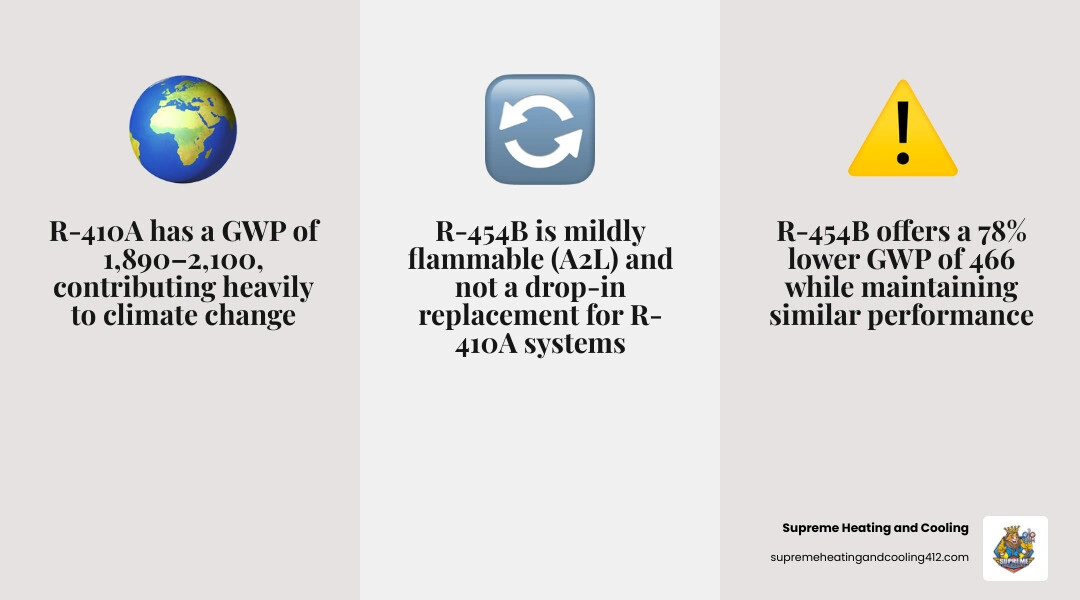
R410A vs R454B Refrigerant: What You Need to Know About the Phase-Out

The biggest reason for the shift from R-410A to R-454B is environmental regulation.
R-410A worked well for years, but it has a very high Global Warming Potential, or GWP. Depending on the source, R-410A is typically listed between 1,890 and 2,100. R-454B comes in at 466. That is roughly a 75% to 78% reduction, which is a major reason it fits current federal requirements for new residential comfort systems.
That does not mean every R-410A system suddenly became illegal in 2025. Existing systems in homes across Pittsburgh, Monroeville, Bethel Park, Fox Chapel, Greensburg, Penn Hills, and surrounding communities can still be serviced. What changed is the manufacture and import of most new R-410A equipment for residential use.
If your current system has a leak, the first priority is still fixing the leak itself, not just adding refrigerant. We cover that in more detail in our AC Freon Leak Ultimate Guide. The refrigerant transition has made proper diagnosis even more important, because repeated top-offs are never a good long-term plan.
Here is the simple side-by-side view:
| Category | R-410A | R-454B |
|---|---|---|
| Environmental impact | Much higher GWP | Much lower GWP |
| Safety class | A1 | A2L |
| Flammability | Non-flammable | Mildly flammable |
| Efficiency | Strong baseline performance | Often slightly higher |
| New system status in 2026 | Legacy refrigerant | Standard for many new systems |
| Use in old R-410A equipment | Designed for it | Not approved as a substitute |
For homeowners, the key takeaway is this: R-410A is now a legacy refrigerant, while R-454B is part of the new-equipment future.
The Role of the AIM Act in 2026
The AIM Act, passed in 2020, set the direction for the HFC phasedown in the United States. HFC stands for hydrofluorocarbon, and R-410A falls into that category. The law aims to cut production and consumption of high-GWP HFCs over time, with an overall long-term phasedown target of 85%.
That is why this transition is not just a manufacturer preference or an industry trend. It is being driven by federal rules that push new comfort-cooling equipment toward refrigerants with much lower climate impact.
As of May 2026, the practical result for homeowners is:
- New residential systems are generally designed around low-GWP refrigerants
- R-410A is still used to service older systems already installed
- Reclaimed and existing supplies of R-410A still matter for repairs
- Leak prevention and proper maintenance are more important than ever
This is also why we always recommend caution around “quick refill” conversations. If your AC is low on refrigerant, something caused that problem. Our article Don't Get Fooled: Understanding AC Leaks and Refills explains why simply adding refrigerant without repairing the leak is usually a temporary bandage, not a real fix.
Understanding R410A vs R454B Refrigerant What You Need to Know for System Efficiency
R-454B is not just about emissions rules. In many applications, it can also deliver a modest efficiency advantage.
Research and field guidance commonly show R-454B with about a 3% to 5% higher COP, or coefficient of performance, compared with R-410A in similar equipment. In plain English, that means it can move heat a little more effectively when the system is properly designed for it.
But there is an important catch: “properly designed” does a lot of work in that sentence.
R-454B may require about 10% to 20% more heat-transfer surface to match the same capacity as an R-410A design. That usually means manufacturers need to make engineering changes in the coil and system layout rather than simply pouring a different refrigerant into the old design and calling it a day.
So yes, R-454B can be very efficient. No, it is not magic AC fairy dust.
If your system is having cooling issues, refrigerant pressures are only one part of the picture. Dirty coils, airflow restrictions, metering problems, and leaks can all affect performance. Our guide on AC Refrigerant Pressure Problems explains how these symptoms can overlap.
Key Differences in Safety and Performance
At a glance, R-410A and R-454B look fairly similar. Both are modern high-pressure refrigerants used in air conditioning and heat pumps. But the differences matter.
Here are the major ones:
- R-410A is an A1 refrigerant, meaning low toxicity and non-flammable
- R-454B is an A2L refrigerant, meaning low toxicity and mildly flammable
- R-454B has a much lower GWP
- R-454B generally operates at slightly lower pressure than R-410A
- R-454B is a zeotropic blend with about 1.5 degrees F of temperature glide
- R-410A behaves more like a near-azeotropic blend with minimal glide
That temperature glide piece is easy to overlook, but it matters. Because R-454B is a blend, its components do not boil and condense at exactly the same temperature. That small glide means charging and service practices must be more controlled. It is one reason R-454B must be handled according to the equipment design and manufacturer procedures.
Some other property differences often cited include:
- Critical pressure: about 673.9 psi for R-454B vs about 711 psi for R-410A
- Boiling point: about -58.9 F for R-454B vs about -55.3 F for R-410A
Those numbers are useful technically, but for most homeowners the bigger practical points are safety classification, environmental impact, and system compatibility.
If you've ever seen iced-over lines or a system struggling to cool, refrigerant problems can be involved, but they are not always caused by the refrigerant type itself. Our article on Freezing AC Refrigerant Lines covers common causes.
Safety Considerations for A2L Refrigerants
R-454B is classified A2L, which means it has low toxicity and mild flammability.
That phrase can sound alarming at first, especially when it is going into a home system. The important context is that A2L refrigerants are designed to be used safely in equipment specifically built for them. They have a low burning velocity and require certain conditions to ignite. In normal residential operation, systems include design safeguards that account for this classification.
In newer R-454B equipment, manufacturers may include features such as:
- Leak detection sensors
- Control boards that trigger blower operation if a leak is detected
- Components selected for A2L system use
- Installation requirements that support ventilation and safe operation
For homeowners, the practical rule is simple: let qualified HVAC professionals handle refrigerant-related service, and never attempt a DIY refrigerant swap or recharge.
If you suspect a refrigerant leak in your home, pay attention to reduced cooling, ice buildup, hissing sounds, or unusually long run times. Our article on AC Refrigerant Leak in Homes explains what to watch for and when to call for help.
R410A vs R454B Refrigerant What You Need to Know Before Your Next Installation
If you're replacing an aging air conditioner or heat pump in 2026, the refrigerant matters because it affects equipment design.
R-454B is not a direct one-for-one copy of R-410A performance inside the same exact machine. To get the right capacity and efficiency, manufacturers often redesign:
- Indoor and outdoor coil sizing
- Compressor selection
- Metering components
- Sensors and control logic
- Safety features for A2L refrigerant use
That 10% to 20% larger heat-transfer surface requirement is one of the most important behind-the-scenes changes. It helps explain why a proper R-454B system can perform very well, but an old R-410A system should not be “converted” casually.
This also means installation quality still matters tremendously. Even the best refrigerant cannot save a poorly installed system with bad airflow, incorrect charge, or duct issues.
If your heat pump may have a refrigerant issue, our Heat Pump Refrigerant Leak article can help you understand the warning signs.
Can I Use R-454B in My Current R-410A System?
In short: no.
R-454B is not a drop-in replacement for an existing R-410A system. You should not remove R-410A from an older unit and recharge it with R-454B.
There are several reasons:
- R-454B is A2L, while older R-410A equipment was designed for A1 refrigerant
- The system components were not approved around that refrigerant's safety classification
- Performance characteristics are different
- Charging procedures are different
- R-454B's temperature glide adds blend-management considerations
- Warranties and code compliance can be affected
- Manufacturers design and list equipment for a specific refrigerant
Even when pressures look somewhat similar, that does not make the refrigerants interchangeable. Similar is not the same. A sedan and a pickup truck both have four tires, but you still would not swap every part between them and expect a happy ending.
For homeowners, the better question is usually:
- If my R-410A system needs repair, is it worth repairing?
- If it needs replacement, should I move to a new R-454B system?
The answer depends on the system's age, condition, leak history, and overall reliability. If your current system only has a minor issue, repair may make sense. If it has major leaks, repeated refrigerant problems, or aging components, replacement may be the smarter long-term path.
If you're dealing with suspected low refrigerant or leaks, our AC Freon Leak page explains how we approach diagnosis and repair.
How the Transition Affects Pennsylvania Homeowners
For homeowners in Pittsburgh and nearby communities, the R-410A to R-454B shift has a few very practical effects.
First, if you already have an R-410A system, you do not need to panic. It can still be serviced in 2026. Existing installed systems are not banned from use just because new equipment rules changed.
Second, refrigerant availability will likely become more of a long-term service consideration. As production allowances tighten over time, R-410A may become less convenient to source than it was during its peak years. That does not mean it disappears overnight, but it does mean leaks become even more costly and frustrating to ignore.
Third, if you're buying a new central AC or heat pump now, it will likely use R-454B or another approved low-GWP refrigerant platform. That makes new equipment more future-aligned with current regulations.
Fourth, our Pennsylvania climate makes system performance and proper installation especially important. In the Pittsburgh area, we ask AC systems to handle humid summer days, shoulder-season temperature swings, and heat-pump operation for many homes that want year-round comfort. The refrigerant matters, but so do:
- Correct equipment sizing
- Strong airflow
- Proper refrigerant charge
- Good duct performance
- Routine maintenance
- Fast leak diagnosis when problems show up
For homeowners deciding between repairing an older R-410A system and replacing it, we usually suggest thinking about the whole picture rather than just the refrigerant name. Ask:
- How old is the system?
- Has it had repeated leak or pressure problems?
- Is cooling uneven or unreliable?
- Does it struggle during the hottest days?
- Are major components wearing out together?
A well-maintained R-410A system may still have useful life left. But if you are already facing major repairs, a newer system designed for R-454B may offer better long-term peace of mind and regulatory fit.
Frequently Asked Questions about R-454B
Is R-454B safe for residential use?
Yes, when used in equipment designed for it and installed correctly.
R-454B is an A2L refrigerant, which means mildly flammable, not highly flammable. Residential systems using it are built with that safety classification in mind. For homeowners, the important part is making sure installation and service are done properly and that refrigerant leaks are addressed promptly.
Will R-410A still be available for repairs in 2026?
Yes, in many cases.
R-410A is still being used to service existing systems, including through existing inventory and reclaimed refrigerant. However, it is a phased-down refrigerant for new equipment, so homeowners should expect it to become more of a legacy product over time. If your R-410A system develops a leak, fixing it quickly is the best way to avoid repeated service headaches.
Does R-454B require special equipment?
Yes.
R-454B systems require equipment specifically designed for that refrigerant. On the service side, tools and procedures must also be appropriate for A2L refrigerants. For homeowners, the main takeaway is not to treat an R-454B system like an older R-410A setup. It needs the right equipment, the right parts, and the right service approach.
Conclusion
The R-410A to R-454B transition can sound technical, but the homeowner takeaway is straightforward: R-410A is the older legacy refrigerant still found in many existing systems, while R-454B is one of the main lower-GWP refrigerants used in new residential equipment in 2026.
If your current system is still running well, good maintenance and prompt leak repair can help you get the most from it. If you're replacing an aging AC or heat pump, it makes sense to choose equipment designed for today's standards rather than yesterday's refrigerant.
At Supreme Heating and Cooling, we believe this process should feel informative, not pushy. We help homeowners across Pittsburgh, Monroeville, Bethel Park, Fox Chapel, Greensburg, Penn Hills, and surrounding areas understand their options clearly so they can make the best decision for their home and family.
If you need help with AC repair, refrigerant leak diagnosis, or replacing an older cooling system, contact our team for professional air conditioning services in Pittsburgh and surrounding areas.


.svg)
.webp)
.svg)
