
.svg)

.webp)

Why Humidity and Your Mini Split Maintenance Schedule Go Hand in Hand
How humidity affects your mini split maintenance schedule is something every homeowner in Pittsburgh and the surrounding Pennsylvania area should understand — especially during those sticky, muggy summers that push indoor moisture levels well past the comfort zone.
Here's the quick answer:
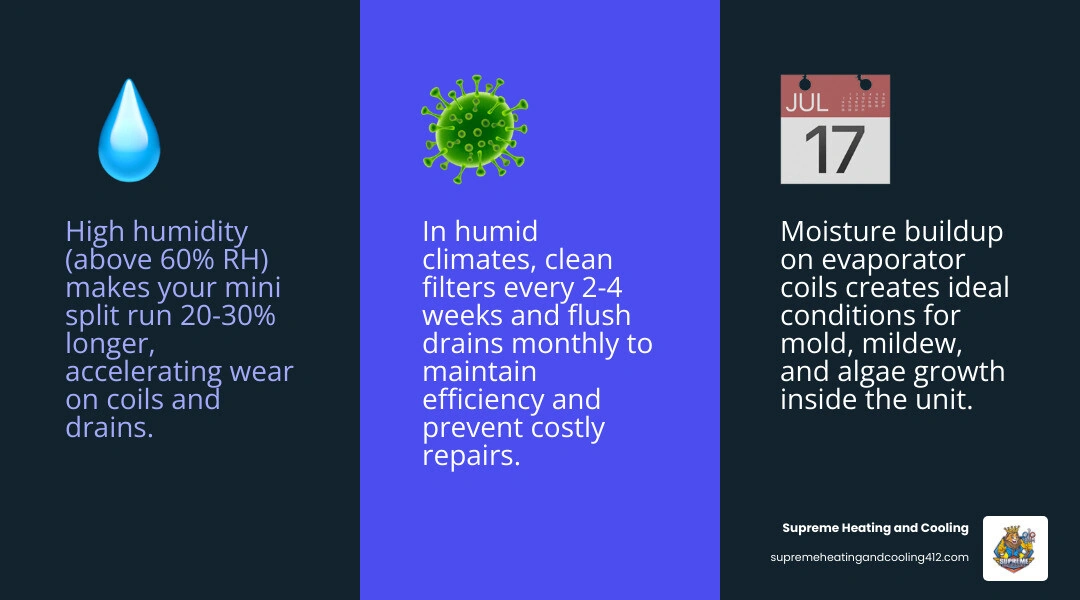
High humidity forces your mini split to work harder, which means you need to maintain it more often.
| Humidity Condition | What Happens to Your Mini Split | Maintenance Impact |
|---|---|---|
| Below 60% RH (normal) | System runs efficiently, coils stay cleaner | Standard schedule: filters every 4-6 weeks, annual pro tune-up |
| 60-65% RH (elevated) | Longer run times, faster moisture buildup on coils | Increase filter cleaning to every 2-4 weeks |
| Above 65-70% RH (high) | 20-30% longer operation, mold risk on coils and drain pan | Coil cleaning and drain flush every 1-2 months |
When indoor relative humidity climbs above 60%, your mini split's evaporator coil collects moisture rapidly. That moisture creates the perfect conditions for mold, mildew, and algae — right inside your unit. Dirty coils and clogged drains don't just cause bad smells. They quietly drain efficiency, drive up your energy bills, and shorten your system's lifespan.
The good news? Once you know what to look for — and how often to act — you can stay ahead of humidity-related wear before it becomes a costly repair.
The Science of Moisture: How Humidity Affects Your Mini Split Maintenance Schedule
To truly understand how moisture dictates your system's upkeep, we have to look at the physics of how air conditioners actually cool your home. Many people think an air conditioner simply blows cold air into a room. In reality, it is a heat-extraction machine. And in places like Swissvale, PA, or Plum, PA, a massive portion of that heat is trapped in water vapor.
Latent Heat vs. Sensible Heat
When we talk about indoor climate control, we deal with two distinct types of heat:
- Sensible Heat: This is the heat you can easily measure with a standard thermometer. When the temperature drops from 85°F to 72°F, your mini split is removing sensible heat.
- Latent Heat: This is the "hidden" heat stored in airborne water vapor. High latent heat is what makes a 78°F day in Pennsylvania feel like a sticky, oppressive 90°F.
To lower the indoor temperature, your mini split must tackle both. As warm, humid air is pulled across the ice-cold evaporator coils of your indoor unit, the temperature of the air drops below its dew point. Just like water droplets forming on a cold glass of iced tea on a hot July afternoon in Penn Hills, the moisture in your indoor air condenses onto the cold metal fins of the evaporator coil.
This condensation process is how your mini split dehumidifies your home. However, extracting pints of water from the air hour after hour places a unique physical toll on the system. For a closer look at keeping these components in top shape, check out our guide on Proper Maintenance Tips for Ductless Mini Split Air Conditioner.
Why High Humidity Increases System Workload
When relative humidity (RH) levels soar past 60%, the latent heat load on your ductless system increases exponentially. Instead of focusing its energy on lowering the air temperature (sensible cooling), the system must spend a significant amount of energy turning airborne water vapor into liquid condensate.
This heavy moisture load affects your system in several measurable ways:
- Longer Run Times: High humidity can cause mini split systems to run 20% to 30% longer to reach your desired thermostat setting. Because the system is running extended cycles, every moving part experiences increased wear and tear.
- Compressor Stress: The outdoor compressor has to work harder and run longer at higher capacities to maintain the refrigeration cycle required to keep the indoor coils cold enough to condense water.
- Efficiency Loss: When a mini split is constantly fighting high humidity, its overall efficiency drops. Modern systems with high SEER2 ratings are designed to modulate their output to save energy, but persistent relative humidity above 65% to 70% can lead to a 15% to 25% increase in energy consumption.
Because the system is running longer and processing gallons of water daily, the standard maintenance intervals designed for dry climates simply do not apply. The wet environment inside the indoor head unit accelerates dust accumulation and biological growth, making a proactive maintenance schedule absolutely essential.
Signs Your Ductless System is Struggling with High Humidity

Your mini split will usually tell you when it is losing the battle against high indoor moisture levels. If you live in high-humidity pockets near the Allegheny or Monongahela rivers — such as Aspinwall, PA, or Swissvale, PA — keep a close eye out for these warning signs. Ignoring them can quickly lead to restricted airflow and system strain. To learn more about diagnosing these problems, read about how to Solve Airflow Issues Ductless Systems.
Damp Air and Musty Odors
If your home has a sticky, "clammy" feel even when the air conditioner is running, your mini split is likely struggling to manage the latent load. This often happens if the unit is oversized for the space, causing it to cool the room too quickly and shut off before it has run long enough to remove moisture.
Furthermore, if you notice a sour, musty smell when the blower fan kicks on, you are likely smelling mold or mildew. The damp, dark interior of a mini split head unit is prime real estate for mold spores. Dust and organic debris collect on the wet evaporator coils, providing a food source for biological growth. Once mold takes hold, it restricts airflow, degrades indoor air quality, and requires a professional deep cleaning to resolve.
Fogged Windows and Water Leaks
When indoor relative humidity is too high, you may notice condensation forming on the supply grilles of your mini split or on the window panes of your room. This is a clear indicator that the air is saturated with moisture.
More seriously, high humidity can lead to active water leaks. As your mini split pulls moisture from the air, the water flows down the evaporator coil into a small drain pan and exits the home through a condensate drain line. In highly humid conditions, this drain line is constantly wet. Over time, algae, mold, and dust mix together to form a thick, jelly-like slime that clogs the narrow drain line.
When the line clogs, the water has nowhere to go but down your wall. If you notice water dripping from the bottom of your indoor unit, you are dealing with a classic condensate backup. For a detailed troubleshooting guide on this issue, refer to our article on Ductless Mini Split Water Leakage.
Adjusting Your Maintenance Routine for Humid Pennsylvania Climates
Because the local weather in western Pennsylvania ranges from dry, freezing winters to incredibly muggy summers, a "one-size-fits-all" maintenance plan won't cut it. Homeowners in Monroeville, PA, or Verona, PA, need to adjust their upkeep frequency based on seasonal humidity patterns.
To help you visualize the difference, here is a practical comparison of how humidity dictates your maintenance tasks:
| Maintenance Task | Standard Frequency (Dry/Moderate Climate) | High-Humidity Frequency (Western PA Summers) |
|---|---|---|
| Filter Cleaning | Every 4 to 6 weeks | Every 2 to 4 weeks (more often with pets) |
| Condensate Drain Flush | Once a year (Spring) | Every 1 to 2 months during peak summer |
| Evaporator Coil Inspection | Once a year | Every 3 to 6 months |
| Outdoor Condenser Clearing | Every 6 months | Every 3 months (checking for debris and airflow blocks) |
| Professional Tune-Up | Once a year | Twice a year (Spring and Fall) |
If you want to ensure your system is perfectly prepared for seasonal shifts, scheduling local care is highly recommended. You can read more about tailored local services on our Mini Split Maintenance Monroeville PA page.
How Humidity Affects Your Mini Split Maintenance Schedule for Air Filters
The reusable, washable mesh filters inside your mini split's indoor unit are your system's first line of defense. They trap dust, pet dander, and airborne particles before they can reach the wet evaporator coil.
Under normal, dry conditions, cleaning these filters once a month is perfectly fine. However, how humidity affects your mini split maintenance schedule becomes very apparent when you look at a dirty filter in August. When high humidity meets airborne dust, the moisture binds the dust particles together, turning them into a thick, sticky barrier on the filter mesh.
This damp, dusty paste restricts airflow much faster than dry dust. When airflow is choked:
- The evaporator coil gets too cold, which can cause the moisture on the coil to freeze, completely blocking airflow and potentially damaging the system.
- The system has to run even longer to cool the room, driving up your energy bills.
- Dust bypasses the clogged filter and sticks directly to the wet coils, accelerating mold growth.
During peak summer in Pennsylvania, we recommend checking and washing your filters every two to four weeks. It only takes a few minutes: pop open the front cover, slide the filters out, rinse them with lukewarm water in the sink, let them air dry completely (reinstalling wet filters will instantly trigger mold growth), and slide them back in.
How Humidity Affects Your Mini Split Maintenance Schedule for Coils and Drains
While cleaning filters is a simple DIY task, managing the internal coils and condensate drains often requires a deeper level of care.
Because high humidity means a constant stream of water flowing through your system, the evaporator coils and condensate lines are highly susceptible to organic buildup. Dust that slips past the filters sticks to the wet coil fins. This grime insulates the coil, making it harder for the refrigerant inside to absorb heat from your home.
Additionally, the condensate drain pan and drain line can quickly become restricted by algae slime. During the muggy summer months, flushing your drain line with a cup of plain white vinegar every month or two can help keep algae at bay.
However, a professional deep clean is the best way to protect your investment. During a professional tune-up, technicians use specialized, self-rinsing coil cleaners and high-pressure drain flushes to clear out deep-seated grime and biological growth that DIY methods can't reach. If you are in the southern suburbs, you can schedule this essential service by visiting our Mini Split Maintenance Bethel Park PA page.
Practical Tips to Manage Moisture and Reduce System Strain
While keeping up with your maintenance schedule is crucial, there are several operational strategies you can use to reduce the overall moisture load on your mini split. By managing how your system runs and controlling outdoor air infiltration, you can keep your home comfortable while minimizing wear and tear.
Utilizing Dry Mode Effectively
Most modern mini splits come equipped with a dedicated Dry Mode (often represented by a water droplet icon on your remote control). Understanding how and when to use this mode can make a massive difference in your home's comfort and your system's workload.
In standard Cool Mode, the mini split runs its compressor and fan to lower the indoor temperature to your specific thermostat setting. Once that temperature is reached, the compressor shuts off.
In Dry Mode, the system shifts its priority entirely to moisture removal:
- The system modulates the compressor to keep the indoor evaporator coil extremely cold.
- The indoor fan speed is dropped to its lowest setting.
- By blowing air very slowly across an icy coil, the system maximizes the amount of water vapor that condenses out of the air, without drastically lowering the room's temperature.
Dry Mode is incredibly useful during "shoulder seasons" — those rainy spring or mild autumn days when the indoor temperature is a comfortable 70°F, but the air feels damp and sticky. Running your mini split in Dry Mode during these times removes the clammy feeling without overcooling your home, and it does so very efficiently.
Tip: Avoid using "Auto Mode" on your fan settings during highly humid periods. If the fan runs continuously after the compressor shuts off, it can re-evaporate the water sitting on the drain pan and blow it right back into your living space, raising indoor humidity levels again.
When to Add a Supplemental Dehumidifier
While mini splits are excellent at dehumidifying during the cooling season, they do have physical limits. A mini split only removes moisture while it is actively cooling. If your home has a very high latent heat load — which is common in older, poorly sealed homes or houses with damp basements in areas like Oakmont, PA, or Glenshaw, PA — the mini split may not be enough to keep relative humidity below the recommended 60% threshold.
You should consider adding a standalone or whole-house dehumidifier if:
- Your indoor relative humidity consistently stays above 60% even when the mini split is running.
- You experience cold, clammy air (the temperature is low, but the moisture is high).
- You are trying to manage humidity in a subterranean basement zone where very little sensible cooling is required, meaning the mini split rarely runs long enough to dehumidify.
By pairing a supplemental dehumidifier with your mini split, you offload the heavy latent moisture work from your air conditioner. This allows the mini split to focus on sensible temperature control, running shorter, more efficient cycles and significantly reducing the frequency of required maintenance.
Frequently Asked Questions About Mini Splits and Humidity
Can a mini split replace a standalone dehumidifier?
In many cases, yes. A properly sized inverter mini split running in Dry Mode can easily maintain comfortable humidity levels (between 40% and 60% RH) in a standard, well-insulated room. However, in exceptionally damp spaces like basements, or during prolonged periods of extreme Pennsylvania humidity, a standalone dehumidifier may still be necessary. Because mini splits only dehumidify as a byproduct of cooling, they cannot remove moisture without also lowering the temperature, which can lead to overcooling in spaces that are already cool but damp.
Why does my mini split smell musty during humid weather?
A musty smell is a classic sign of mold, mildew, or bacterial growth inside the indoor unit. High humidity keeps the evaporator coils and drain pan constantly wet. When airborne dust and organic matter slip past the filters, they stick to these wet surfaces, creating a perfect breeding ground for mold. The solution is a thorough cleaning of the filters, followed by a professional coil sanitization and drain line flush to eliminate the biological growth at its source.
How often should I clean my filters in a humid climate?
During the heavy-use summer months in humid climates, you should inspect and clean your mini split's air filters every two to four weeks. If you have pets, live near a busy road with high dust levels, or have family members with allergies, stick closer to the two-week mark. Keeping the filters clean ensures optimal airflow, which prevents the coils from freezing and keeps dust from accumulating on the wet internal components.
Conclusion
Managing indoor moisture is about far more than just staying comfortable; it is a fundamental part of protecting your home's HVAC investment. Understanding how humidity affects your mini split maintenance schedule allows you to take control of your indoor air quality, prevent mold growth, and avoid unexpected system breakdowns when you need cooling the most.
By keeping your filters clean, utilizing Dry Mode during muggy shoulder seasons, and adjusting your maintenance routine to match the local Pennsylvania climate, you can ensure your system runs efficiently for years to come.
When you need professional support, our team at Supreme Heating and Cooling is here to help. We specialize in providing friendly, knowledgeable, and trustworthy ductless maintenance and repair services across the greater Pittsburgh region — including Penn Hills, Monroeville, Bethel Park, Fox Chapel, and Verona. We pride ourselves on our honest, non-pushy approach, competitive pricing, and commitment to keeping your family comfortable year-round.
Don't let summer humidity take a toll on your home's comfort. If you are located near the Verona area and want to keep your ductless system running at peak efficiency, visit our Mini Split Maintenance Verona PA page to schedule your professional tune-up today!


.svg)
.webp)
.svg)
