.svg)

.webp)

Why Homeowners Deal With the Same AC Problems Again and Again
Understanding the most common AC repairs and what causes them can save you from sweating through a Pittsburgh summer waiting on an emergency service call. The same handful of problems show up on service trucks again and again — and most of them were preventable.
Here are the most common AC repairs homeowners face and what's behind them:
| AC Repair | Most Common Cause |
|---|---|
| Dirty air filter | Dust and debris buildup blocking airflow |
| Bad capacitor | Heat stress and voltage fluctuations |
| Frozen evaporator coil | Restricted airflow or low refrigerant |
| Refrigerant leak | Corrosion, vibration wear, or loose fittings |
| Clogged condensate drain | Algae and sludge buildup in the drain line |
| Thermostat or electrical issue | Dead batteries, corroded wires, or a tripped breaker |
| Short cycling | Oversized unit or a failing electrical component |
These aren't random failures. They follow patterns — and once you know the patterns, you can spot trouble early, handle a few simple checks yourself, and know exactly when to call a pro.
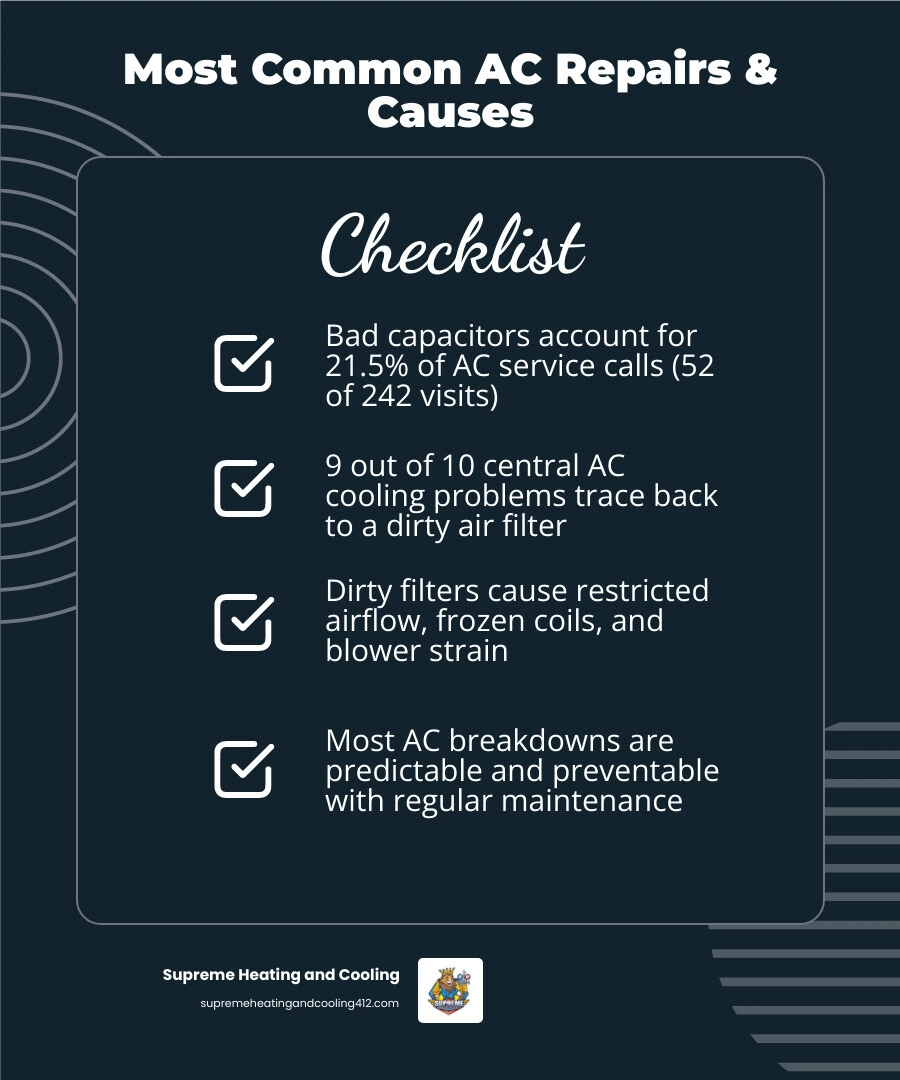
Research from real service call data backs this up: bad capacitors alone account for more than 1 in 5 AC service visits, and 9 out of 10 central AC cooling problems trace back to a single dirty air filter. Most breakdowns aren't mysterious. They're predictable — and largely preventable with the right maintenance habits.
Whether your AC is blowing warm air, making strange noises, or just not keeping up on a hot Pennsylvania afternoon, this guide breaks down what's really going on and what to do about it.
The most common AC repairs and what causes them
In May 2026, as the humidity begins to climb in communities like Plum, Oakmont, and Wilkinsburg, we see a surge in specific repair requests. While every home is unique, the mechanical systems that keep us cool are surprisingly consistent in how they fail.
The most frequent repairs we encounter include replacing burnt-out capacitors, clearing blocked condensate lines, and fixing refrigerant leaks. However, the "repair" is often just the symptom. The true cause is usually found in restricted airflow, electrical strain, or simple age. When you understand most common ac repairs and what causes them, you realize that a failure in one area—like a blower motor—is often triggered by a failure in another—like a filter that hasn't been changed in six months.
Dirty air filters: the hidden cause behind most common AC repairs and what causes them
It sounds too simple to be true, but nine times out of ten, when a central air unit isn't working well, it comes down to a clogged filter. A dirty filter acts like a wall, forcing your system to work twice as hard to pull air through.
This restriction leads to a domino effect of problems:
- Weak Airflow: You'll notice less air coming out of your registers in Bethel Park or Fox Chapel.
- Frozen Coils: Without enough warm air passing over the evaporator coil, the refrigerant inside gets too cold, turning condensation into ice.
- Blower Motor Strain: The motor has to spin faster and hotter to move air, leading to premature burnout.
- Higher Energy Use: Your system runs longer cycles to reach the thermostat setting, spiking your electric bill.
Regularly checking your AC Filter Housing Damage is a critical step in preventing these issues.
Bad capacitors: why they account for so many service calls
If your AC is the heart of your home's comfort, the capacitor is the pacemaker. These small, cylindrical components store electricity and provide the high-voltage "jolt" needed to start the compressor and fan motors.
Statistics show that bad capacitors account for 52 out of 242 AC repair calls—that’s 21.5% of all service visits. They are essentially the "MVP" of AC failures.
- What causes them to fail? Heat is the primary enemy. During a Pennsylvania heatwave, capacitors can overheat. Voltage fluctuations and general wear and tear also play a role.
- The Warning Signs: You might hear a clicking sound followed by a low hum, but the outdoor fan won't spin. If the capacitor looks swollen or is leaking oil, it has reached the end of its life.

Frozen evaporator coils: what causes ice in hot weather
Seeing ice on your AC unit when it’s 90 degrees outside in Monroeville seems like a paradox, but it’s a very real sign of trouble. The evaporator coil is responsible for absorbing heat from your indoor air.
When airflow is blocked (by that dirty filter we mentioned) or when refrigerant levels are low, the coil's temperature drops below freezing. Moisture from the air then freezes onto the coil. If you continue to run the system, the ice block grows, eventually blocking all airflow and potentially sending liquid refrigerant back to the compressor—a "death sentence" for the unit. If you see ice, turn the system off immediately to let it thaw before calling for AC Unit Not Cooling support.
Refrigerant leaks: why low refrigerant is never normal
Your AC system is a closed loop. It does not "consume" refrigerant like a car consumes gas. If your refrigerant is low, you have a leak.
Leaks often occur due to:
- Formicary Corrosion: Small pinhole leaks caused by a chemical reaction between the copper coils and household cleaners or building materials.
- Vibration: Over years of operation, the constant vibration of the unit can cause fittings to loosen or lines to rub together.
- R-22 Phase-Out: As of May 2026, R-22 (Freon) is no longer produced. If your older system has an AC Freon Leak, the cost of repair and recharge may make replacement a more logical choice.
Ignoring a leak doesn't just result in warm air; it forces the compressor to run hotter, leading to a total system failure.
Clogged condensate drains: small blockage, big water damage
As your AC cools the air, it also removes humidity. This moisture collects in a drain pan and flows out through a condensate line. Over time, algae, mold, and "sludge" can grow in this line, creating a blockage.
When the water has nowhere to go, it backs up. This can lead to Water Puddles Near Your Fox Chapel AC or, worse, ceiling stains and mold growth if the unit is in an attic. Modern systems often have float switches that shut the AC down if water is detected in the pan, which is a common reason for AC Drainage Problems Summer service calls.
Thermostat, breaker, and electrical control issues
Sometimes the problem isn't the AC unit itself, but the brain or the power source.
- Thermostats: Dead batteries or poor sensor placement (like being in direct sunlight) can cause the system to cycle incorrectly.
- Tripped Breakers: If your AC pulls too much power—often due to a failing motor or a dirty coil—it will trip the circuit breaker. This is a safety feature. If your AC Circuit Breaker Keeps Tripping What It Means is usually that the system is under extreme electrical strain.
- Contactors: These are the switches that physically close to send power to the compressor. They can become "pitted" or corroded over time, preventing an AC Won't Turn On scenario.
Early warning signs you should never ignore
Your AC usually tries to tell you it’s struggling before it quits entirely. Paying attention to these red flags can be the difference between a minor tune-up and a major overhaul.
- Rising Bills: If your energy costs are climbing but your habits haven't changed, the system is losing efficiency.
- Uneven Cooling: If the upstairs in your Greensburg home is sweltering while the downstairs is freezing, you likely have airflow or ductwork issues.
- Short Cycling: This is when the AC turns on and off every few minutes. It puts massive strain on the compressor and capacitors.
Why your AC is blowing warm or hot air
There is nothing more frustrating than feeling a breeze that isn't cold. If your AC Blowing Hot, start by checking your thermostat settings to ensure it wasn't accidentally switched to "heat" or "fan only."
If the settings are correct, the culprit is usually a refrigerant leak or a failed compressor. You can follow these Why is my AC Blowing Warm Air Troubleshooting Steps to narrow down the cause before calling us.
Noises, odors, and breaker trips that signal deeper trouble
Strange sounds are never a good sign in an HVAC system.
- Buzzing or Clicking: Usually points to an electrical issue, like a failing capacitor or contactor.
- Squealing: Often a sign of a belt or motor bearing issue.
- Hissing: A classic sign of a refrigerant leak.
Odors are equally telling. A "dirty sock" smell often means mold in the drain pan, while a Cause Burning Smells from AC indicates overheating wires or a motor on its last legs. Don't ignore these Signs You Need AC Repair Don't Ignore These Red Flags.
Safe DIY checks before you call for AC repair
Before you pick up the phone, there are a few safe "sanity checks" every homeowner in the Pittsburgh area should perform. These can often solve the problem without a service fee.
- Check the Thermostat: Ensure it has fresh batteries and is set to "Cool" and "Auto."
- Inspect the Filter: If it’s gray and thick with dust, replace it immediately.
- Check the Breaker: Look at your electrical panel. If the AC breaker is tripped, reset it once. If it trips again, do not try a second time—call a professional.
- Clear the Outdoor Unit: Ensure there are at least two feet of clearance around your condenser. Remove leaves, tall grass, or debris.
- Look at the Drain Line: If you see water pooling where it shouldn't, your drain might be clogged.
Simple fixes that can solve some of the most common AC repairs and what causes them
Maintenance is a habit, not a one-time event. To keep your system running smoothly:
- Monthly Filter Checks: During peak summer months, check your filter every 30 days.
- Gentle Cleaning: You can gently rinse the outdoor coils with a garden hose (power off first!) to remove pollen and dust.
- Open the Vents: Ensure all registers are open and unobstructed by furniture to maintain proper airflow.
When most common AC repairs and what causes them require a professional
While we encourage homeowners to be proactive, certain tasks are dangerous for anyone without specialized training. You should always call a professional for:
- Refrigerant Issues: Handling refrigerant requires EPA certification. It is illegal and dangerous to attempt to "top off" your own system.
- Electrical Wiring: High-voltage components like capacitors and contactors can hold a lethal charge even when the power is off.
- Gas or Burning Smells: These are immediate safety risks.
- Frozen Coils: While you can thaw them, a professional needs to find out why they froze to prevent it from happening again.
How maintenance prevents repeat breakdowns and extends AC life
The best repair is the one that never has to happen. A well-maintained AC system can last 15 to 20 years, whereas a neglected one may fail in as little as 10. Neglected systems also lose 5% to 15% of their efficiency every single year.
An annual tune-up includes cleaning the coils, flushing the drain line, testing the electrical components, and checking refrigerant levels. This proactive approach catches the "pitted" contactor or the "weak" capacitor before it leaves you without air on a Sunday afternoon.
| Feature | Well-Maintained System | Neglected System |
|---|---|---|
| Lifespan | 15–20 Years | 10–12 Years |
| Energy Efficiency | High (Saves on bills) | Low (Costs 15%+ more) |
| Repair Frequency | Rare / Minor | Frequent / Major |
| Air Quality | Clean and Filtered | Dust and Mold risks |
The role of dirty air filters in causing multiple AC problems
We cannot emphasize this enough: the air filter is the gatekeeper of your system's health. Beyond just causing breakdowns, a dirty filter allows dust to bypass the filtration system and settle on the evaporator coils. This creates a sticky "blanket" that insulates the coils, preventing them from cooling the air and eventually leading to mold growth. Changing your filter every 30 to 90 days is the single most effective thing you can do for your home's comfort.
Why short cycling and age make repairs more frequent
As systems age, they naturally become more prone to failure. However, "short cycling" accelerates this process. If your AC is oversized for your home, it will cool the air too quickly and shut off, only to turn back on a few minutes later. This constant starting and stopping wears out the compressor—the most expensive part of the system—and the capacitors.
If you find yourself paying for the same repairs year after year on an R-22 system, we often recommend the "$5,000 Rule." Multiply the age of the unit by the repair cost. If the total is more than $5,000, it’s usually time to consider a modern, high-efficiency replacement.
FAQs about the most common AC repairs and what causes them
How often should I change my AC filter?
For standard 1-inch filters, we recommend every month during heavy use. High-quality pleated filters can last up to 90 days. If you have pets or live in a dustier area like New Kensington, check them more frequently.
What should I do if my AC coil freezes?
Turn the system completely off at the thermostat and switch the fan to "On" (not "Auto"). This will circulate warm air to help thaw the ice. Check your filter. If the ice returns after you turn the cooling back on, call us for a professional inspection.
Are refrigerant leaks dangerous to ignore?
Yes. Beyond the environmental impact, a leak causes your compressor to work harder and run hotter. This will eventually lead to a "burnt-out" compressor, which is often a total loss for the system.
Conclusion: Catch small AC issues before they become major breakdowns
Taking fast action when you notice the first sign of trouble—a strange noise, a slightly higher bill, or a musty smell—can save you thousands in the long run. By understanding the most common AC repairs and what causes them, you are better equipped to protect your home and your family's comfort.
At Supreme Heating and Cooling, we pride ourselves on providing trustworthy, non-pushy service to our neighbors throughout the Pittsburgh area. Whether you need a quick capacitor replacement in Bethel Park or a full system evaluation in Penn Hills, our personable team is here to help.
Don't wait for a total breakdown. If your system is acting up, reach out for professional Air Conditioning support today and keep your home comfortable all summer long.


.svg)
.webp)
.svg)
