.svg)

.webp)
Why Is My AC Blowing Warm Air? Troubleshooting Steps That Actually Work
Why is my ac blowing warm air troubleshooting steps is one of the most common questions homeowners ask when summer heat hits and their cooling system lets them down. Here is a quick look at the most likely causes and what to check first:
- Thermostat set incorrectly — Make sure it is set to "Cool" and fan is set to "Auto," not "On"
- Dirty or clogged air filter — A blocked filter restricts airflow and is the number one cause of warm air
- Tripped circuit breaker — The outdoor unit may have lost power without you knowing
- Dirty condenser coils — Debris buildup on the outdoor unit blocks heat from escaping
- Frozen evaporator coils — Ice buildup stops the cooling process entirely
- Low refrigerant or a leak — Without enough refrigerant, your system cannot absorb indoor heat
- Failing compressor — Grinding or clicking noises from the outdoor unit may signal a serious mechanical issue
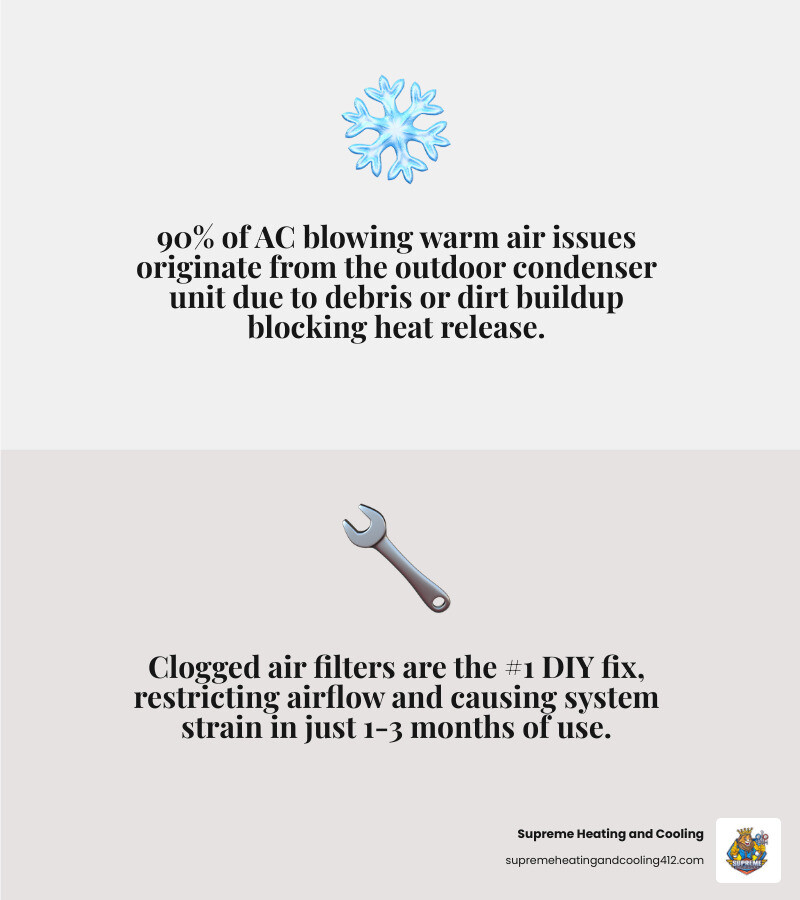
Most of the time, the problem starts outside. In fact, roughly 90% of warm air issues trace back to the outdoor condenser unit. That said, something as simple as a wrong thermostat setting or a clogged filter can be the entire reason your home feels like an oven — even when the AC appears to be running fine.
If you live in the Pittsburgh area and your AC is struggling to keep up this summer, Supreme Heating and Cooling is here to help you get to the bottom of it fast.
Why is my ac blowing warm air troubleshooting steps for homeowners
When your air conditioner stops doing its job, it doesn’t always mean the whole system is broken. In many cases, the unit is still running, but it is failing to remove heat from the air. To understand Why AC is Blowing Warm Air, we first have to look at how the cooling cycle works.
Essentially, your AC is a heat mover. It uses refrigerant to soak up heat from inside your home and dump it outside. If anything interrupts this flow—like a layer of dust on a filter or a thick coat of pollen on the outdoor coils—the heat stays trapped in your vents. This creates an airflow restriction that puts massive strain on the system. Over time, that strain can lead to expensive mechanical failures.

Checking thermostat settings for why is my ac blowing warm air troubleshooting steps
It might sound too simple to be true, but we see it all the time in places like Plum and Oakmont: the thermostat is simply on the wrong setting. If someone in the house accidentally bumped the screen or changed the fan settings, your AC might blow air that feels lukewarm.
- Cool Mode: First, verify that the thermostat is actually set to "Cool." If it’s set to "Heat" or "Off," the system obviously won't produce cold air. In April 2026, as we transition from chilly mornings to hot afternoons, it’s easy to forget to switch the mode.
- Fan Settings (Auto vs. On): This is a big one. If your fan is set to "On," the blower will run 24/7, even when the AC isn't actually cooling the air. This means it will circulate room-temperature air through your house between cooling cycles. Setting it to "Auto" ensures the fan only blows when the air is actually being chilled.
- Batteries: If your thermostat display is fading or unresponsive, try replacing the batteries. A weak signal can prevent the thermostat from communicating correctly with your AC unit.
If you’ve checked these and the air is still warm, it might be one of the Signs It's Time for AC Repair.
Replacing dirty filters for why is my ac blowing warm air troubleshooting steps
If there is a "MVP" of AC maintenance, it’s the air filter. A clogged filter is the primary cause of an AC blowing hot air. When the filter is caked with dust, pet hair, and debris, the blower fan has to work twice as hard to pull air through.
When airflow is restricted, the evaporator coil (the part inside that gets cold) doesn't get enough warm air passing over it. This causes the coil to get too cold, which leads to condensation freezing into a block of ice. Once that ice forms, no air can get through at all, and your system will start blowing warm air or stop blowing air entirely.
We recommend that homeowners in Pittsburgh, PA, replace their air filters every 1 to 3 months. If you have pets or live near a dusty area like New Kensington, you might need to change it even more frequently. If you've neglected the filter and your system is now struggling, you may need professional AC Repair Pittsburgh PA to ensure no permanent damage was done to the blower motor.
Inspecting the Outdoor Condenser and Electrical Panel
As we mentioned earlier, the "90% rule" in the HVAC industry suggests that the vast majority of cooling problems originate in the outdoor unit. This unit, known as the condenser, is responsible for releasing the heat collected from your home. If it can't breathe, your home won't cool down.
Whether you are in Bethel Park or Forest Hills, your outdoor unit is exposed to the elements. Grass clippings, cottonwood seeds, and dirt can clog the delicate fins of the condenser coils. When these coils are dirty, the refrigerant cannot release its heat, and the air coming out of your supply registers will stay warm. For residents needing AC Repair Bethel Park PA, a thorough coil cleaning is often the first step we take.
| Feature | DIY Coil Cleaning | Professional Maintenance |
|---|---|---|
| Tools Needed | Garden hose, soft brush | Specialized foam cleaners, fin combs, gauges |
| Risk Level | Low (if power is off) | High (handled by experts) |
| Effectiveness | Removes surface debris | Deep cleans and straightens bent fins |
| Frequency | Monthly during summer | Once per year (Spring) |
Clearing the outdoor unit
To keep your system running efficiently, you should maintain at least a 2-foot clearance around your outdoor unit. Overgrown bushes, weeds, or even a stack of firewood leaning against the unit can choke the airflow.
- Trim Vegetation: Cut back any plants or branches that are crowding the unit.
- Remove Debris: Clear away leaves, twigs, and grass clippings that have sucked against the sides of the unit.
- Gently Wash: After turning off the power to the unit, you can use a garden hose to gently rinse the coils. Important: Never use a pressure washer, as the high-pressure stream will flatten the delicate aluminum fins and ruin the unit.
Resetting tripped circuit breakers
If your indoor blower is running but the air is warm, it’s possible the outdoor unit has lost power. Air conditioning systems are usually on two separate circuits: one for the indoor air handler and one for the outdoor compressor.
Check your electrical panel for a tripped breaker. Sometimes, a power surge during a Pittsburgh thunderstorm can cause the breaker to flip. If you find a tripped breaker:
- Flip it completely to the "Off" position.
- Wait about 5 minutes to let the system fully discharge.
- Flip it back to "On."
Also, check the service switch (disconnect box) located near the outdoor unit. Make sure it hasn't been accidentally turned off. If the breaker trips again immediately after you reset it, do not try again. This indicates a short circuit or a failing component that requires an expert's eyes. This is similar to the steps found in our Heater Won't Start Troubleshooting Guide, as electrical issues are universal across HVAC systems.
Identifying Mechanical Failures and Frozen Coils
If the simple fixes don't work, we have to look deeper into the mechanical side of the system. One of the most common sights we see in Wilkinsburg and Swissvale during peak summer is a "frozen" AC.
The evaporator coil is designed for approximately a 20-degree temperature drop. If the air entering the system is 80 degrees, the air coming out should be about 60 degrees. However, if the coil is covered in ice, that heat transfer can't happen. You might see frost on the copper refrigerant lines leading into the house, or you might even see ice forming on the outdoor unit.
Signs of refrigerant leaks
Refrigerant is the "lifeblood" of your AC. Contrary to popular belief, an AC does not "use up" refrigerant like a car uses gas. It circulates in a closed loop. If your system is low on refrigerant, it means you have a leak.
Signs of a leak include:
- Hissing or Bubbling Noises: This often indicates gas or liquid escaping from the lines.
- Ice on Coils: Low refrigerant levels cause the pressure to drop, which makes the coils get too cold and freeze over.
- The "Soap Test": If you suspect a leak on an exposed line, you can spray a mixture of soap and water on the area. If bubbles start to form, you've found the leak.
Fixing a leak is not a DIY job. Refrigerant handling is strictly regulated by the EPA, and only certified technicians can legally recharge your system. If you suspect a leak, turn off the unit immediately and contact our HVAC Repair Services.
Symptoms of a failing compressor
The compressor is often called the "heart" of your air conditioner. It is the pump that moves the refrigerant between the indoor and outdoor units. If the compressor fails, the cooling process stops entirely.
Watch out for these symptoms:
- Grinding or "Chattering" Noises: This suggests mechanical parts are failing inside the compressor housing.
- Hard Starts: If you hear the unit hum and click but it struggles to kick on, the compressor might be "over-amping" or seizing up.
- Tripped Breakers: A failing compressor often draws too much electricity, causing the breaker to trip repeatedly.
A compressor replacement is a major repair. In some cases, especially with older units in areas like Monroeville, it might be more cost-effective to replace the whole unit rather than just the compressor. If you are experiencing a Heat Pump Blowing Cold Air in Monroeville PA during the winter, or warm air in the summer, the compressor or the reversing valve is usually the culprit.
Frequently Asked Questions about AC Troubleshooting
We know that having your AC go out in the middle of a Pennsylvania heatwave is stressful. Whether you are dealing with a standard AC or a Heat Pump Blowing Cold Air in Castle Shannon PA when it should be warm, these diagnostic tips can help keep your family safe and comfortable.
Should I turn off my AC if it is blowing warm air?
Yes, absolutely. If your AC is blowing warm air, you should shut it down at the thermostat immediately. Continuing to run a malfunctioning system can cause "slugging" in the compressor or burn out the fan motor. If the coils are frozen, running the system will only make the ice block thicker. Turning it off protects the most expensive components and prevents unnecessary energy waste.
How do I know if my evaporator coils are frozen?
The most obvious sign is a significant reduction in airflow coming from your vents. If the fan is blowing but you can barely feel anything, check the indoor unit (usually located in a closet, basement, or attic). Look for visible frost on the copper lines or the coil housing. If you find ice, switch your thermostat to "Off" but turn the "Fan" setting to "On." This will blow unchilled air over the coils to help them thaw. Expect this process to take up to 24 hours.
What happens if I ignore a refrigerant leak?
Ignoring a leak is a recipe for disaster. First, it’s bad for the environment, as many older refrigerants contribute to ozone depletion. Second, running a system with low refrigerant puts extreme stress on the compressor. Eventually, the compressor will overheat and fail, turning a relatively simple leak repair into a total system replacement. If your cooling is inefficient, it’s always better to catch the problem early.
Conclusion
At Supreme Heating and Cooling, we believe that every homeowner in the Pittsburgh area deserves a home that is a sanctuary from the summer heat. From Glenshaw to Greensburg, we’ve seen every possible reason why an AC might blow warm air, and we’ve fixed them all with our trademark honest, non-pushy service.
While many of the why is my ac blowing warm air troubleshooting steps listed above—like changing your filter or clearing your outdoor unit—can be handled by you, some issues require a professional touch. Regular preventative maintenance is the best way to avoid these "warm air" nightmares before they even start.
If you’ve tried the DIY steps and you’re still sweating, don’t wait for the problem to get worse. Our personable team is ready to restore your peace of mind and your home's comfort. Schedule Professional AC Service Today and let us get your system back to blowing the crisp, cold air you need!


.svg)
.webp)
.svg)
