.svg)

.webp)
Why Spring AC Maintenance to Prevent Summer Failures Is the Smartest Move You Can Make
Spring AC maintenance to prevent summer failures is one of the most effective steps Pittsburgh-area homeowners can take to stay cool, avoid emergency repair bills, and keep energy costs under control all season long.
Here is a quick answer if you want the essentials right now:
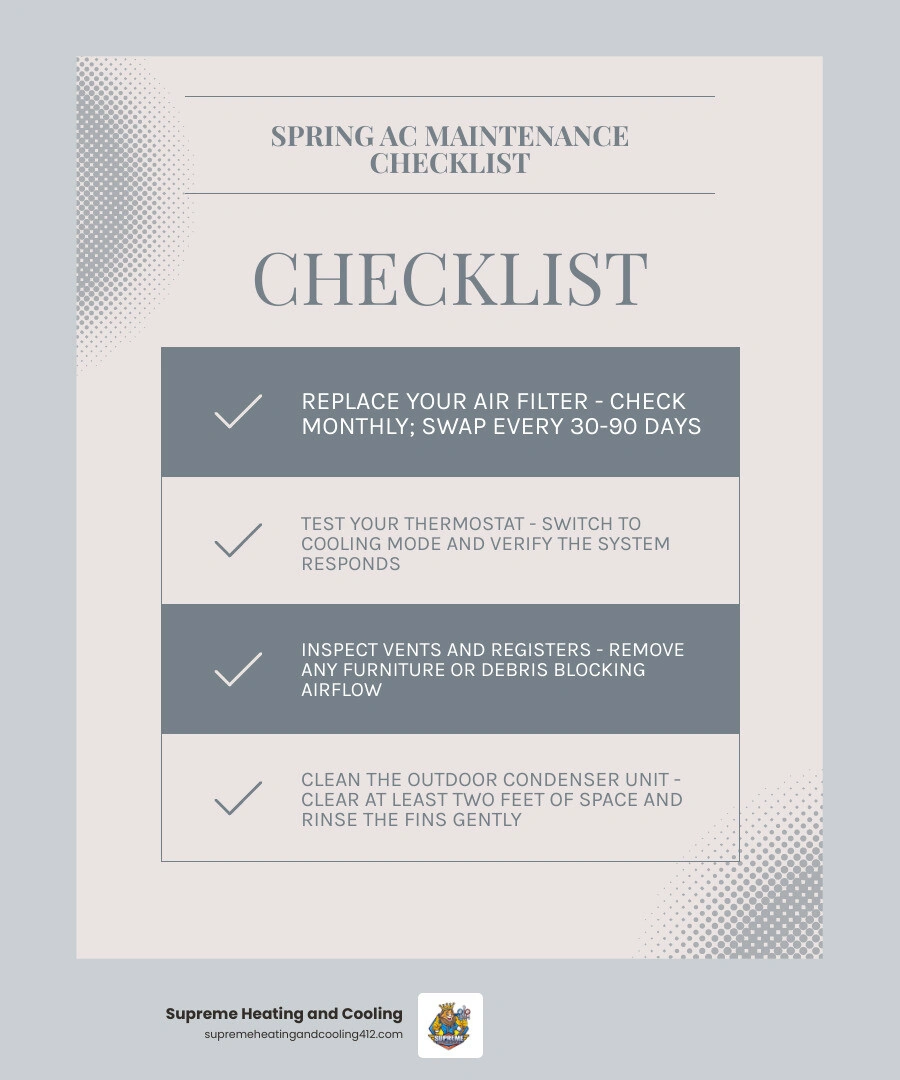
How to prevent summer AC failures with spring maintenance:
- Replace your air filter - Check monthly; swap every 30-90 days
- Test your thermostat - Switch to cooling mode and verify the system responds
- Inspect vents and registers - Remove any furniture or debris blocking airflow
- Clean the outdoor condenser unit - Clear at least two feet of space around it and rinse the fins gently
- Flush the condensate drain line - Pour distilled white vinegar down the line to prevent algae clogs
- Schedule a professional tune-up - Have a technician check refrigerant, coils, electrical connections, and overall system health
Think about what happens every summer: temperatures climb, everyone flips on their AC at the same time, and systems that have been sitting idle since fall are suddenly expected to run all day. That is exactly when small, overlooked problems turn into complete breakdowns. According to industry data, as many as 87% of emergency AC calls could have been avoided with a simple spring checkup. Yet most homeowners do not think about their cooling system until the first sweltering day of the year - when technicians are fully booked and replacement parts may be backordered.
Spring is the window that changes all of that. Acting now, before peak demand hits, means you get ahead of the rush, catch issues while they are still minor, and walk into summer with confidence instead of crossed fingers.
Why Spring AC Maintenance to Prevent Summer Failures Matters
Spring is when your AC has the best chance of getting ready for summer before heavy use begins. After months of sitting idle, the system may have collected dust, leaves, pollen, and hidden wear. A weak capacitor, dirty coil, clogged drain line, or loose wire might not seem like a big deal in April, but in July it can turn into a no-cooling call fast.
Maintenance also matters for efficiency. Heating and cooling make up roughly half of a typical home's electricity use, so even modest AC inefficiencies can show up on summer utility bills. Systems that miss yearly maintenance often run 15% to 25% less efficiently, and dirty coils alone can reduce efficiency by up to 30%.
How spring ac maintenance to prevent summer failures reduces breakdown risk
The first real heatwave is stressful for any cooling system. It goes from occasional testing to long, demanding run cycles almost overnight. That is when weak parts finally fail.
Routine spring service helps lower that risk dramatically. Industry research shows that up to 87% of emergency AC calls are preventable with a spring tune-up, and proper preseason maintenance can reduce the chance of summer breakdowns by as much as 95%.
Why such a big difference? Because most major failures start as small problems:
- Dirty filters restrict airflow and can lead to frozen coils
- Loose electrical connections create heat and unreliable operation
- Low refrigerant makes the compressor work harder
- Clogged drains can shut the system down or cause water damage
- Dirty outdoor coils trap heat and force longer run times
In other words, spring maintenance is not just cleaning. It is early problem detection.
Why spring is the best time to schedule AC service
For homeowners in Pittsburgh, Monroeville, Bethel Park, Fox Chapel, Greensburg, Penn Hills, and nearby communities we serve, the best time to schedule service is usually March through May, before the first stretch of hot, humid weather.
Spring gives you a few advantages:
- Better appointment availability
- More time to fix small issues before summer
- A chance to test the system before you truly need it
- Less risk of waiting during peak-season service rushes
If you have not had cooling service in over a year, this is a great time to schedule your first AC service.
What happens if you skip spring HVAC maintenance
Skipping spring maintenance does not guarantee failure, but it absolutely raises the odds.
Common results include:
- Higher utility bills from reduced efficiency
- Longer run times and uneven cooling
- Short cycling or hard starts
- Frozen evaporator coils
- Drain clogs and moisture problems
- Extra strain on the compressor
- Shorter equipment life
Neglected systems also tend to wear out earlier. Regular maintenance can extend AC lifespan by 5 to 10 years, which is a strong reminder that annual service is not just about this summer. It protects the long-term health of the equipment too. For more on why routine care matters, see our guide to preventative AC maintenance.
Spring AC Maintenance to Prevent Summer Failures: DIY Checklist for Homeowners
There is a lot homeowners can do safely before summer. A simple spring checklist helps you catch airflow issues, drainage problems, and outdoor debris buildup before they turn into repairs.
Before doing any work near the outdoor unit, turn off power at the disconnect. And if a task involves electrical parts, refrigerant, or opening sealed components, leave that to a professional.
A solid DIY checklist includes:
- Inspecting or replacing the air filter
- Testing the thermostat in cooling mode
- Checking vents and returns for blockages
- Clearing the condenser area outdoors
- Flushing the condensate drain line
- Listening for unusual noises during startup
If you want a broader seasonal list, our spring home AC tune-up checklist is a helpful companion.
Replace or inspect air filters before cooling season starts
If we had to name one small task with an outsized impact, this would be it.
A dirty filter restricts airflow, makes the blower work harder, reduces comfort, and can contribute to coil freezing. A clean filter can save about 5% to 15% of the energy your air conditioner uses.
A good rule of thumb is:
- Check filters every month during cooling season
- Replace every 30 to 90 days depending on conditions
- Replace more often if you have pets, allergies, high pollen, smoke, or home renovations
If the filter looks gray, clogged, or you cannot see light through it easily, it is time. More help here:
Check thermostat settings, batteries, and cooling response
Before the weather turns hot, switch your thermostat to cool and lower the setting a few degrees below room temperature. Then listen and watch:
- Does the thermostat respond quickly?
- Does the outdoor unit start?
- Is cool air coming from the vents within several minutes?
- Is the display working normally?
If your thermostat uses batteries, replace them in spring. Weak batteries can cause frustrating "ghost" problems that look like AC trouble but are really just control issues.
For most homes, a summer setting around 75 to 78 degrees is a practical balance between comfort and energy use. Smart thermostats can also help maintain steady temperatures instead of big swings that make the system work harder.
Inspect vents and airflow in every room
Poor airflow is one of the easiest warning signs to miss. Walk through the house and check every supply register and return vent.
Look for:
- Furniture blocking vents
- Curtains covering registers
- Dust buildup on grilles
- Closed or partially closed vents
- Rooms that feel much warmer than others
Blocked vents can lead to uneven cooling and make your AC run longer than necessary. Also check return vents, since the system cannot move air well if it cannot pull it back.
If one room always feels stuffy while another is freezing, that may point to a balancing or duct issue rather than a thermostat problem.
Clear and prepare the outdoor condenser unit for summer

Your outdoor condenser needs room to breathe. Leaves, cottonwood fluff, grass clippings, and overgrown landscaping can choke airflow and trap heat right where the system is trying to release it.
Follow the two-foot rule:
- Keep at least two feet of clear space around the unit
- Remove weeds, vines, branches, and debris
- Clean off visible dirt from the cabinet and surrounding pad
You can gently rinse the condenser fins with a garden hose on low pressure. Do not use a pressure washer, which can bend fins and reduce airflow. Also make sure any winter cover has been fully removed before startup.
More outdoor prep tips:
Why the condensate drain line matters and how to clear it
Your AC does not just cool the air. It also removes humidity. That moisture drains away through the condensate line, and when that line clogs with algae or sludge, trouble follows.
A blocked drain can cause:
- Water backup around the indoor unit
- Musty odors
- Mold or mildew concerns
- Safety shutoff activation
- Ceiling or wall damage in some homes
If your system has an accessible drain cleanout, a simple preventive step is pouring distilled white vinegar into the line to help reduce buildup. If you already see standing water, repeated clogs, or water stains, it is time for service rather than more guessing.
For more detail, see AC condensate drain maintenance.
What a Professional AC Tune-Up Should Include
DIY maintenance is useful, but it only covers the basics. A professional tune-up goes deeper into the parts homeowners cannot safely or accurately evaluate on their own.
A thorough tune-up should include:
- System inspection
- Refrigerant and performance checks
- Electrical testing
- Coil inspection and cleaning as needed
- Airflow verification
- Thermostat calibration
- Drainage inspection
- Startup and shutdown testing
This is where hidden issues are usually found.
What technicians check during spring ac maintenance to prevent summer failures
During a spring tune-up, we look at the components most likely to cause poor performance or sudden summer failures.
That often includes checking:
- Refrigerant charge and signs of leaks
- Capacitor and contactor condition
- Electrical connections and wire tightness
- Blower motor performance
- Compressor operation
- Motor amperage and voltage readings
- Thermostat accuracy
- Temperature split and airflow
These checks matter because many common AC failures are electrical or performance-related, not just "dirty unit" problems. For a deeper look, visit our AC tune-up checklist: what your technician should check and our page on air-conditioner maintenance.
Coil cleaning, electrical inspection, and refrigerant checks explained
Three tune-up items deserve special attention.
First, coil care. Dirty evaporator and condenser coils interfere with heat transfer. That means the system has to run longer to cool the same house. Research shows dirty coils can reduce efficiency by up to 30%.
Second, electrical inspection. Loose wires are linked to about 30% of AC failures. Electrical issues can cause intermittent cooling, hard starts, nuisance breaker trips, or complete no-cool situations. Catching them in spring is much better than discovering them in a July heatwave.
Third, refrigerant checks. Low refrigerant is not normal "use." It usually points to a leak. Warning signs include longer run times, weak cooling, ice on the refrigerant lines, or hissing sounds. Running with low charge can overwork the compressor, which is one of the most important parts in the system.
Learn more about coil health in our guide to AC evaporator coil care.
How regular maintenance improves efficiency and extends AC lifespan
Maintenance helps efficiency in a few simple ways:
- Clean filters improve airflow
- Clean coils improve heat transfer
- Proper refrigerant charge improves cooling capacity
- Tight electrical connections improve reliability
- Correct airflow reduces strain and runtime
Without annual maintenance, systems may run 15% to 25% less efficiently. That matters when cooling is a major part of your summer electric bill. Maintenance can also help improve indoor air quality by reducing dust buildup, moisture issues, and airflow restrictions.
Just as important, regular service reduces wear and tear. Lower strain means less damage over time, and that is one reason well-maintained systems often last years longer. More on that here:
Warning Signs Your AC Needs Immediate Service
Some problems should not wait for your annual visit. If your AC is acting unusual in spring, early summer, or during a heatwave, fast attention can prevent bigger damage.
Symptoms that point to low refrigerant or electrical issues
Call for service if you notice:
- Warm air from the vents
- Weak airflow
- Hissing or bubbling sounds
- Ice on refrigerant lines or coils
- Unusually long run times
- Buzzing near the outdoor unit
- Tripped breakers
- Burning or sharp electrical smells
Hissing and bubbling can suggest a refrigerant leak. Ice buildup often points to airflow restriction, low refrigerant, or both. Buzzing, breaker trips, and burnt smells may indicate electrical issues that should be checked promptly.
Common causes of summer AC failures and how to avoid them
The most common summer failures usually trace back to a short list of preventable issues:
- Dirty air filters
- Clogged condensate drains
- Dirty coils
- Loose wires
- Failing capacitors
- Leaky ducts
- Skipped annual tune-ups
Avoiding them comes down to consistent upkeep: change filters, keep the outdoor unit clear, watch for moisture problems, and schedule spring maintenance before peak season. If you are already seeing symptoms, our guides on preventative AC repair tips and signs it's time for AC repair can help you know when to act.
When poor airflow is really a duct or vent problem
Sometimes the AC itself is fine, but the air distribution is not.
Leaky ducts can waste 20% to 30% of the cooled air your system produces. That means your equipment may be working hard while part of that comfort disappears into unconditioned spaces. Closed dampers, crushed duct sections, blocked returns, or heavily obstructed vents can also create hot and cold spots.
Here is a quick comparison:
| Normal AC behavior | Urgent AC warning signs |
|---|---|
| Air feels cool and steady | Air feels warm or barely moving |
| System cycles on and off predictably | System short cycles or runs constantly |
| Rooms are mostly even in temperature | One or more rooms stay hot |
| Condenser sounds smooth during operation | Buzzing, rattling, grinding, or clicking |
| Drain area is dry | Water pooling or repeated moisture |
If airflow problems keep showing up in the same areas of the house, duct inspection may be the missing piece.
Frequently Asked Questions About Spring AC Maintenance to Prevent Summer Failures
How often should air filters be replaced during the cooling season?
Most homeowners should check filters every month and replace them every 30 to 90 days. The exact timing depends on:
- Number of pets
- Allergy concerns
- Indoor air quality
- Amount of dust or pollen
- How heavily the AC runs
For homes with pets, smoke, or allergy sensitivity, monthly replacement is often the better choice.
Is a professional tune-up worth it if my AC seems to be working fine?
Yes. AC systems can cool "well enough" while still hiding issues like weak capacitors, dirty coils, low refrigerant, drainage problems, or loose wiring. Those are exactly the problems that often show up later as no-cool calls.
A professional tune-up helps with:
- Catching hidden wear early
- Improving efficiency
- Reducing breakdown risk
- Supporting longer system life
- Keeping maintenance records up to date
This is especially important for older systems or units that have not been serviced in a while. More here:
- The benefits of professional air conditioning maintenance services
- How often should you schedule an AC tune-up
How does spring maintenance help lower utility bills in summer?
Spring maintenance lowers bills by helping your AC cool your home with less effort.
That happens when:
- Clean filters allow better airflow
- Clean coils transfer heat more efficiently
- Proper refrigerant charge supports normal operation
- Accurate thermostat control prevents overcooling
- Better airflow reduces runtime
- Duct and vent issues are addressed
Since heating and cooling account for roughly 50% of household electricity use, even a moderate efficiency improvement can make a noticeable difference over a full summer.
Conclusion
A little spring attention can prevent a lot of midsummer frustration. When you handle the basics early and schedule professional maintenance before the rush, you give your AC the best chance to run reliably, efficiently, and safely through the hottest months of the year.
At Supreme Heating and Cooling, we believe homeowners deserve clear answers, friendly service, and honest recommendations without the pressure. If you want peace of mind before summer arrives, we are here to help with trusted cooling care across Pittsburgh and surrounding communities.
For more information or to book seasonal service, visit our air conditioning services page.


.svg)
.webp)
.svg)
