.svg)

.webp)

Why Knowing What Your Technician Should Check During a Spring AC Visit Protects Your Home and Wallet
What your technician should check during a spring AC visit covers more ground than most homeowners expect — and knowing the full list helps you make sure you're actually getting the service you're paying for.
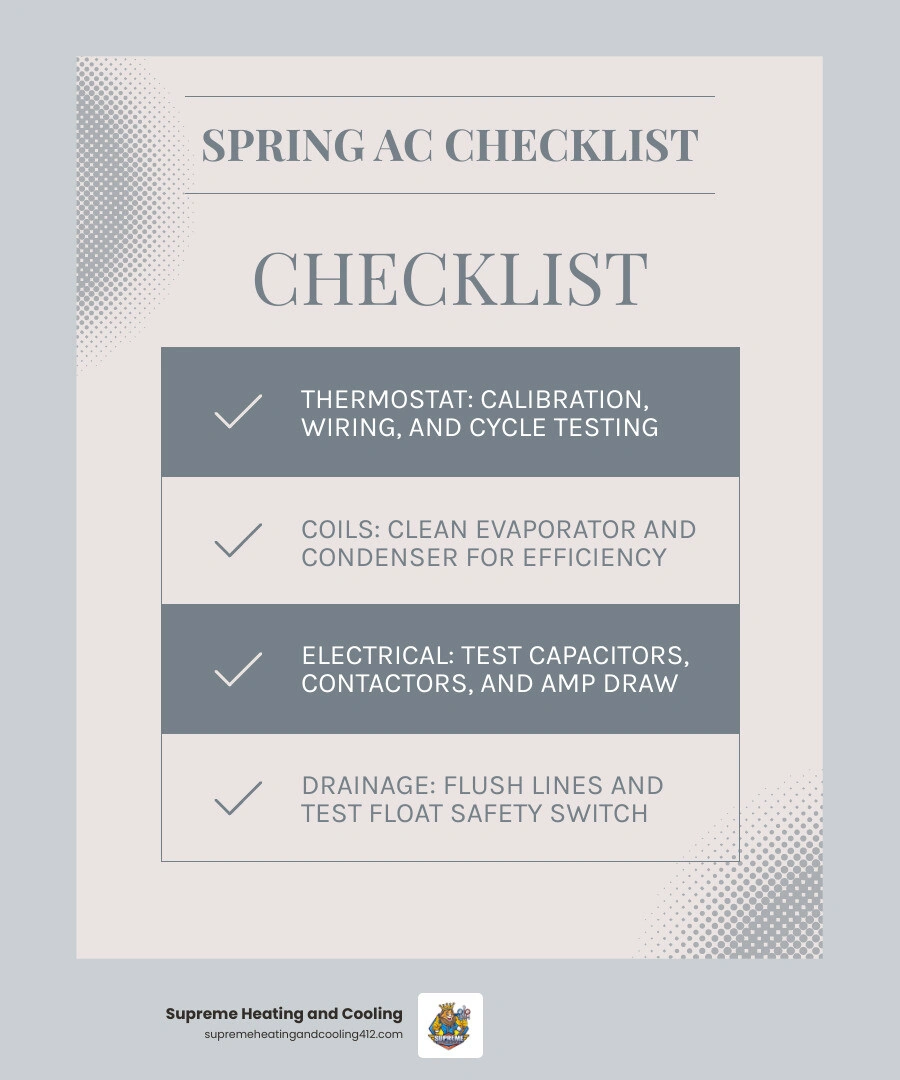
Here's a quick overview of what a thorough spring AC inspection should include:
- Thermostat calibration — verify accuracy, wiring, and cooling cycle response
- Air filter and blower — check condition, MERV rating, and airflow performance
- Electrical components — test capacitors, contactors, connections, and amp draw
- Refrigerant levels — check pressure, superheat, subcooling, and inspect for leaks
- Evaporator and condenser coils — clean both and check for damage or buildup
- Condensate drain and pan — flush for clogs, test the float safety switch
- Outdoor unit — remove debris, inspect fan motor, check clearance and insulation
- Temperature split — confirm 15–22°F difference across the evaporator coil
- Safety checks — test disconnect switch, grounding, and CO detectors
- System performance test — run a full cooling cycle and document all readings
Every spring, the same situation plays out in neighborhoods across Pittsburgh and surrounding Pennsylvania communities: a homeowner skips their annual AC service, the first real heat wave arrives in July, and suddenly they're on the phone trying to get an emergency appointment — along with everyone else in the area. According to industry data, 75% of no-cooling calls during summer are directly linked to a lack of maintenance. A well-maintained system uses 15–20% less energy and can last 5–10 years longer than one that's been neglected. A proper spring tune-up typically takes 60 to 90 minutes and should leave you with documented readings, a written report, and real confidence heading into summer.
What Your Technician Should Check During a Spring AC Visit: The Core Inspection List
When we arrive at your home in Monroeville or Bethel Park for a spring visit, we don't just "look" at the unit. A professional inspection is a methodical process designed to catch small issues before they become catastrophic failures in July. Understanding AC Tune-Up Checklist: What Your Technician Should Check allows you to follow along and ensure no corner is cut.
Thermostat, controls, and cooling performance checks
The thermostat is the brain of your HVAC system. During what your technician should check during a spring ac visit, the first step is often verifying that the brain and the body are communicating correctly. We check the calibration to ensure that when your thermostat says it's 72°F, it actually is. Even a 2-degree variance can cause your AC to run significantly longer than necessary, spiking your utility bills.
We also inspect the wiring for any signs of corrosion or loose connections and perform a full cycle test. This involves turning the system to "cool" and watching how it responds. We are looking for "short cycling," where the system turns on and off too rapidly, which is a major red flag for electrical or airflow issues. Finally, we measure the "temperature split"—the difference in temperature between the air going into the return and the air coming out of the vents. A healthy system should show a 15–22°F difference.
Air filter, blower, and airflow checks
Airflow is the lifeblood of your air conditioner. If the air can't move, the system can't cool. We start by inspecting the air filter. While this seems simple, using the wrong MERV rating can actually damage your system. A filter that is too restrictive (high MERV) can cause the blower motor to work 15% harder, leading to premature failure.
Our technicians also inspect the blower motor and the blower wheel itself. Dust buildup on the wheel blades acts like tiny weights, throwing the motor out of balance and reducing its efficiency. We check the static pressure within your ducts to ensure there are no major obstructions or significant duct leakage. In many homes, duct leakage accounts for 20–30% of cooling loss. For a deeper dive into these steps, you can review our Spring Home AC Tune-Up Checklist.
Outdoor unit and condenser inspection
The outdoor unit (the condenser) lives a hard life. It’s exposed to Pennsylvania winters, spring pollen, and debris. During the visit, we ensure there is at least a 2-foot clearance around the unit. Landscaping that grows too close chokes the system, preventing it from releasing heat efficiently.

We inspect the condenser coils for dirt and "bent fins." These aluminum fins are fragile; if they are crushed, they block airflow. We use a specialized tool called a fin comb to straighten them. We also check the fan motor for proper lubrication and signs of wear, and we examine the refrigerant line insulation. If that foam insulation is cracked or missing, you're losing cooling energy before the air even reaches your home.
Indoor coil, condensate, and drainage inspection
Inside your home, usually in the attic or basement, sits the evaporator coil. This is where the actual cooling happens. Because this coil is cold and damp, it is a magnet for dust and biological growth. A dirty evaporator coil can reduce system efficiency by 30% or more.
We also pay close attention to the condensate drain line. Your AC can produce up to five gallons of water per day as it dehumidifies your home. If the drain line is clogged with algae or debris, that water has nowhere to go but into your home. We flush the line and test the "float switch"—a safety device that shuts the system down if it detects a backup, preventing thousands of dollars in water damage to your ceilings or floors.
Electrical, Safety, and Refrigerant Checks That Matter Most
The mechanical parts of your AC are important, but the electrical and chemical components are what actually make it run. These are areas where professional expertise is non-negotiable. Understanding The Benefits of Professional Air Conditioning Maintenance Services means realizing that we are checking things the average homeowner simply cannot see.
Which electrical components should be checked and why
Electrical failures are the most common reason for emergency service calls in the heat of summer. Specifically, faulty capacitors are the #1 reason for repair calls. A capacitor is like a battery that gives your motor the "push" it needs to start. During a spring visit, we measure the microfarads of your capacitors. If they are more than 5-10% off their rated value, they are likely to fail during the next heat wave.
We also inspect the contactor—the switch that tells the outdoor unit to turn on. Over time, the contact points can become "pitted" or charred, leading to a poor connection that can eventually burn out your compressor. We tighten all electrical connections because the vibration of the unit can loosen them over time, and heat causes wires to expand and contract, which further loosens terminals.
How technicians verify refrigerant levels and check for leaks
There is a common myth that refrigerant needs to be "topped off" every year. This is false. Your AC is a sealed system. If the refrigerant is low, there is a leak. During what your technician should check during a spring ac visit, we use specialized gauges to check the "superheat" and "subcooling" levels. These measurements tell us exactly how the refrigerant is performing.
If we find low levels, we look for signs of a leak, such as oily residue on the refrigerant lines. Adding more refrigerant without fixing a leak is like pouring water into a bucket with a hole in it; it’s a temporary fix that can eventually destroy the compressor. Low refrigerant often leads to the evaporator coil freezing into a solid block of ice, which completely stops the cooling process.
Safety checks homeowners should expect during a spring visit
Your safety is our priority. We test the disconnect switch near the outdoor unit to ensure it can be safely powered down during an emergency or repair. We also verify the grounding of the entire system to prevent electrical shocks.
Inside the home, we check the safety float switches on the drain pan. We also recommend testing your smoke alarms and Carbon Monoxide (CO) detectors during this visit. Even if you have an all-electric AC, if your system is part of a hybrid setup with a gas furnace, CO safety is critical. CO detectors typically expire every 7 years and should be replaced regardless of battery status.
Cleaning Tasks That Improve Efficiency, Air Quality, and Utility Bills
A clean system is an efficient system. When your AC is bogged down by dirt, it has to run longer to reach your desired temperature, which wears out parts faster and sends your energy bills skyrocketing.
What should be cleaned during a thorough spring AC tune-up
A thorough cleaning involves more than just a quick dusting. We focus on:
- Condenser Coils: We wash away pollen, dust, and grass clippings from the outdoor unit.
- Evaporator Coils: We check for dust bridging the gaps between the cooling fins.
- Condensate Drain: We flush the line with a vinegar solution or specialized tablets to prevent algae growth.
- Blower Assembly: We ensure the motor and housing are free of debris that could cause overheating.
- Air Filters: We replace or clean filters to ensure the highest possible Indoor Air Quality.
How maintenance improves efficiency and lowers energy use
The statistics are clear: a neglected air conditioner can lose up to 5% of its efficiency for every year it goes without service. Conversely, a well-maintained system uses 15–25% less energy. Dirty coils alone can reduce efficiency by 15% because they act as insulation, preventing the refrigerant from absorbing or releasing heat effectively.
By ensuring your system is clean and calibrated, we reduce the "runtime." If your system can cool your home in 15 minutes instead of 20, that’s 25% less wear and tear on your compressor every single cycle. Over the course of a Pittsburgh summer, those savings add up significantly on your utility bills.
The most common problems found during spring maintenance visits
During our visits to homes in Fox Chapel or Penn Hills, we frequently encounter the same "silent killers" of HVAC systems:
- Weak Capacitors: These are often just days away from failing when we catch them.
- Clogged Drain Lines: Pennsylvania humidity leads to rapid algae growth in stagnant water.
- Loose Wiring: Vibrations from the unit naturally loosen connections over time.
- Bent Coil Fins: Often caused by hail, stray pebbles, or even high-pressure car washes.
- Thermostat Miscalibration: Causing the unit to run when it doesn't need to.
Why Spring Is the Best Time to Schedule Service Before Summer
Timing is everything. While you can technically get a tune-up in July, there are several reasons why the "sweet spot" is between late March and early May.
Why spring timing helps prevent summer emergencies
The first 90-degree day in Pittsburgh has a way of exposing every hidden weakness in an AC system. By scheduling early, you ensure your system is ready for that first heat spike. Furthermore, HVAC companies are at their busiest during the summer. If you wait until June to call, you might be waiting days for an appointment. In the spring, our schedules are more flexible, and we can take the time to be extra thorough. As mentioned earlier, 75% of summer "no-cool" calls are preventable with this one spring visit. Review How Often Should You Schedule an AC Tune-Up to plan your year.
How long a thorough spring AC tune-up should take
A legitimate, professional AC tune-up is not a 10-minute walkthrough. It should take between 60 and 90 minutes. This allows the technician enough time to perform the 15+ points of inspection, clean the coils properly, and—most importantly—run the system for at least 15–20 minutes to get accurate refrigerant pressure readings. If a technician is in and out of your house in 20 minutes, they haven't performed a comprehensive tune-up.
How spring AC maintenance differs from fall heating maintenance
While some tasks overlap (like filter changes), the focus is entirely different. Spring maintenance is about the "cooling side": refrigerant pressures, condenser coils, and condensate drainage. Fall maintenance focuses on the "heating side": inspecting the heat exchanger for cracks, checking gas pressure, and ensuring the burner assembly is clean and safe. Both are essential, but the spring visit is what ensures you stay cool when the humidity hits.
What Homeowners Can Do Themselves and What Requires a Licensed Technician
We believe in empowering homeowners, but we also want to keep you safe. There is a clear line between "housekeeping" and "technical service." For professional-grade care, you can always rely on our Expert Regular AC Maintenance.
Safe DIY tasks between professional visits
You can significantly help your system by performing these tasks:
- Change Air Filters: Do this every 30-90 days, or more often if you have pets.
- Clear Debris: Keep a 2-foot radius around the outdoor unit free of leaves and bushes.
- Check Vents: Ensure that supply and return grilles aren't blocked by furniture or curtains.
- Thermostat Batteries: Replace them once a year to prevent the thermostat from dying mid-summer.
- Rinse the Coil: You can gently rinse the outdoor coil with a garden hose (never a pressure washer).
Signs your AC needs immediate professional attention before summer
If you notice any of the following, don't wait for your scheduled appointment:
- Weak Airflow: Your vents feel like they are barely blowing.
- Warm Air: The air coming out isn't cold, even if the unit is running.
- Strange Noises: Grinding, squealing, or loud banging.
- Musty Odors: This often indicates mold in the ducts or a clogged drain line.
- Frequent Cycling: The unit turns on and off every few minutes.
- Ice on the Lines: If you see ice on the copper pipes, turn the system off immediately and call us.
What documentation you should receive after the visit
A "real" tune-up ends with a report. If you receive a one-page invoice with no data, you didn't get a professional service. Here is what you should expect to see:
| Inspection Category | What Should Be Documented |
|---|---|
| Refrigerant | Superheat and subcooling measurements |
| Electrical | Capacitor microfarad readings and motor amp draws |
| Airflow | Temperature split (delta T) and filter condition |
| Drainage | Confirmation that the float switch was tested and line flushed |
| Condition | Photos of coils and any parts showing significant wear |
Frequently Asked Questions About What Your Technician Should Check During a Spring AC Visit
How often should a home AC system be professionally serviced?
Your system should be professionally serviced once a year in the spring. If you have a heat pump (which provides both heating and cooling), it should be serviced twice a year—once in the spring for the cooling side and once in the fall for the heating side. This is the industry standard recommended by all major manufacturers to keep the system running efficiently. You can Schedule Your First AC Service with us easily.
Does regular spring maintenance really help AC lifespan and warranty coverage?
Absolutely. A well-maintained AC system typically lasts 15–20 years, whereas a neglected one often fails between years 10 and 12. Furthermore, most major manufacturers (like Carrier or Lennox) require proof of annual professional maintenance to honor their parts warranties. If your compressor fails in year 7 but you have no maintenance records, the manufacturer may deny your claim. Extending AC with Maintenance is the best way to protect your investment.
When should homeowners in the Pittsburgh area schedule AC maintenance?
For homeowners in Pittsburgh, Monroeville, Bethel Park, and surrounding areas, the ideal time is between late March and early May. This ensures your system is ready before the first humid days of June. You can find specific location-based services here: AC Maintenance Pittsburgh PA.
Conclusion
A spring AC visit is more than just a luxury—it's a critical "wellness check" for one of the most expensive systems in your home. By knowing what your technician should check during a spring ac visit, you ensure your family’s comfort and protect your wallet from emergency repair costs. At Supreme Heating and Cooling, we pride ourselves on providing trustworthy, non-pushy service that gives you real peace of mind. Our team is dedicated to keeping your home in Pittsburgh, Monroeville, or Fox Chapel cool all summer long. Don't wait for the heat to arrive—ensure your system is ready today with professional Air Conditioner Maintenance.


.svg)
.webp)
.svg)
