.svg)

.webp)
Which AC Stage Is Right for Your Pittsburgh Home?
When it comes to a single stage vs two stage vs variable speed AC comparison, most homeowners are surprised to learn that the biggest differences have nothing to do with the brand or the size of the unit — they come down to how the compressor works. Here is a quick breakdown before we dive deeper:
| AC Type | How It Operates | Best For |
|---|---|---|
| Single-stage | Runs at 100% capacity or completely off | Budget-conscious buyers, smaller homes, mild climates |
| Two-stage | Switches between ~65% and 100% capacity | Larger homes, moderate humidity, balanced comfort |
| Variable-speed | Adjusts from 25% to 100% in tiny increments | Premium comfort, high humidity, uneven rooms |
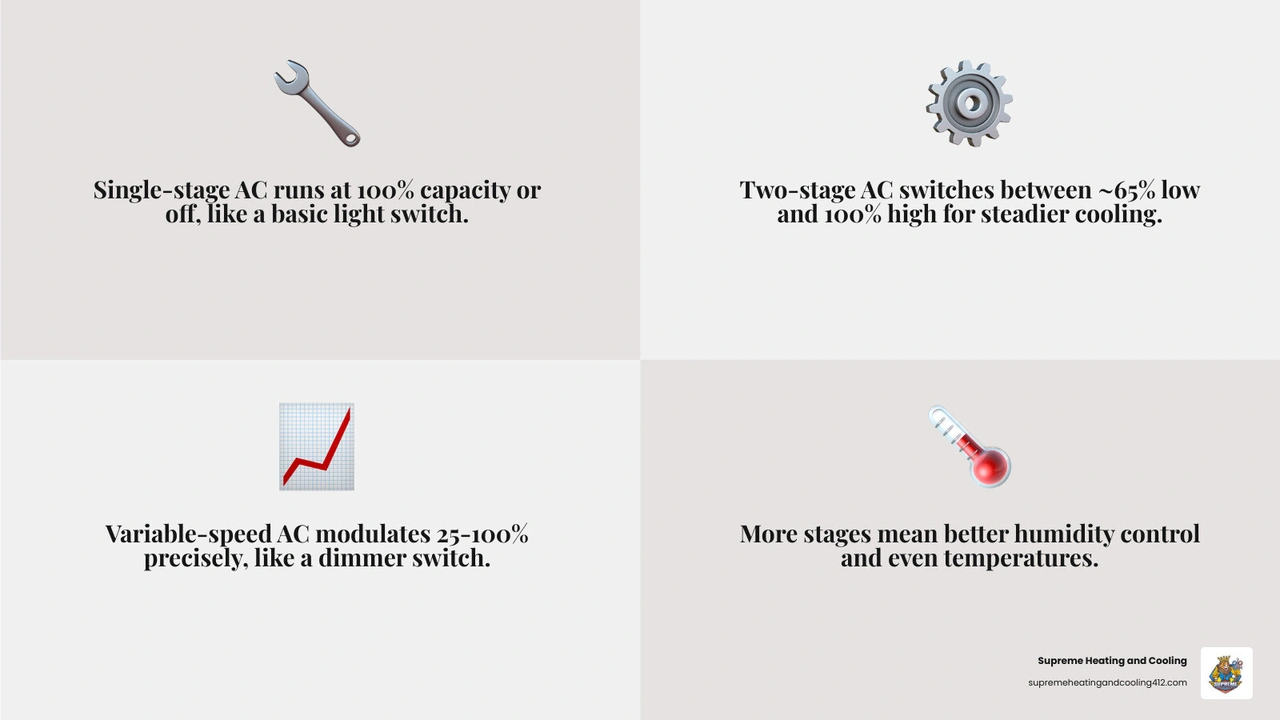
Think of it this way: a single-stage system is like a light switch — fully on or fully off. A two-stage system gives you a low and a high setting. A variable-speed system works more like a dimmer, constantly fine-tuning output to match exactly what your home needs at any given moment.
That difference in how the compressor runs affects everything — your energy bills, how evenly your home cools, how well moisture gets pulled out of the air, and how quietly the system operates day to day.
For homeowners across Pittsburgh and the surrounding Pennsylvania area, where summers bring both heat and humidity, choosing the right stage type can make a real difference in comfort and long-term value. The sections below walk through each system honestly so you can make a confident, informed decision.
Single Stage vs Two Stage vs Variable Speed AC Comparison: The Big Differences at a Glance
At the simplest level, these systems differ in how many cooling "gears" they have.
- Single-stage has one speed: full blast
- Two-stage has two outputs: low and high
- Variable-speed modulates gradually over a wide range
That one difference changes how often the system cycles, how stable your temperature feels, how much humidity it removes, and how much noise you notice.
| Feature | Single-Stage | Two-Stage | Variable-Speed |
|---|---|---|---|
| Compressor operation | 100% on or off | Low stage and high stage | Modulates across many speeds |
| Typical operating range | 100% only | About 65% and 100% | About 25% to 100% |
| Typical SEER2 range | 14-15 | 17-18 | 20+ |
| Temperature consistency | Basic | Better | Best |
| Humidity control | Basic | Better | Best |
| Noise level | Loudest of the three | Quieter | Quietest |
| System complexity | Lowest | Moderate | Highest |
| Best fit | Simpler needs | Balanced upgrade | Maximum comfort and efficiency |
What a single-stage air conditioner is and how it works
A single-stage air conditioner has a compressor with one cooling output. When your thermostat calls for cooling, it turns on at 100% capacity. When the set temperature is reached, it shuts off completely.
That means it works in short, full-power bursts. In many homes, that creates a pattern like this:
- Turn on
- Cool quickly
- Shut off
- Wait
- Turn on again
This is why single-stage systems often create more noticeable temperature swings. You may feel cool right after a cycle, then a little warmer before the next one starts.
Single-stage systems are still very common. Research suggests they are installed in roughly 70% to 80% of homes. That is partly because they are simpler and familiar, and partly because they can work well when the home is properly sized, well insulated, and does not need advanced humidity control.
The trade-off is that simple operation is less precise. A single-stage AC is basically the HVAC version of someone who only knows how to sprint.
What a two-stage air conditioner is and how it differs from single-stage
A two-stage air conditioner adds a second operating level. Instead of being only off or full power, it can usually run at a lower stage of about 60% to 70% capacity and a higher stage at 100%.
In real life, that means it can handle most summer days in low stage and only shift to high stage when outdoor temperatures rise or cooling demand increases. Many two-stage systems run in low stage about 80% of the time.
Compared with single-stage, that usually means:
- Longer cooling cycles
- More even temperatures
- Better moisture removal
- Less start-stop wear
- Quieter operation
If a single-stage system is a light switch, a two-stage system is like having low and high on a fan. It is still simple enough for many homes, but much better at matching everyday cooling needs.
What a variable-speed air conditioner is and what makes it unique
A variable-speed AC is the most precise option. Instead of only one or two outputs, it can adjust across a broad range, often from about 25% up to 100% capacity. Some systems can make extremely small adjustments, with up to 700 distinct settings.
This is what makes it unique: it does not wait for your house to get noticeably warm and then blast cold air. It ramps gently up or down to maintain comfort almost continuously.
That leads to several major benefits:
- Very steady indoor temperatures
- Superior humidity control
- Higher efficiency
- Much quieter operation
- Better comfort in homes with hot and cold spots
In a true single stage vs two stage vs variable speed AC comparison, variable-speed stands out because it is designed to match the load instead of over-correcting. It is the system most likely to make your home feel consistently comfortable instead of alternately chilly, warm, then chilly again.
How Performance Changes From One AC Stage to the Next
As you move from single-stage to two-stage to variable-speed, performance improves in several important ways: efficiency, comfort, humidity control, and noise.

Energy efficiency and SEER2 ratings in a single stage vs two stage vs variable speed ac comparison
SEER2 is the modern rating used to measure cooling efficiency. Higher numbers generally mean lower electricity use for the same amount of cooling.
Typical ranges look like this:
- Single-stage: about 14-15 SEER2
- Two-stage: about 17-18 SEER2
- Variable-speed: 20+ SEER2
Why the gap? Efficiency improves when a system avoids constant full-power starts and stops. Single-stage systems do the most on-off cycling. Two-stage systems reduce that by running at low capacity most of the time. Variable-speed systems go further by fine-tuning output to match actual demand.
Research shows variable-speed systems can reduce utility bills by roughly 20% to 50% compared with single-stage systems, depending on what is being replaced, how long the system runs, and how well the home is set up. Going from an older 8 SEER unit to a very high-efficiency variable-speed model can produce especially dramatic savings.
That said, efficiency on paper is only part of the story. Installation quality matters a lot. Even the best equipment can underperform if sizing, airflow, duct design, or refrigerant charge is off.
Which system gives the best comfort and temperature control
If your top priority is comfort, the ranking is usually pretty clear:
- Variable-speed
- Two-stage
- Single-stage
Variable-speed systems are best at maintaining a nearly constant indoor temperature. Some can keep temperatures within about half a degree of the set point. That means fewer hot spots, fewer cold blasts, and fewer times when you notice the system kicking on.
Two-stage systems are a strong middle ground. Because they spend most of their time in low stage, they cool more gently and steadily than single-stage equipment.
Single-stage systems cool the house, but they do it less gracefully. They are more likely to create:
- More noticeable temperature swings
- Some rooms feeling warmer than others
- Quick cycles that end before the home feels balanced
In many Pittsburgh-area homes, especially larger two-story homes or homes with uneven sun exposure, that extra control can make a very noticeable difference.
Humidity control and why longer run times matter
Cooling is only half the job in summer. The other half is removing moisture from the air.
This is where longer run times really help. Air conditioners dehumidify by pulling warm indoor air across the evaporator coil. The longer air moves across that coil, the more moisture can be removed.
- Single-stage systems often cool quickly and shut off fast
- Two-stage systems run longer at lower output
- Variable-speed systems run longest and most consistently
That is why variable-speed systems typically deliver the best dehumidification. Research indicates they can remove up to 400% more humidity than standard single-stage systems in demanding conditions.
Why that matters in western Pennsylvania:
- Less sticky indoor air
- Better comfort even at slightly higher thermostat settings
- Less clammy feeling in basements and first floors
- Better support for indoor air quality
One important warning: even the best AC stage cannot fix bad sizing. An oversized unit may cool the home too quickly, shut off early, and leave humidity behind. That is one reason we always emphasize proper load calculations before replacement.
Upfront Simplicity vs Long-Term Value: What Homeowners Should Expect
When homeowners compare AC stages, they are often balancing simplicity against performance. Simpler systems tend to have fewer components. More advanced systems usually offer better efficiency and comfort but rely on more sophisticated controls.
Regular maintenance helps all three system types. If you want a good overview of service timing, take a look at how often to schedule an AC tune up.
Which AC type is usually the quietest
Variable-speed systems are usually the quietest, followed by two-stage, then single-stage.
That is because noise often comes from two things:
- Compressor startup and shutdown
- Fast, high-volume airflow
Single-stage systems run at full power whenever they turn on, so they create the most noticeable sound swings. Two-stage systems are quieter because low-stage operation is gentler. Variable-speed systems are quietest because they often run at reduced output for long periods rather than repeatedly blasting on.
This applies both outdoors and indoors. Inside the house, lower-speed airflow can also reduce the "whoosh" at vents. If noise is already a concern, our article on high velocity AC noise problems may also be helpful.
Maintenance requirements and repair considerations for each stage type
In general:
- Single-stage systems are mechanically simpler
- Two-stage systems add more controls and staging logic
- Variable-speed systems are the most complex
That does not automatically mean advanced systems are unreliable. It means diagnosis and repair usually require more specialized knowledge, especially with inverter-driven variable-speed equipment.
Here is the practical homeowner version:
- Single-stage: usually the simplest to service
- Two-stage: moderate repair complexity
- Variable-speed: more advanced electronics and control components
No matter which type you choose, maintenance still matters more than most people expect. Dirty coils, poor airflow, clogged drains, neglected filters, and low refrigerant can hurt performance and lifespan on any system.
Expected lifespan and durability of single-stage, two-stage, and variable-speed systems
A well-installed and well-maintained central AC system often lasts around 12 to 20 years. Stage type affects wear patterns, but it is not the only factor.
Single-stage systems may experience more frequent hard starts and stops, which can create more compressor stress over time.
Two-stage systems can sometimes last longer than single-stage systems because they spend so much time in low stage, reducing full-load wear.
Variable-speed systems also avoid many hard starts and can operate very smoothly, but they depend heavily on correct installation and proper maintenance. Their long-term durability is strongest when the system is matched correctly to the home and installed by an experienced team.
In other words, lifespan is not just about equipment category. It is also about:
- Proper sizing
- Correct airflow
- Refrigerant charge
- Duct performance
- Routine service
Which AC Stage Fits Your Home, Climate, and Ductwork Best?
The best AC type depends on more than technology alone. It also depends on your house.
If you are planning a replacement, finding the perfect fit and getting the most out of your AC replacement is a great next read.
Best choice for smaller homes, larger homes, and hot-humid climates
Single-stage is often a reasonable fit for:
- Smaller homes
- Homes with simple layouts
- Homes without major humidity issues
- Homeowners who want straightforward cooling
Two-stage is often a better fit for:
- Mid-size to larger homes
- Homes where upstairs rooms run warmer
- Families wanting better comfort without going to the highest-end option
- Homes that deal with moderate summer humidity
Variable-speed is often best for:
- Larger homes
- Homes with uneven temperatures room to room
- Homes where humidity is a recurring complaint
- Homeowners planning to stay long-term and prioritize comfort
In the Pittsburgh region, humidity is part of the equation, especially in older homes, shaded lots, and houses with basements. That makes two-stage and variable-speed systems attractive for many homeowners who want more than "it cools eventually."
When a two-stage system makes more sense than variable-speed
Variable-speed is not automatically the right choice for every home.
A two-stage system can make more sense when:
- You want a strong balance of comfort and simplicity
- Your ductwork is older and may not be ideal for a high-performance variable setup
- You have concerns about condensation on uninsulated duct sections
- You want better humidity control and quieter operation than single-stage, but do not need maximum modulation
One specific consideration is duct sweating. In some homes with older, uninsulated hard pipe ducts, very cold air and extended low-speed operation can increase condensation risk. That is not a reason to avoid variable-speed in every case, but it is a reason to inspect the duct system carefully before choosing one.
Why proper sizing matters more than stage type alone
This might be the most important part of the whole article: proper sizing matters more than stage type alone.
A correctly sized single-stage system will usually outperform a badly oversized variable-speed system.
We recommend basing replacement decisions on a true load calculation, often called a Manual J, rather than a rough guess based only on square footage. Proper sizing helps avoid:
- Short cycling
- Poor humidity control
- Uneven temperatures
- Excess wear
- Higher energy use
Correct setup also includes airflow design, duct evaluation, and refrigerant charging. Fancy equipment cannot compensate for bad fundamentals.
How to Choose the Right AC Replacement for Your Home
When homeowners ask us which system is "best," our answer is usually: best for what?
The right choice depends on your priorities, such as:
- Lower energy use
- Better humidity control
- Quieter operation
- More even temperatures
- Simpler equipment
- Long-term plans for the home
If you are weighing replacement options in the area, these local resources may help:
- AC replacement in Pittsburgh, PA
- AC replacement in Bethel Park
- AC replacement guide for Aspinwall, PA
- AC replacement in Forest Hills, PA
Questions to ask before replacing your current AC
Before choosing between single-stage, two-stage, and variable-speed, ask yourself:
- How long do we plan to stay in this home?
- Are our summer electric bills a concern?
- Does the house feel muggy even when the AC is running?
- Do some rooms stay too warm?
- Is noise from the indoor or outdoor unit bothering us?
- Is our ductwork in good condition?
- Will the new system need thermostat or control upgrades?
- Do we want better indoor air quality along with better cooling?
These questions often lead to a clearer answer than focusing only on equipment labels.
Signs your current system may be the wrong fit
Sometimes the issue is not just that your AC is old. It may have been the wrong fit from the start.
Warning signs include:
- Large temperature swings
- Frequent on-off cycling
- Clammy indoor air
- High humidity despite cooling
- Loud startup and shutdown
- Uneven room temperatures
- Frequent repair needs
If that sounds familiar, there may be a sizing, ductwork, airflow, or stage mismatch involved. Noise complaints can also point to airflow issues, especially in certain duct setups. Our guide on high velocity AC noise problems explains more.
Frequently Asked Questions About Single Stage vs Two Stage vs Variable Speed AC Comparison
Is a variable-speed AC worth it for most homeowners?
It can be, especially if you value comfort, quieter performance, lower humidity, and long-term efficiency. Variable-speed systems are usually the top choice for homeowners who plan to stay put and want the best indoor comfort experience.
That said, "worth it" depends on the home. If your ductwork, sizing, and installation are not handled correctly, you will not get the full benefit.
Do two-stage AC units last longer than single-stage units?
They often can. Because two-stage systems run in low stage much of the time, they may reduce compressor stress compared with systems that repeatedly slam on at full power. Lower-speed operation can mean less wear over the years.
But again, installation and maintenance are huge factors. A well-installed single-stage unit may outlast a poorly installed two-stage unit.
Are variable-speed ACs always the best choice?
No. They are often the best performers, but not always the best fit.
A variable-speed system may not be ideal if:
- The ductwork is in poor condition
- Uninsulated ducts create condensation concerns
- The system is not being sized properly
- The installer is not experienced with advanced controls and setup
The best AC is the one that matches your house, your comfort goals, and your existing system conditions.
Conclusion
In a single stage vs two stage vs variable speed AC comparison, the pattern is simple:
- Single-stage offers basic, dependable cooling
- Two-stage gives you a strong middle ground with better comfort and humidity control
- Variable-speed delivers the most precise comfort, best efficiency, and quietest operation
For many homeowners, the real answer is not "Which stage is best?" It is "Which stage is best for this home?"
That is where sizing, ductwork, insulation, airflow, and installation quality matter just as much as the equipment itself. At Supreme Heating and Cooling, we help homeowners make that decision with clear recommendations, honest guidance, and no pressure.
If you are exploring an upgrade, you can learn more about our energy efficient AC services.


.svg)
.webp)
.svg)
